
 Deutsch
 Dansk
Dansk Svenska
 Nederlands
 Español
 Lietuvos
What a non-specialist can realistically own, how many hours a week it costs to do SEO on your own, what to buy, what to measure, and the ten-second test that tells you to hand it over.
Most people who ask how to do my own SEO have already decided the answer is that they can’t. They arrive at the question after a quote from an agency, a look at a competitor’s blog, and ten minutes on a tool that showed them 400 red warnings.
Christian Aalykke has watched hundreds of those people change their minds. He runs Customer Success at Morningscore and teaches our Growth Academy, which means he sits with small business owners for six lessons at a time and watches the moment the logic clicks.
“A lot of these people described themselves as completely blank on SEO,” he says. “Some of them called themselves IT experts and still said it – we don’t understand SEO. What most of them find, once they get through an academy, is comfort. There is a deeper logic underneath, and the logic is actually quite simple once you sit down and get your head around it.”
This guide is built from a two-and-a-half hour conversation between Christian and me. I run SEO at Morningscore, so I asked the questions I get asked: what can a non-specialist actually own, how many hours a week does it take, what should you buy, what should you measure, and when should you admit defeat and call someone.
The only right person to talk to was Christian, as he is the course holder for all of our SEO courses and helps a lot of SMBs doing SEO.
The short answer: you can do most of your own SEO, and one part will fight you
Split SEO into three jobs and the question answers itself.
Content. Yours. Always. “If a company cannot do the content part, something is wrong inside that company,” Christian says. “They have to be able to articulate what they do well, who they do it well for, and how they do it.”
That is not an SEO skill. That is a business skill. If you cannot describe your own service better than a stranger with an AI tool, the content is not your real problem.
Technical SEO. Yours, mostly. The name scares people away from work they are already qualified to do. More on this below.
Third-party authority – links and mentions. This is where the honest answer changes. “We should be honest with ourselves and admit that not everyone has the resources, the desire, or the time to work with that part,” Christian says.

Nobody wants to hear that the hardest third is the one nobody enjoys. It stays true anyway. Everything else in this guide assumes you accept it.
Christian puts a number on the rest: “If you had to estimate, around 75% of the things sitting inside Morningscore can be learned by companies and people with no SEO experience.”
Technical SEO is smaller than the word “technical” suggests
Ask a small business owner what stops them, and technical SEO comes up first. Ask them what technical SEO means and the answer gets vague.
Here is the honest version. Modern content management systems already solved most of it for you. WordPress, Shopify, Webflow, and the rest compete for the same customers, and clean code is part of the pitch. They have had years and real commercial pressure to get the fundamentals right.
“The biggest technical challenges have usually been handled in advance by these systems,” Christian says.
What you are left with splits into two piles.
The pile you can own this week: title tags, meta descriptions, alt text, short and readable URLs, internal links, heading structure. None of it requires code. All of it moves rankings.
The pile that gets genuinely technical: page speed work, canonical tags, schema markup, large-scale mobile rendering problems. “Schema can feel illogical if you don’t have a basic understanding of how crawlers and language models collect information,” Christian says. “The basic understanding has to come first.”
To be honest, yes, there is more to technical SEO than what classic CMS’ handle, but that is mostly for larger sites, international sites, etc. that simply have a more complex setup with more potential pitfalls.
The three technical factors that matter most for a small site
I asked Christian to name three, on the assumption that the reader is a service business or a small shop, not an enterprise with a headless stack.
He named them in about four seconds.
1. Mobile friendliness. Google evaluates your site as a mobile site first. A desktop-first build in 2026 is a self-inflicted wound.
2. Page speed. “If your page takes four, five, six, seven, eight seconds to load, you can be 100% sure you get a high bounce rate. Users will not sit and wait, and in most cases that sends a pile of negative signals back to Google.” Run your site through our website speed test and fix the worst offender first.
3. URL structure. URLs tell Google what a page is for. Christian’s example, translated out of Danish garden supplies:
Bad: christiansgardenshop.com/outdoor/items/product-listing/
Good: christiansgardenshop.com/pots-and-vases/plant-pots
“URLs are one of the most important parameters Google looks at when it tries to work out what the hell you actually want.”
Our SEO checker scans these three across your whole site, so you get a list rather than a hunch. The title tag checker and meta description checker handle the rest of the on-page pile in bulk.
The trap hiding inside technical SEO
Technical SEO gives you checkboxes. Checkboxes feel like progress. That is exactly the problem.
“People spend far, far too much time on it,” Christian says. “They sit and polish the outside of a car that has no engine.”
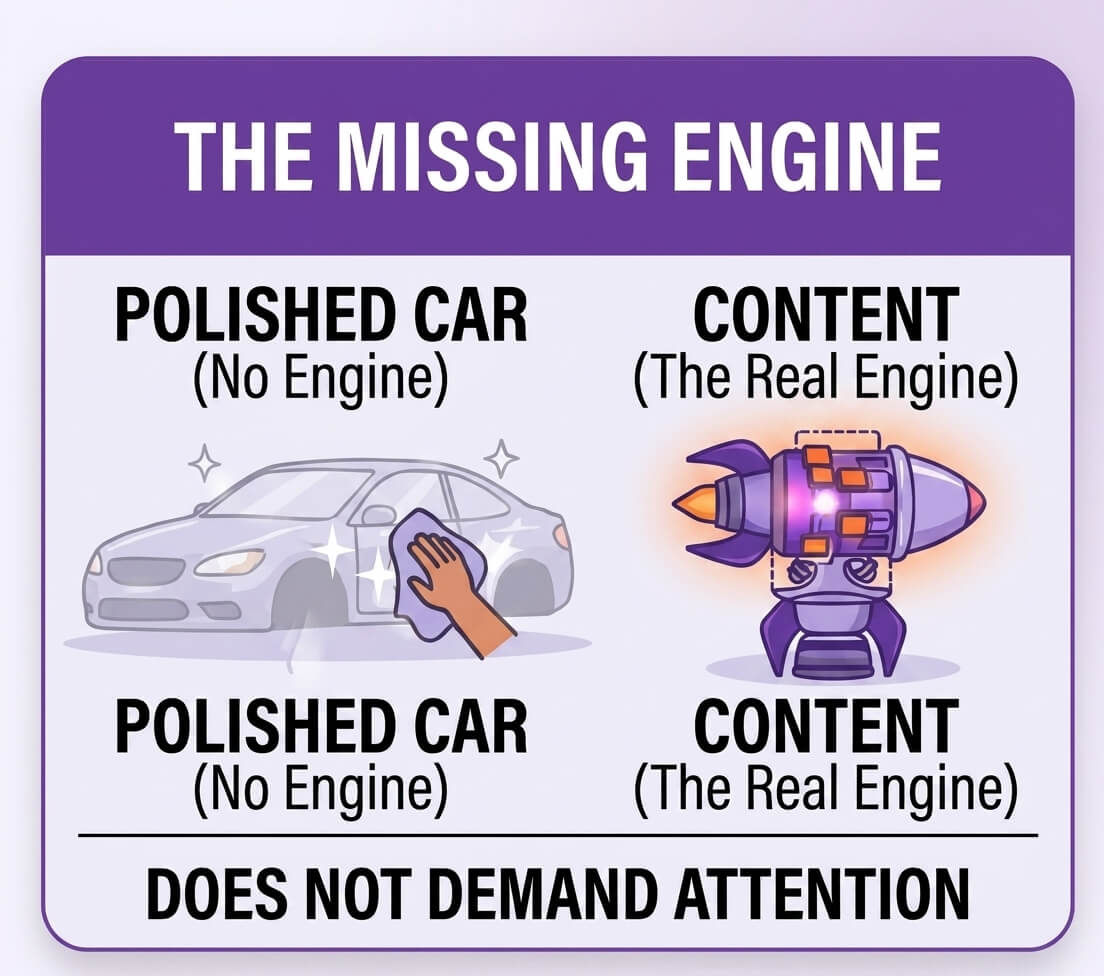
He rates this the single most expensive mistake small businesses make, and he blames tool vendors like ourselves for feeding it. A red warning demands attention. A missing article about the thing your customers actually search for does not demand anything.
So the warning wins, week after week, and the site stays invisible in search engines and LLM answers.
Cap technical work at 10% of your time once the basics are in place. Then go build the engine.
How many hours a week does doing your own SEO take?
Two to three hours. That is Christian’s floor, and he means a real floor and not a marketing number.
“If you invest two or three hours on a weekly basis, you can almost always move markers, assuming you have taken the methods on board to some degree.”
Before you use that number, define success. Christian’s warning here matters more than the hours: “For a lot of companies, success means yesterday we didn’t understand SEO, today we do. Yesterday indexing was a mystery, today we can actually influence it. For many, that alone is the dividing line between failure and success.”
Two stories show what two or three hours buys.
The small travel agency with zero visibility
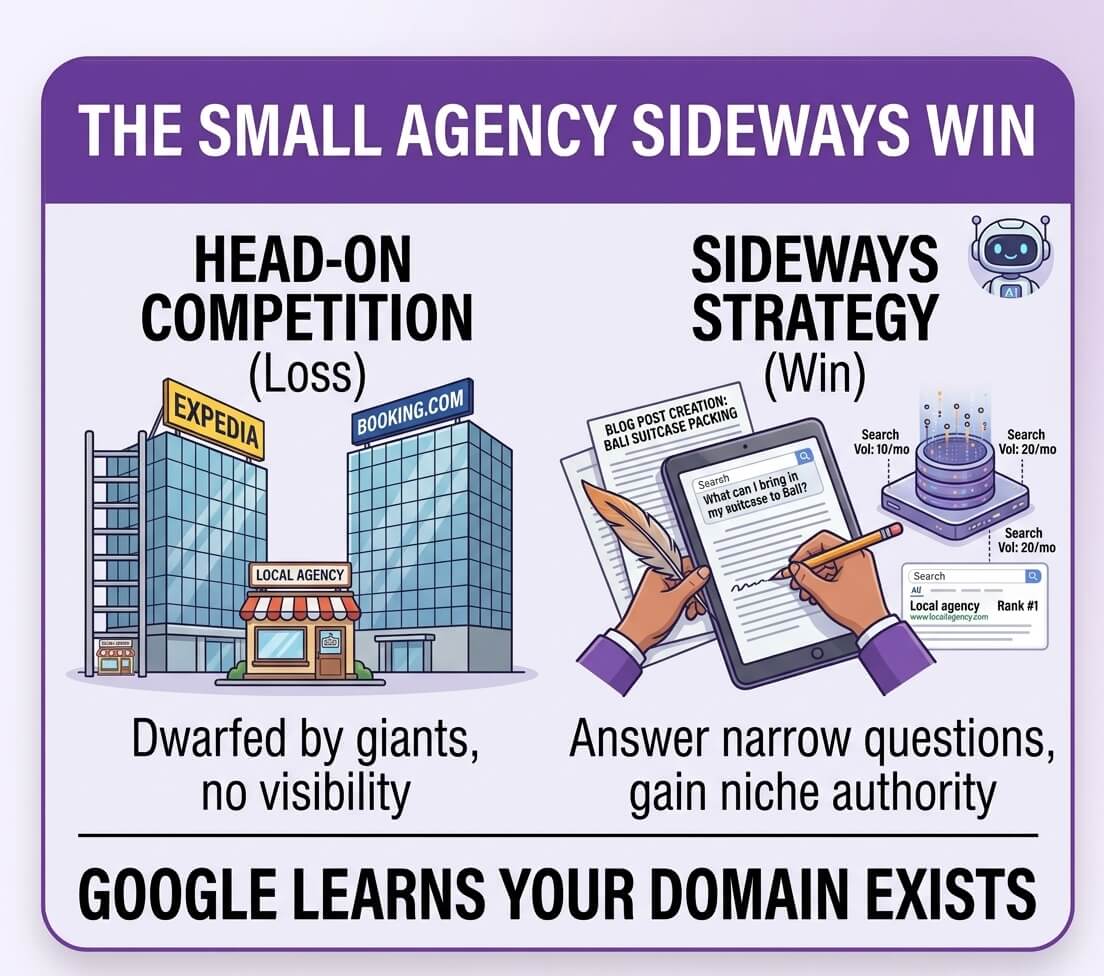
Picture a small tour operator with no rankings at all, competing against Expedia and Booking.com. Head-on competition ends in a loss every time.
So they go sideways. They write a blog post answering a narrow question from someone who has picked a destination but not yet booked: what can I bring in my suitcase to Bali? Maybe they use AI to speed up the draft. They get it indexed.
“It might only be ten or twenty searches a month,” Christian says. “But for a travel agency like that, going from total obscurity to actually sitting at number one, two or three on some keywords is a massive success. They have made Google take an interest in their domain, and they have increased the chance that Google will look more kindly on that domain in future and use it as a resource.”
Ten searches a month is not the win. Google learning your domain exists is the win.
The union with a three-year-old CV template page
Now picture an organisation that already has Google’s attention. Somewhere on the site sits a blog post with CV templates, untouched for three years, written before anyone thought about authorship, data or credibility signals.
Someone spends an hour. They add a named author with a real background. They update the facts. They rewrite the headings around what should a good CV contain in 2026. They add the kind of specificity that could not have come out of a language model.
“Because they already have Google’s attention and already have the credibility signals, they can go from position eight to position two and see a massive increase in traffic from that alone,” Christian says. “All of these things can be done in hours.”
The compounding effect nobody tells beginners about
Both stories point to the same rule. “SEO very often gets exponentially easier over time. The stronger your foundation, the easier and faster you can build on top of it.”
A developer at Morningscore once described it as dating, and Christian has used the analogy ever since.
“For the first long stretch there’s a dance where you get to know each other and both parties hold back. Then at some point you break the ice, the other party works out that hey, he’s actually quite funny, and mutual respect and interest start flowing much, much faster.”
Break through the wall once. Google learns there are resources on your site, users react well, indexing gets easier from there. That is why the first three months feel like shouting into a void and month nine feels like cheating.
Weekly time budget for doing your own SEO
| Hours/week | Content | Authority & mentions | Technical & measurement | Realistic goal in 90 days |
|---|---|---|---|---|
| 2 hours | 1.5 h | 15 min | 15 min | One or two niche pages indexed and ranking on low-competition long-tail terms |
| 5 hours | 2.5 h | 2 h | 30 min | A small topic cluster live, first three or four earned links, first soft conversions |
| 10 hours | 4.5 h | 4 h | 1 h + 30 min reporting | Cluster complete, internal links pointing at commercial pages, competing on mid-tail terms |
The 10-hour row is not a promise that ten hours beats a specialist. Christian’s own caveat: advice to spend two or three hours a week would be terrible advice for Morningscore, because we compete against companies fielding teams of specialists. Match your hours to your competition, not to a blog post.
Where to spend the hours: split content and links roughly 50/50
I asked Christian how a small business should divide five hours a week across the three categories.
“It depends heavily on where you are in your journey,” he said, which is true and unhelpful, so I pushed for a one-size-fits-all answer.
“Split it fifty-fifty between content and building third-party references. The technical side is mostly handled by the CMS already. And those two things very often travel together.”
That last sentence carries the actual method. Building content and building links are the same task done in the right order.
“If you’re sitting there building content anyway, you have to start by thinking: could anyone have an interest in referring to this? That’s the best way to think about content. Am I filling a gap, or am I improving on what’s already there?”
Then he made the comparison that reframes link building for anyone who has ever written a thesis:
“It’s exactly like the academic world. The better the research you publish, the more other people run around citing it. Google’s third-party validation system works on almost exactly that logic. Links equal citations, and citations equal a higher degree of authority.”
Nobody links to a page that recites what forty other pages already said. So answer the question: who would link to this? before you write, not after you publish. Our guide to link building for small business covers the tactics; this section covers the sequencing.
Keyword research did not die. It changed jobs.
People talk about AI search as a sudden paradigm shift in keyword research. Christian rejects the framing.
“It has changed, but it has been changing the whole time. Google got more sophisticated than writing “ flower pot 500 times on the page a long, long time ago. That’s SEO from the stone age.”
What replaced exact matching is semantic matching, and the practical translation is short.
“Treat keywords as cues, not as something that has to correlate one to one.”
You still need consistent, deliberate use of the right words in the right places. Google’s crawler still looks for patterns in your text. If you want to rank for wall-mounted shelves, the words wall-mounted shelves still belong in the URL, the H1, and the subheadings.
What changed is everything after that. “You have to think much more now about what questions users have about flower pots. How do I deliver the best possible guide to which pots to choose? How do I show I actually have insight into this topic that goes beyond what any idiot can get a language model to write?”
Start with our long tail keyword research guide, then use competitor keyword research to find the gaps.
Why classic keyword research still beats chasing AI visibility
Christian gave three reasons, and I agree with all three.
Nobody has opened the books. ChatGPT, Claude, and Google AI Mode publish no volume data. “You can stick a finger in the air and hope it reveals what’s going on inside the language models.” That is guesswork wearing a strategy costume.
Google still dwarfs everything else. SparkToro and Datos put Google at more than 14 billion searches a day in 2024, roughly 373 times ChatGPT’s search volume, with Google search growing 21.6% year over year. Both grew at once. The search market got bigger; it did not move.
Commercial searches still land on Google. Search plant pot or garden grill and look at what is missing from the results page. No AI Overview. No invitation into a conversation. “Nobody knows better than Google what the user wants here. A clean list of who can best service the need I just expressed.”
The line that makes AI search make sense
Christian’s framing has stuck with me since the first time he used it on a course:
“Language models are about understanding. Google is about finding.”
You are going to a festival. Two people, one tent, unknown weather. You do not know what to look for, so you ask a language model, and it talks you toward manufacturer A, model B. Then what happens?
You go to Google and search for that exact tent.
The fridge that proved it
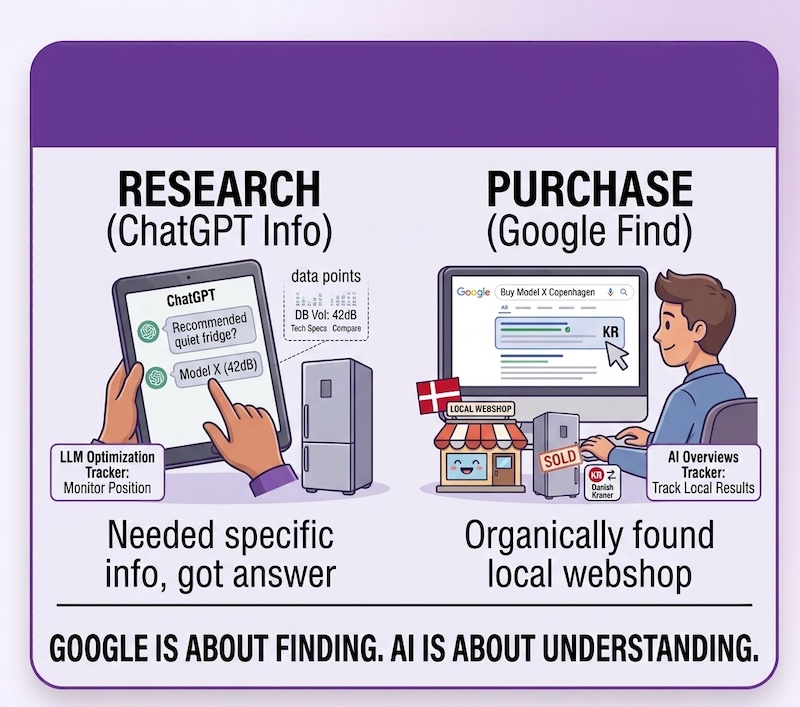
Someone in our industry made a public case out of their own buying journey. They researched a fridge on ChatGPT, needed specific noise-level specifications, got a recommendation, and concluded that search had migrated to ChatGPT and that everyone should optimise accordingly.
Then they bought the fridge. From a webshop. Found through a Google search. Ironic.
The webshop that took the money never appeared in that ChatGPT conversation. It ranked organically for the model number. ChatGPT could have named any retailer on earth, and the outcome would not have changed, because the purchase happened on a search engine.
Christian and I reverse-engineered the same query for fun. “When I asked it to recommend a retailer, it gave me several retailers in England where I’d pay 4,000 kroner in shipping.” We sit in Denmark. Google returned excellent local results in one query. The organic results hit it dead on.
None of this means ignore AI search. It means fund it out of the right budget. Track where you stand with the ChatGPT rank tracker and the AI Overviews tracker, and read our guide to LLM optimization when you want the deeper version.
How to find real search intent instead of guessing it
Beginners conflate writing text with doing SEO. The gap between those two things is search intent, and finding it takes about thirty seconds.
“We often say Google decides the intent, but that’s a truth with modifications. The users decide the intent. Google learns over time what users mean.”
So go look at what Google learned.
Right-click a keyword in Morningscore to open the incognito result. Read the top five. Blog posts mean informational intent. Category pages mean commercial intent. Comparison pages mean the user is still deciding. Then write the format Google already validated, rather than the format you assumed.
This single habit prevents the most common beginner failure: writing a 2,000-word guide for a keyword where every ranking result is a product category page.
How to make your content something other than a copy of a copy
Anyone can produce average content now. That fact rearranged the whole game.
Christian’s analogy: “Imagine a race where everyone turns up in the same Mercedes with exactly the same horsepower, and the drivers are equivalent in insight, experience and willingness to drive fast. The one who wins is the person who turns up with a Mercedes that has ten extra horsepower under the bonnet.”
Those ten horsepower have a name. Google calls it non-commodity content.
What Google actually asked for
At Google Search Central Live in Toronto in April 2026, Danny Sullivan drew a line between commodity and non-commodity content. Non-commodity content is unique, specific, and authentic – it brings a viewpoint others cannot easily replicate, it talks about a specific instance rather than general rules, and it demonstrates first-hand knowledge.
Google’s own example used a running store:
| Commodity | Non-commodity |
|---|---|
| Top 10 Things to Consider When Buying Running Shoes | Why This Customer’s Shoes Collapsed After 400 Miles: A Wear Pattern Analysis |
Christian’s read on it is sharper than the slide: “Non-commodity content is also commodity content, otherwise it wouldn’t be there. There’s no reason to write non-commodity content if it doesn’t have a commercial purpose.”
The point is not purity. The point is the ten extra horsepower.
The resource small businesses keep forgetting they own
You talk to your customers. You hold your products. You hear the complaints. That is the asset almost every small business walks straight past in its rush to sound objective.
“It is much, much more interesting for me to read someone selling a chair who has actually sat in it,” Christian says. “He can describe the comfort. He can describe whether it’s still pleasant after five hours. Whether it’s good for reading a book. Whether it’s good for watching television.”
He points at TripAdvisor to prove the demand exists. Search almost any hotel, and TripAdvisor sits near the top. Not because of a technical trick.
“If we want to know whether a hotel is good, we frankly don’t care about a generic list of how wide the beds are. We would much rather hear from Tina and Thomas, who actually stayed there, slept in the bed, and came back with an honest assessment. And we would much rather see their authentic photos than some glorified picture the sender wants to deliver.”
Google is trying to replicate what humans already look for. Build the thing humans look for, and you stop guessing about the algorithm.
The 80/20 rule for AI-assisted writing
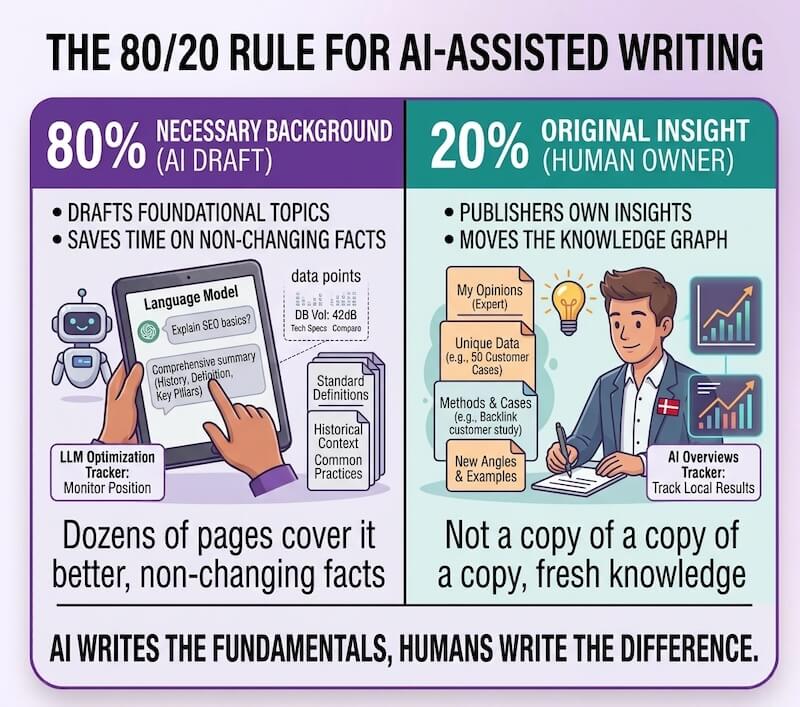
I use language models to write. So does Christian. Here is the split that keeps it from producing sludge.
Roughly 80% of a ranking article is necessary background. If someone searches what is SEO and I answer in one sentence, that sentence can be perfectly correct and still has a zero percent chance of ranking, because I have not covered the topic.
Dozens of pages cover it better. So I need the background, and the background does not change from year to year. Let AI draft it. Save the time.
The other 20% carries the whole page: my own opinions, my own data, my own methods, my own examples, my own cases, and my own angles on questions that have no factual answer.
Christian pushes the same idea further with his own field. “You can’t publish a post about backlinks that is pure original insight from A to Z. We still need what are backlinks, when did the value attributed to them shift, what does Google emphasise.
A language model can help generate that.
Where we have to be original is presenting our own methods – telling you we talked to 50 customers who built links, and here is what manifested on domains of this size.”
Without that, “we’re just a copy of a copy of a copy of a copy. We haven’t moved the knowledge graph at all.”
Our guide on how to use AI for SEO goes deeper on the workflow.
Write a content brief, exactly like you used to
Before language models, nobody hired a copywriter by writing please write a post about this topic. You wrote a content brief. Often a long document, with tone of voice, structure, brand words, forbidden words, angles, required sections, etc.
“You should never ask a language model to write without giving it the equivalent of a content brief,” Christian says.
Then stop being polite about it.
“People tend to be so blinded by the anthropomorphic illusion that they perceive it as intelligence. In reality, you’re dealing with a machine where you have to cut everything out in cardboard and bend it in neon. But if you do that, it can be extremely effective.”
A brief that earns its keep contains, at minimum:
- Three to five URLs of your own posts, labelled as your tone and structure
- The top four or five ranking URLs, with an instruction to run a content gap analysis against them
- A link to Google’s helpful content guidelines, with an instruction to write against them
- A requirement to cite external sources for every factual claim
- A requirement to include internal links to specific pages you name
- Analogies and metaphors as an explicit instruction
- Your opinions, written out in full
That last one does most of the work. Ask a model whether banana cake tastes good, and it will say yes, because most people who published about banana cake said yes. If you hate banana cake, and the post goes out under your name, you have to tell it so.
The same applies to links, to social media, to every contested question in your industry. Your position will not appear unless you put it there.
Christian’s warning on the flip side is worth pinning above your desk. If you instruct a model to argue that social media marketing is terrible, it will happily invent supporting evidence and pull from stale training data. “Then we end up postulating rubbish. You can use AI, but AI cannot be the beginning and the end.”
The model does not know what it does not know
This is the most useful sentence in the entire interview, and Christian said it to me first.
“A language model doesn’t know what it doesn’t know. And the hard part is that it will pretend to know.”
He learned it the expensive way. After the Boeing Dreamliner crash in India in 2025, with tickets already booked on a Dreamliner, he asked ChatGPT whether the aircraft was safe.
“It told me without blinking that it was the safest aircraft in existence. Not one single incident had led to a death involving a Boeing Dreamliner. At which point you could say – there are the remains of three hundred Indians in an apartment block somewhere who would disagree.”
He mentioned the crash. The model ran a search. Then it corrected itself.
The same failure mode hits your content work.
Christian built our academy lesson on language models partly with AI research, then checked it against people with real careers in artificial intelligence. “The wiser I got, the more I could see it had fed me bullshit in nearly fifty percent of cases.”
Source criticism is not optional. Our AI content writer runs up to eleven internal rounds to fact-check its own claims, verify external links, and catch invented URLs that resolve to 404s. Even then, treat the output as a strong first draft rather than a finished article.
The last 20% stays yours.
Link building when you have no budget and no contacts
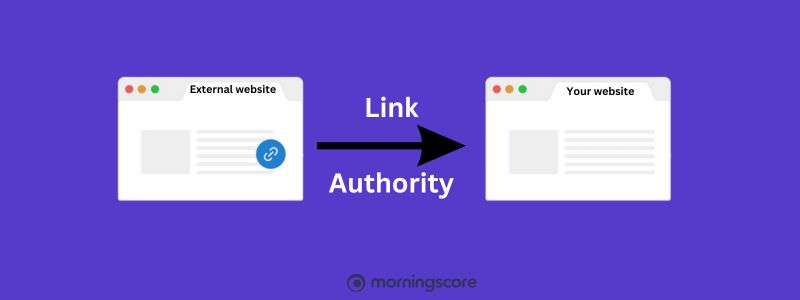
Link building is the hardest part of SEO for specialists. It does not get easier for beginners. It does get cheaper.
Paying for links is the easiest option in terms of workload and the worst in terms of everything else. Christian’s description: “running the card through the machine over and over so other people mention you.”
Large publishers know exactly what their column space is worth. They will quote you a price, and you will pay it.
The alternative he teaches works better for anyone starting from zero.
Use a language model as a prospecting engine
This is the tactic Christian has had the most success with in customer sessions. Open ChatGPT and ask for a list of sites matching very specific criteria.
For a shop selling plant pots and garden supplies, the prompt looks something like this:
Give me a list of websites in [country] that write about DIY projects, planting, and garden maintenance, including allotments. They must have a dedicated blog section. Prioritise sites that appear to be run by organisations of no more than two to four people.
The size filter is the whole trick.
“Big sites know perfectly well what their column space is worth,” Christian says. “But if you’re a small new site missing links, and the further down you are, the more even small links help — links that don’t necessarily come from a national newspaper – then you just need to get started. It’s much easier to reach out to an organisation that maybe doesn’t know its worth yet, and already has a blog section in place.”
Then qualify the list before you write to anyone. Drop each domain into Morningscore. Do they rank for anything? Do they have links of their own?
“I had one the other day. We asked for sites with blog sections in marketing, and we found a very small site that would clearly be easy to approach, but which actually ranked in the top five for a lot of B2B marketing keywords.”
A small site ranking top five is worth more to you than a large site charging four figures. Our competitor analysis tool and backlink checker do this qualification in about a minute per domain.
The outreach that actually gets answered
Christian’s template, translated and tightened:
I can see you write about how to plant rose bushes, and your blog section is genuinely good. Would you be interested in reviewing our pots, which are designed specifically for roses and rose bushes? We will supply all the content, so that side is covered. In return we can send you four pots to test, and offer all of your readers 25% off anything they buy from us through your link.
Three things make it work. You lead with something specific about their site. You remove the work. You give them something their audience wants.
“Start with the ones who will be a little bit flattered, and a little bit curious, that somebody finds their site interesting.”
Forums and Reddit: do it, but calibrate
I asked whether joining relevant conversations on Reddit and niche forums still carries value.
“A hundred percent, but we’re more in GEO territory there,” Christian said, and then he flagged the problem.
Sites that become useful for link building attract companies that pollute them, operating under fake names and staging debates.
Recent data confirms the correction has already started: Reddit’s citation share in ChatGPT Search fell 86.4% in four days in August 2026, from an average of 3.83% to 0.52%, according to data from Promptwatch reported by Search Engine Land.
His verdict stays balanced. “It’s good to do, and it doesn’t hurt you. But don’t turn your expectations up to we posted in a Reddit thread, so now it explodes. Do it, and adjust your expectations accordingly.”
Mentions or links? Both, and here is why
Ahrefs studied 75,000 brands and found branded web mentions correlate far more strongly with AI visibility than link metrics do: 0.664 for ChatGPT, 0.709 for AI Mode, 0.656 for AI Overviews, against near-zero correlations for backlink counts and URL Rating.
Read casually, that looks like permission to stop building links. Christian’s counter-argument closes the loop, and it is the sharpest thing he said all day.
Most small and medium businesses leave a digital footprint too small for a language model to learn anything about them from training data. You can test this in thirty seconds. Ask any model how many employees Morningscore has, or when it was founded, and watch the little circle spin while it searches the web. Ask when Coca-Cola was founded, and the answer arrives instantly.
“Because we’re not in its training data, we’re not part of the initial pool the language models prefer to draw from,” Christian says. “That leaves us with pool B, which is what we popularly call RAG data, where the model uses the internet to find its answer. And one of the places it chooses to fetch information from is a rather fine little index that somebody built.”
That index is Google’s.
“So you can actually argue that backlinks are extremely important for language models. If they need the information, they have to get it from an index, and your position in that index is still carried by third-party mentions in the form of a backlink.”
Backlinks are an indirect factor for AI visibility. Indirect factors that gate your presence in the source everything else reads are not factors you can afford to lose track of.
The tool stack for doing your own SEO under $100 a month
I asked Christian what he would buy on a budget of roughly $60 to $100 a month, then warned him I would fact-check the prices.
His answer, minus the part where he sells our own product to me:
“A good SEO tool, a good tracker, and access to a language model. Otherwise we can go on forever.”
| Job | Tool | Cost |
|---|---|---|
| Rankings, keyword research, competitors, backlinks, site scans | Morningscore | From $69/month |
| Real traffic and conversions, not estimates | Plausible or Google Analytics | From ~$9/month, or free |
| Index coverage straight from Google | Google Search Console | Free |
| Drafting, clustering, link prospecting | ChatGPT or Claude, free tier | Free |
| Deep technical crawl, optional | Screaming Frog, free up to 500 URLs | Free |
| Lead capture, if you sell services | HubSpot free tier | Free |
Two notes on that table.
Every SEO tool shows estimated traffic. Ours included. That is why a real analytics tool sits on the list rather than being optional. At Morningscore, we use Plausible over Google Analytics because it strips out the noise and still measures conversions, which keywords convert, and which landing pages carry their weight. Same philosophy we build the tool on.
Screaming Frog belongs to a specific kind of person. Excellent, deeply nerdy, free up to 500 pages. If you already enjoy technical work, use it. If you do not, skip it or you will spend a weekend in blind alleys.
Beyond that, if you sell services rather than products, you eventually need somewhere for leads to land. Everything else is nice to have.
We are not claiming other tools hold less data than ours. They hold more – if we are bringing up the biggest competitors like Ahrefs and Semrush. We are claiming that perhaps 95% of businesses do not need it, because most of that data requires a near-full-time data analyst before it produces a decision.
For the full landscape, see our breakdown of the 20 best SEO tools, personally tested, and the best SEO software for small businesses.
What to measure: the KPI chronology
Rankings and traffic make terrible primary KPIs and excellent early ones. The trick is knowing which stage you are in.
Stage 1 – Can we move indexing at all? Before anything else, can you get pages into the index? Christian starts every engagement here. If nothing indexes, nothing else matters.
Stage 2 – Do those indexed pages produce traffic? If they index but nobody arrives, you chose the wrong keywords, or you chose keywords so early in the buying journey that clicks were never the point. Both are useful information.
Stage 3 – Can we lift the commercial pages? This is where the strategy earns its money. Picture a painter who has ranked for how to paint windows, how to paint a carport, and how to paint a summer house. Those posts attract people who are about to conclude the job is harder than they thought. So the painter builds internal links from those guides to the pages that make money, and adds a line to every guide: we can always give you a good price, and we usually come out the same week.
“Google’s crawler starts to understand there is something worthwhile on this site,” Christian says. “Then we start pointing those blog posts at the more profitable pages.”
Stage 4 – Soft conversions. Not sales. Actions. A trial signup, a booking, a newsletter subscription, a stress test completed on a psychologist’s site, a quote request, a demo booked.
Our internal link checker matters most at stage 3, where the internal links you build decide whether the informational traffic ever reaches a page that sells anything.
Why sales is the wrong SEO KPI
Morningscore measures my performance on organic leads. Not revenue.
That is deliberate. Once someone signs up for a trial, I cannot do anything more. I do not run email marketing. I do not answer the phone. I do not design the product. My responsibility ends where the lead begins, and the lead moves into a different box with different owners and different KPIs.
Apply the same logic to your own business. If leads arrive and sales do not, your SEO did not fail.
Run the arithmetic: five hours a week is roughly twenty hours a month, call it $2,000 of someone’s time. If the leads coming in should convert at an average rate to more than $2,000, the channel works. Zero sales on top of good leads points to a different problem – pricing, email marketing, the product, the sales process, or the site itself.
One caveat from Christian, delivered with a laugh: quality control cuts both ways. Anyone can flood the lead count by promising 90% off in a banner. Plenty of leads. No customers. No boss who honours the discount.
The ranking-equals-sale myth
Christian gets visibly annoyed about this one.
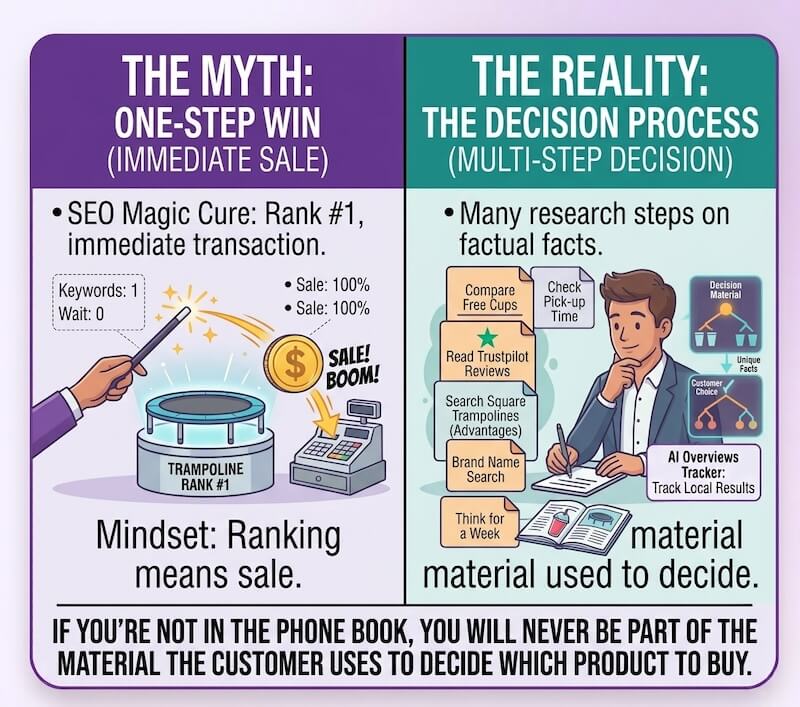
“People need to break the mindset that SEO is some kind of magic cure, where if we rank number one for trampoline, boom, we win the sale immediately. That is not how the world works.”
Here is how it actually works. You need a slush machine for a children’s party. You search. You open result one. Then two, three, four, five. You check what Trustpilot says about each. Do you get free cups? Do you collect it yourself? How fast do they pick it up?
Or you research trampolines, learn from source one that square trampolines have advantages you did not know about, run a new search for square trampolines, read four more sources, think about it for a week, then search the brand name directly and buy.
“There are many steps in this. But if you’re not in the phone book, you will never be part of the material the customer uses to decide which product to buy.”
The drum kit warning
One more trap, because Christian has watched people walk into it repeatedly.
You run a music shop. You sell three drum kits, always the same three, none of them cheap. The rest of your range is niche – ukuleles, saxophones, xylophones. Then you run keyword research and discover 50,000 monthly searches for drum kits.
Suppose you win. You build links forever, you write the world’s best category page, you take the ranking.
You still lose.
“Users arrive, see your three drum kits, and think this oversells and underdelivers. I didn’t come to look at three overpriced drum kits. I expected something completely different from the pages at the top. You get a pile of negative user signals, you lose the indexing, and really you just set yourself up for failure.”
Which gives you one more KPI, and the cheapest one to check: look hard at your own business before you decide which keywords to chase.
For ecommerce specifically, category pages remain the strongest weapon in classic SEO, because most searches stay unspecific and Google prefers pages with genuine range. Our ecommerce SEO guide covers that in detail.
Christian’s 14-step checklist for optimising one page from scratch
I asked Christian to take us into the engine room. It is Tuesday morning. A business owner sits in front of one category page with a URL, some products, and nothing else. What does the checklist look like?
He answered without pausing. On-page only, no link building until step 14.
- Search Google for exactly what you want to sell.
- Add the competitors who show up into Morningscore.
- Open their keywords and find the topic you are working on.
- Open their Pages report to see which URLs they use for it.
- Click those URLs to get the full list of keywords each one is indexed for.
- Read that list as cues, not as terms to stuff. Ask what information users are missing.
- Map the content you need to cover, section by section.
- Write the content.
- Check the SERP again in incognito, this time reading title tags and meta descriptions. Whatever ranks there has already earned clicks, so it tells you what motivates this audience.
- Run a content gap analysis. Have you at least hit the median depth of the pages you are competing with?
- Raise the information gain. What can you add that the others cannot replicate?
- Check E-E-A-T signals. Named author. Author background. Unique insight. Unique images. Unique video.
- Add internal links pointing to the page, so the crawler can find it. If it does not index immediately, you have at least sent attention in its direction.
- Start building backlinks, if you can.
Steps 1 through 8 build the body. Steps 9 through 12 add the ten extra horsepower. Steps 13 and 14 make sure someone finds it. Our on-page SEO guide expands each step, and the 54-step SEO checklist covers the site-wide version.
The four mistakes that cost small businesses the most
I asked for three. Christian gave three, then added a fourth mid-answer because it kept bothering him.
1. Too much time on technical SEO
Covered above, and worth repeating because it is the most common failure by a distance. Technical SEO offers a tick-box system. Meta description too long? Fix, tick, done. It feels productive, and it is measurable, which is exactly why people hide in it.
“They sit and polish the outside of a car that has no engine.”
2. Peaking
This one surprised me, and it is the most original observation in the whole interview.
“I don’t know how many times I’ve sat with Journey users and told them, word for word: be a bit greedy, for God’s sake.”
Here is the pattern. Getting started with SEO felt enormous and dangerous and intimidating. Then they got help, and something ranked beautifully. And then they stopped.
Christian’s picture of it: someone who has never bowled steps onto the lane, throws the ball, and hits the wildest strike anyone has seen. “That person very often feels: I don’t need to send another ball down this lane today. I have peaked.”
Nobody says the fear out loud. What if the next thing does not do as well?
The next thing often will not. That is the job.
I see the same misunderstanding from the outside. People assume specialists hit the target first time, every time. We do not. More often than not, the first attempt underperforms. The difference between a specialist and a beginner is not accuracy. It is willingness to go back, look at the data after a few months, and say this did not work, it needs redoing.
Christian’s version: “That’s probably the real difference between a beginner and an experienced practitioner. The experienced one is willing to go back and say this didn’t work. It needs to be changed. It needs to be better. And that’s just part of the game.”
3. Refusing to touch backlinks
Consistently, permanently, on principle. Some businesses simply decide link building is not for them, and then wonder why content alone stopped moving them.
4. Reading normal fluctuations as punishment
“Many of our users imagine that fluctuations reflect Google disliking what they made. Nope.”
Google constantly shuffles results, because Google exists to serve Google, and higher click rates mean internal success. Some weeks a result underperforms, so Google tests moving it. If the new position performs worse, it moves back.
Christian’s example uses our own keyword. One week, 90% of the people searching SEO tool already know Morningscore, and they skip us because they came looking for an alternative. The next week, 90% of searchers have never heard of us, and all-in-one SEO tool in the meta description sounds appealing. Click rates jump, and so does the position.
“Position four last week, position one this week. The week after, market conditions work against us again, and we drop back to four. That’s a completely normal part of the game.”
There is no little black book in California. If it worked before, it still works. Publishing something that underperforms does not damage what already ranks.
The bonus mistake: copying what worked
You rank number one with a page. Naturally you rebuild the same structure for a new topic – same depth, same explanation level, same technical approach.
It can still fail completely. I have watched it fail on my own site more than once.
Competition differs. Search intent differs. Search behaviour differs. The audience differs. Google’s algorithm does not hand out a fixed answer key, and the same is true across two businesses you own. Replicating the winner is a reasonable place to start. It is a terrible place to stop.
When to stop doing your own SEO
Two versions of this question hide inside one. When should you hand SEO to a specialist? And when should you conclude that SEO is wrong for your business entirely?
Christian took a long run-up at it, which tells you the answer has nuance.
Start with our CEO’s framing: Google is a pie, and there is nearly always room to squeeze another ingredient in somewhere.
Now the counter-example. You start a tool shop. You stock a decent range of adjustable wrenches at fair prices. An honest agency tells you the truth: look at the results page, and you see Home Depot, Lowe’s, Screwfix, B&Q, and down it goes.
“We cannot take your unknown shop, no matter how much artificial link value we pump into it and no matter how good the content we make, and knock those very authoritative sources off their perch.”
Christian is blunt about the reason, and it is worth sitting with.
“Google is not an egalitarian player where we can expect that good content alone gets us up to beat the biggest players. If I started a shop tomorrow selling PlayStation and Xbox games, I would never be able to compete with the biggest retailer. It simply is not going to happen. Even if my range came close to theirs and my prices matched, Google has so much history with them and knows it works.”
The signal that tells you to walk away
Here is the diagnostic, and it takes ten seconds.
Search your target keyword. Scroll to page two. If you find a household name stranded in the middle of page two – a major retailer, with a relevant page, that could not even reach page one – you have your answer.
That keyword needs money. Not link purchases. Real, sustained, expensive work.
The ladder that opens a different door
The same search that closes one door usually opens another. Christian demonstrates this on every course.
Search bookshelf. Forget it. You compete with IKEA and every furniture chain in the country.
Search wall-mounted bookshelf. A couple of the big players remain, but the field thins.
Search wall-mounted wooden bookshelf. Maybe fifty searches a month. If you sell wall-mounted wooden bookshelves, you should want that keyword far more than the first one, because conversion and buyer intent run much higher.
“Number one is partly a mirage. Number two is hard. Number three is straightforward, it sits right there for the taking, and with a good page you can probably rise very fast and collect a lot of good signals from Google.”
Then you climb. Do well on the third tier and you can reach for the second. Do well there and, with time and luck, you might genuinely contest the top ten for the head term.
“None of the big players comes close to covering every furniture search with good content. And for Google it is always about having the best index. If nobody has made anything good about wall-mounted shelves, that’s your way in.”
The categories where the answer really is no
Christian named them without hesitation. New life insurance company run from your basement. Dental loans. Online casinos and gambling.
“Every single sliver of a search is covered, because there is so much money in every visit for them. There is nothing to come for.”
“But for almost every other category, whatever you sell, products or services, there will always be some route into the demographic.”
So when do you actually call someone?
When you can see the competition is brutal, but you cannot find the angle.
Finding the fourth way in, after the first three turned out to be occupied, requires experience. Common sense gets you a long way, and most people have it. Common sense plus years of pattern recognition gets you further.
That is the moment to look for help. An agency, a freelancer, a course, a mentor. Which one matters less than recognising the moment. Our Growth Academy exists for exactly this reader, and our customer cases show what the underdog version looks like when it works.
One last thing about the word “free”
SEO gets called a free channel. It is not.
Time is money. If you or an employee spends five hours a week, those hours cost the business something. So SEO costs something, and the honest comparison is against what those same hours would earn elsewhere.
That is not an argument against doing your own SEO. It is an argument for choosing your keywords carefully, because the cheapest hour is the one you did not waste attacking a keyword you were never going to win.
Your first 90 days, condensed
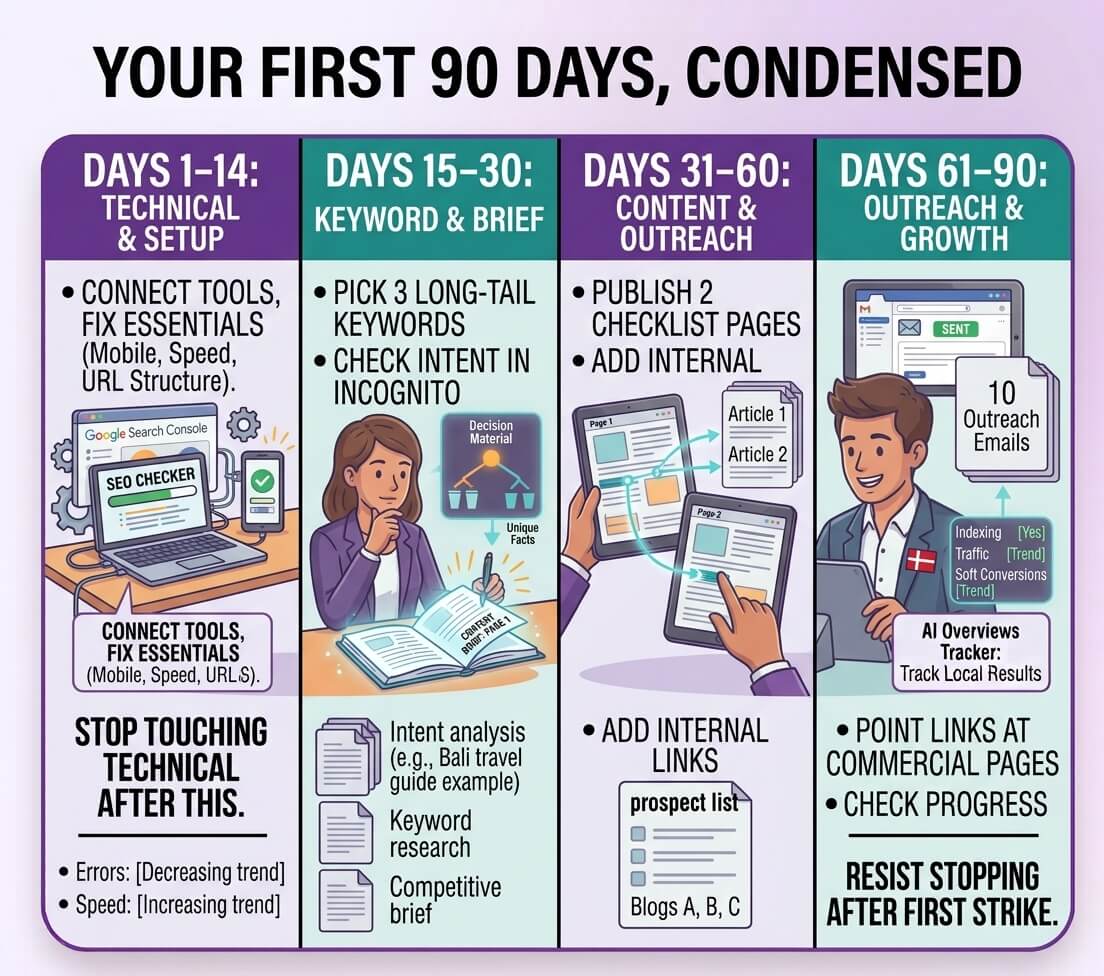
Days 1–14. Connect Google Search Console. Run an SEO checker scan. Fix mobile, speed, and URL structure. Stop touching technical after this.
Days 15–30. Pick three long-tail keywords with real buyer intent. Check intent in incognito for each. Write your first content brief.
Days 31–60. Publish two pages built on the 14-step checklist. Add internal links from anything you already have. Build your prospect list of small blogs.
Days 61–90. Send ten outreach emails. Publish two more pages. Point internal links at your commercial pages. Check indexing, then traffic, then soft conversions, in that order.
Then repeat, and resist the urge to stop after the first strike.
Frequently asked questions about doing your own SEO
Can I really do my own SEO with no experience?
Yes, for most of it. Around 75% of the work inside a tool like Morningscore can be learned by someone with no SEO background. Content is entirely within reach, because it depends on knowing your own business. Technical SEO is smaller than it sounds, since modern platforms handle the hard parts. Link building is the piece most beginners struggle to sustain.
How many hours a week does doing my own SEO take?
Two to three hours a week moves the needle for most small businesses. Five hours a week gets you a working cluster and your first earned links within 90 days. The right number depends on your competition, not on a general rule.
What part of SEO should I not try to do myself?
Third-party authority. Links and mentions demand time, persistence, and outreach, and they are the first thing to slip when the week gets busy. Everything else you can own.
Is keyword research still worth doing now that people use ChatGPT?
Yes. Large Language Models publish no volume data, so optimising for them means guessing. Google still handles vastly more searches, and commercial searches in particular still land there. Keyword research expanded; it did not die.
How much should I spend on SEO tools?
Under $100 a month covers it: one SEO tool, one real analytics tool, and access to a language model. Google Search Console is free and non-negotiable. Everything past that is nice to have until you have a specialist to use it.
How long before doing my own SEO shows results?
Expect the first indexing wins within weeks on low-competition long-tail terms, and meaningful traffic in three to six months. SEO compounds, so the second year costs far less effort than the first.
Do I still need backlinks if AI search prefers brand mentions?
Yes. Ahrefs found brand mentions correlate more strongly with AI visibility than links do. But language models fetch fresh answers from search indexes, and your position in those indexes still depends on links. Backlinks became an indirect requirement rather than an optional extra.
What should I measure to know my own SEO is working?
In order: indexing, then traffic from indexed pages, then movement on commercial pages, then soft conversions such as signups, bookings and quote requests. Sales sit too far downstream to judge SEO by them alone.
When should I hire an SEO agency instead of doing it myself?
When you can see the competition is severe but cannot find an angle in. The clearest signal: search your target keyword, scroll to page two, and find a household-name brand stranded there. If the giants cannot reach page one, you need help or a different keyword.
Can I just use AI to write my SEO content?
For roughly 80% of an article, yes. Background, definitions and structure barely change year to year. The remaining 20% has to carry your data, your methods, your examples and your opinions, because a language model only recites what already exists and does not know what it does not know.
Christian Aalykke is Head of Customer Success at Morningscore and teaches the Morningscore Growth Academy, Morningscore basic SEO course, and Morningscore Advanced SEO course.
Lukas is SEO Lead at Morningscore. This article is based on a two-and-a-half hour recorded conversation between us in August 2026.
Sources
- Danny Sullivan, Google Search Central Live Toronto, April 2026 — commodity vs non-commodity content — Search Engine Roundtable
- Ahrefs, “Top Brand Visibility Factors in ChatGPT, AI Mode, and AI Overviews” — Ahrefs
- SparkToro & Datos, “Google Search Grew 20%+ in 2024” — SparkToro
- Search Engine Land, “Reddit’s ChatGPT Search citations fell 86% in four days” — Search Engine Land