
 Deutsch
 Dansk
Dansk Svenska
 Nederlands
 Español
 Lietuvos
Key Takeaways
- LLMO is the practice of optimizing your content to be cited by AI chatbots – the equivalent of SEO, but for large language models like ChatGPT, Gemini, and Perplexity.
- Google still holds a massive portion of the search market, but ChatGPT dominates the chatbot space with around 73-75% market share as of early 2026.
- The most effective LLMO tactics – digital PR, entity-based authority, original stats, and multimodal integration – overlap significantly with modern SEO.
- Writing clear, direct answers and using structured data for entity prominence gives AI the best chance of picking up and citing your content.
More and more people are using LLMs to ask questions, find products, and research guides. This means a new discipline has arrived for marketers: LLMO (Large Language Model Optimization).
With models like ChatGPT, Perplexity, and the Chinese DeepSeek advancing quickly, companies need to adjust. You must move beyond only optimizing for Google and start accounting for the rise of AI search visibility.
This isn’t just the latest trend. If LLMs continue their current growth, there is significant business value in being featured in AI chatbot replies. In 2026, being a citable source is a competitive necessity.
In this post, I will look into generative AI chatbots and how to optimize for them. While some areas are still evolving, early signs show that high-quality SEO foundations are the base for LLMO success.
What is LLMO?
LLM Optimization, or LLMO, is the process of getting your content ready for large language models. These systems, like ChatGPT, Gemini, and Claude, produce text, image, and video responses based on their training and real-time web browsing.
LLMO is the equivalent to SEO. While SEO optimizes for search engines, LLMO optimizes for AI chatbots and generative engines.
This matters because many users now turn to AI-driven conversations to answer questions. If your site’s information is recognized as reliable and authoritative, the AI may quote you as a primary source.
When people see your brand mentioned by an AI, brand trust increases significantly. LLMs and AI chatbots represent the biggest shift in the search market in decades.
For a look at why we call it “LLMO” instead of “GEO” or “GAIO”, you can check out our post on why LLMO is the Winning Name for LLM SEO.
Does optimizing for LLM-based search mean I should ignore traditional SEO?
Absolutely not. You want both. While AI is growing, the majority of users still use standard search engines for thorough research and navigation.
Don’t be misled by social media polls. While ChatGPT holds a strong 73-75% share of the AI market, Google still dominates the overall search landscape. You shouldn’t cut your SEO budget just yet.
Take a look at the traffic sources of morningscore.io in early 2026. While AI referrals are growing, Google and Bing still drive the vast majority of our sessions.
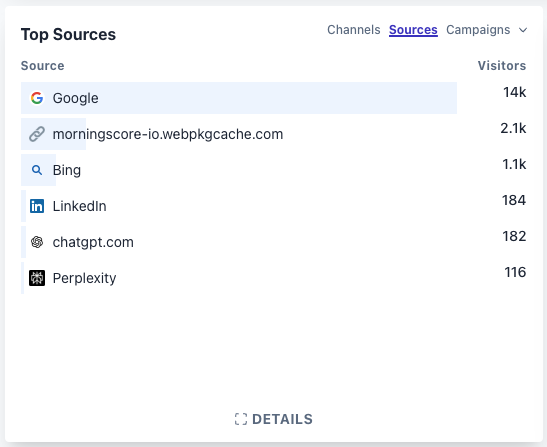
The distribution shows that Google remains the dominant source. Even LinkedIn often beats individual AI chatbots as a traffic driver. Most customers are not as tech-savvy as early AI adopters.
LLMs are heavily used for tasks and summaries, but Google remains the primary way to find businesses and products. However, LLMO is now a critical part of the mid-term marketing mix.
Google AI Overviews (SGE) and Gemini’s integration into Chrome have changed how users interact with results. Proactive, context-aware AI is now replacing traditional assistants on many devices.
How do LLM-based generative AI systems process and “rank” content?
Generative AI models don’t rank pages with a traditional scoreboard. Instead, they analyze text patterns to predict the most helpful and accurate response.
In 2026, models like GPT-5.2 and Claude 4.6 use massive context windows to process information. They favor content that is consistent, frequently updated, and displays high entity authority.
If your site offers original data or a unique perspective, the AI is more likely to feature you. Modern models now use real-time web browsing to find the freshest sources available.
How LLMs work (simply explained)
1. Breaking text into small pieces (Tokens)
LLMs like ChatGPT or Gemini divide text into chunks called tokens. These can be words or parts of words. This allows the model to analyze how language parts relate to each other.
2. Mapping tokens in a ‘semantic space’
Models represent tokens as vectors (lists of numbers). This creates a semantic map where related words, like “apple” and “fruit,” cluster together.
3. From statistics to semantics
LLMs use mathematical relationships to guess the next best token. With enough data, they appear to understand deep context, even if they are essentially calculating probabilities.
4. Measuring relationships
The model calculates the distance between vectors. If the numbers suggest a close connection, like “pasta” and “Italy,” the model recognizes the thematic link.
5. Building a knowledge base through training
Models learn from massive datasets of books, websites, and archives. This helps them master grammar and general facts, though newer models rely more on multi-step reasoning.
6. Adding specialized expertise (RAG approach)
Retrieval Augmented Generation (RAG) allows models to look up live data from the web. This reduces “hallucinations” and ensures the AI can cite current research and news.
How to optimize for LLMs (LLMO)
The key is writing content that humans and AI can both follow easily. Put your main point first. Use facts and personal experience to stand out from generic, AI-generated fluff.
Digital PR
LLMs see the web as clusters of brands and topics. To be mentioned for a specific topic, your brand must have measurable proximity to those words in the AI’s training data.
When someone asks for the “best gamified SEO tool,” ChatGPT mentions Morningscore. This happens because our brand is consistently associated with those specific terms across the web.
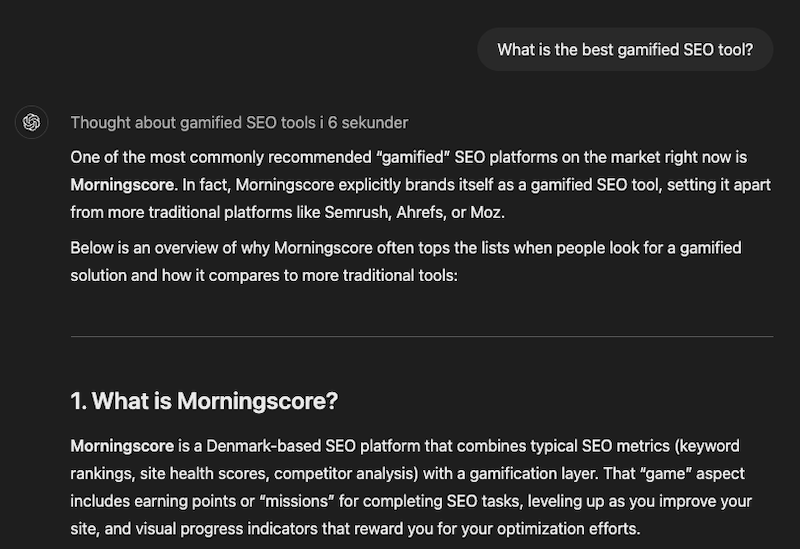
You can build this association through digital PR. Features in major media, press releases, and high-quality guest posts help connect your brand entity to your target keywords.
Build a strong backlink profile
A strong backlink profile signals “digital goodwill.” When an LLM scans the web, it notes which sites are cited by other trusted authorities.
In 2026, backlinks remain a top signal for AI visibility. Quality links from established domains prompt the AI to treat your brand as a trusted resource in its conversations.
Implement stats and quote-worthy content
Recent studies show that websites containing original quotes and statistics see 30-40% more visibility in LLMs. AI models love citing concrete data to back up their answers.
Strengthen your credibility by including original research. These “information nuggets” are easy for AI crawlers to extract and attribute to your website.
Entity research
LLMO requires understanding how your brand is perceived as an entity. Google and AI models use pillars like on-page content and what others say about you to define your authority.
1. Examine your on-page topics
Use NLP tools to see how an algorithm categorizes your pages. If a tool identifies “technical SEO” as your main theme, you are building the right entity signals.
2. Look at your site as a whole
Avoid being “all over the map.” Narrow your focus to a core expertise so LLMs view you as a top authority in a specific niche rather than a generalist.
3. Review your backlinks and anchor text
Analyze how others refer to you. If your anchor text says “best e-commerce solutions,” the model will associate your brand entity with that specific solution.
Reddit and UGC content
Reddit remains a foundational part of how leading LLMs are trained. In 2026, user-generated content (UGC) is a primary source for “human-like” recommendations in AI search.

When users discuss your brand on Reddit, it becomes part of the AI’s permanent dataset. Nurturing a presence on these platforms helps ensure AI-generated outputs are positive and accurate.
Do SEO for LLMO
There is a direct correlation between organic search engine rankings and AI mentions. For example, Bing serves as a major source for ChatGPT Search results.
Do not ditch your SEO strategy. Google still holds the majority of market share, and your SEO foundation is what builds the brand authority needed for LLMO.
Company age and Wikipedia
Old, thriving businesses often have a slight advantage because they have years of authority data. However, new brands can compete by becoming “notable” in their niche.
Having a Wikipedia page remains a massive boost for LLMO. Since AI models use Wikipedia as a core fact-checking source, a well-documented profile ensures the AI gets your facts right.
Provide clear, concise answers
To be mentioned, you must provide answers in the same style that LLMs output them. Use short, direct sentences and conversational language that is easy for a model to parse.
What are the essential LLM optimization tactics for marketers today?
In 2026, Generative Engine Optimization (GEO) is about matching user intent patterns. People chat with AI in everyday styles, so your content should reflect those conversational queries.
New tools like Semrush and Surfer SEO have integrated features for tracking AI visibility. Platforms like Langfuse and Helicone also help monitor how your content performs in production AI environments.
How will LLM transform search marketing?
The biggest shift is that users get direct answers with fewer clicks. This means you must move from simply “ranking” to becoming the cited source within the AI answer.
Current models like Gemini 3.1 Live and GPT-5.2 are multimodal. They can process video and audio in real-time, making it important to optimize across different media formats.
What challenges does LLM optimization pose for smaller brands?
Small brands often lack the deep digital PR of global giants. However, you can thrive by focusing on a “tiny slice” of the pie. Be the absolute best at a very narrow topic.
How can businesses measure success and track metrics in LLM?
Marketers now use metrics like “Share of AI-Generated Answer Inclusion” and brand mentions in AI conversations. Tracking direct and branded search growth is also a key indicator.
Our ChatGPT Rank Tracker and AI Overviews tracking are now live on all Morningscore plans. These tools help you see exactly where your brand appears in AI search.
Is SEO dead?
No, SEO is very much alive. Users still prefer clicking through to sources for in-depth research, and standard search engines provide a breadth of perspectives that AI often lacks.
Google remains the primary driver for lead generation and sales. Your SEO work today is what builds the credibility that AI chatbots will use tomorrow.
What are the latest predictions and statistics on AI growth?
By 2028, LLM chatbots are predicted to reach 15% of the total search market. In 2026, ChatGPT continues to lead, followed by Google Gemini and Anthropic’s Claude models.

The space is changing with lightning speed. Google is leveraging its massive data pool, while OpenAI has retired older models like GPT-4o in favor of smarter, multimodal systems.
FAQ on LLMO
Does LLM optimization require special tools?
Yes, observability platforms like Maxim AI and tracking tools like SE Visible are now common. You need data on how models interpret your specific content themes.
How can I handle incorrect brand mentions by AI?
Verify the source of the data. Update your website and social profiles with corrected facts. Providing consistent, clear info across the web helps the AI correct its “knowledge.”
What’s the best way to follow an LLMO strategy?
Adopt an iterative approach. Track your mentions, follow leading AI researchers, and constantly refine your content to be the most authoritative source in your niche.