
 Deutsch
 Dansk
Dansk Svenska
 Nederlands
 Español
 Lietuvos
Our website generates thousands of visits from Google every month. But it’s very country-specific traffic, even though our reach is global. This made us wonder: can simply **translating your website** help **boost SEO traffic** on its own?
In general we can see a clear correlation between location of quality links and traffic. If we have 20 strong links from Belgium, we see more traffic there than for example Netherlands, even if the country is smaller.
Can translating your website boost SEO traffic without building backlinks?
We decided to give it a shot. In 2025, we launched a full Swedish translation of our website and the results were very positive. By early 2026, data shows that high-quality localization can lead to measurable SEO traffic improvements for about 15% of websites.
And we got rewarded very nicely! Our Swedish traffic value reached new heights and continues to show stability. Recent industry analysis from 2026 suggests that strategic translation now helps mitigate the traffic declines many sites saw in 2025.
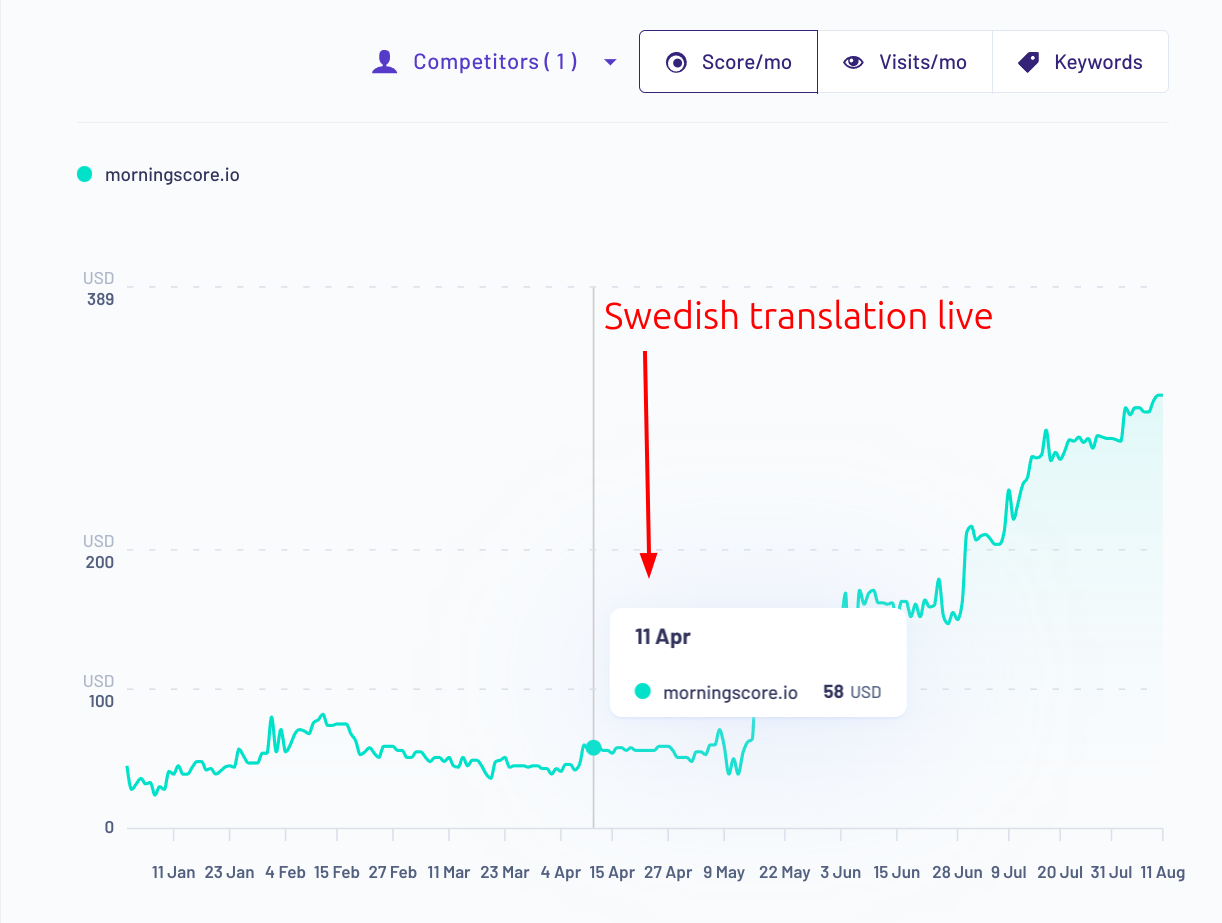
Image: Value of Swedish traffic measured in USD (Morningscore metric)
To be fair we also have a few cool Swedish links, so I can’t say what would happen without any at all. AI-powered translation has reached roughly 95% accuracy in 2026, but it still needs to be paired with local relevance.
For sure more local quality backlinks is never a bad idea. Experts now emphasize that while link quantity was once the focus, the current shift is toward high-quality, niche-relevant links.
Will translating your website boost SEO traffic for any site?
I think it will only be effective if your website already has a strong baseline of backlinks. If your site is new or has few backlinks, I think it’s a waste of time. Start building stronger links first.
In March 2026, Google introduced AI-enhanced features that make machine-translated content more context-aware. This makes tools like Weglot or Lokalise even more powerful for SEO since they automate technical needs like hreflang tags.
However, simple literal translation is no longer enough. To rank well in 2026, your content needs cultural adaptation and proper technical SEO. It is about making the content feel local, not just translated.