
 Deutsch
 Dansk
Dansk Svenska
 Nederlands
 Español
 Lietuvos
Link building for small business doesn’t work like it does for enterprise sites, and every guide that tells you to “just create great content and links will follow” is lying to you. You have no budget, no PR team, and no ten years of domain history to lean on. What you have is time, real relationships, and a business that’s actually useful to specific people. That’s your edge. Here’s how to use it.
This isn’t another list of 12 tactics copy-pasted from the same three SEO blogs. It covers what a good link actually looks like, what it costs you in real hours, a 90-day plan with numbers attached, and something almost nobody writing about this topic in 2026 is covering yet: how link building now feeds AI search visibility, not just Google rankings. Link building is one piece of the broader SEO for small businesses puzzle, but it’s the piece most owners either ignore or get scammed on, which is exactly why it deserves its own guide.
TL;DR
Link building for small business isn’t about volume, it’s about relevance. Audit what you have, pull your competitors’ backlinks and chase the ones they share, lock down the zero-cost foundational links (directories, partners, unlinked mentions), then earn the rest through one solid linkable asset, resource page outreach, and guest/podcast pitches. Budget 3-5 hours a week. Skip paid link networks and directory-spam services entirely. Do this right and you’re also building the topical authority that gets you cited in AI Overviews and AI search, not just ranked in Google.
Key Takeaways
- A good link is relevant and editorially placed, not just high-DA. Ten targeted links beat 100 directory spam links every time.
- Audit your own backlink profile first, then pull your competitors’ links with Morningscore and chase the ones they share. That list is your fastest, least speculative outreach source.
- Lock down zero-cost foundation links (directories, chamber of commerce, supplier/partner pages, unlinked mentions) before doing anything that requires outreach skill.
- One strong linkable asset (a tool, template, or original data piece) does more work than a dozen generic blog posts.
- Budget 3-5 hours a week and expect to see movement in 8-12 weeks, not overnight.
- Never touch paid link networks, PBNs, or bulk directory submission services. The risk isn’t worth it.
- Link building now also feeds AI Overview and AI search citations, not just Google rankings, so topical authority matters more than ever.
What Counts as a Good Link for a Small Business
Forget domain authority scores for a second. A link from a random DA 60 blog that has nothing to do with your industry is worth less than a link from your local chamber of commerce site with a DA of 25. Search engines (and increasingly, AI models pulling in citations) care about relevance and context more than raw authority numbers. It’s also worth knowing that Google has explicitly stated that third-party authority scores don’t represent Google’s own ranking signals – so chasing DA is chasing the wrong target.
Three things actually matter:
- Topical relevance. Does the linking page talk about anything close to what you do? A plumber getting linked from a home renovation blog matters. A plumber getting linked from a crypto news site doesn’t, no matter the DA.
- Real traffic on the page. A link buried on a page nobody visits and Google barely crawls isn’t doing much. Check if the linking page ranks for anything or gets indexed regularly.
- Editorial placement. A link inside the body of an article, placed because it’s genuinely useful to the reader, carries more weight than a link stuffed in a footer or a sidebar widget.
If you’re chasing 100 links in a week from directories nobody’s heard of, you’re not building authority. You’re building a pattern that looks exactly like what search engines penalize.

Audit Before You Build Anything
Most small business owners skip this step and go straight to outreach. Don’t. You’ll waste weeks building links that don’t move anything if you don’t know your starting point.
Pull your current backlink profile using Google Search Console (free) or SEO software for small businesses with a usable free tier. You’re looking for two things: what you already have, and what’s broken.
One thing worth factoring in: links decay over time. Research from Ahrefs on link rot found that at least 66.5% of links created since 2013 had rotted, with 74.5% considered lost when technical and indexability problems were included. That means a chunk of your existing profile is probably already dead – worth checking before you build on top of it.
Then fix your internal linking and basic site hygiene before you send a single outreach email. A backlink pointing to a page with broken navigation, no clear next step, or slow load times is money left on the table. You’re about to send traffic somewhere. Make sure that somewhere converts.
Steal Your Competitors’ Links With Morningscore
Here’s the shortcut most small businesses skip because they don’t know it exists: your competitors have already done your prospecting for you. Every link pointing to them is a site that has proven, in practice, that it’s willing to link to a business exactly like yours.
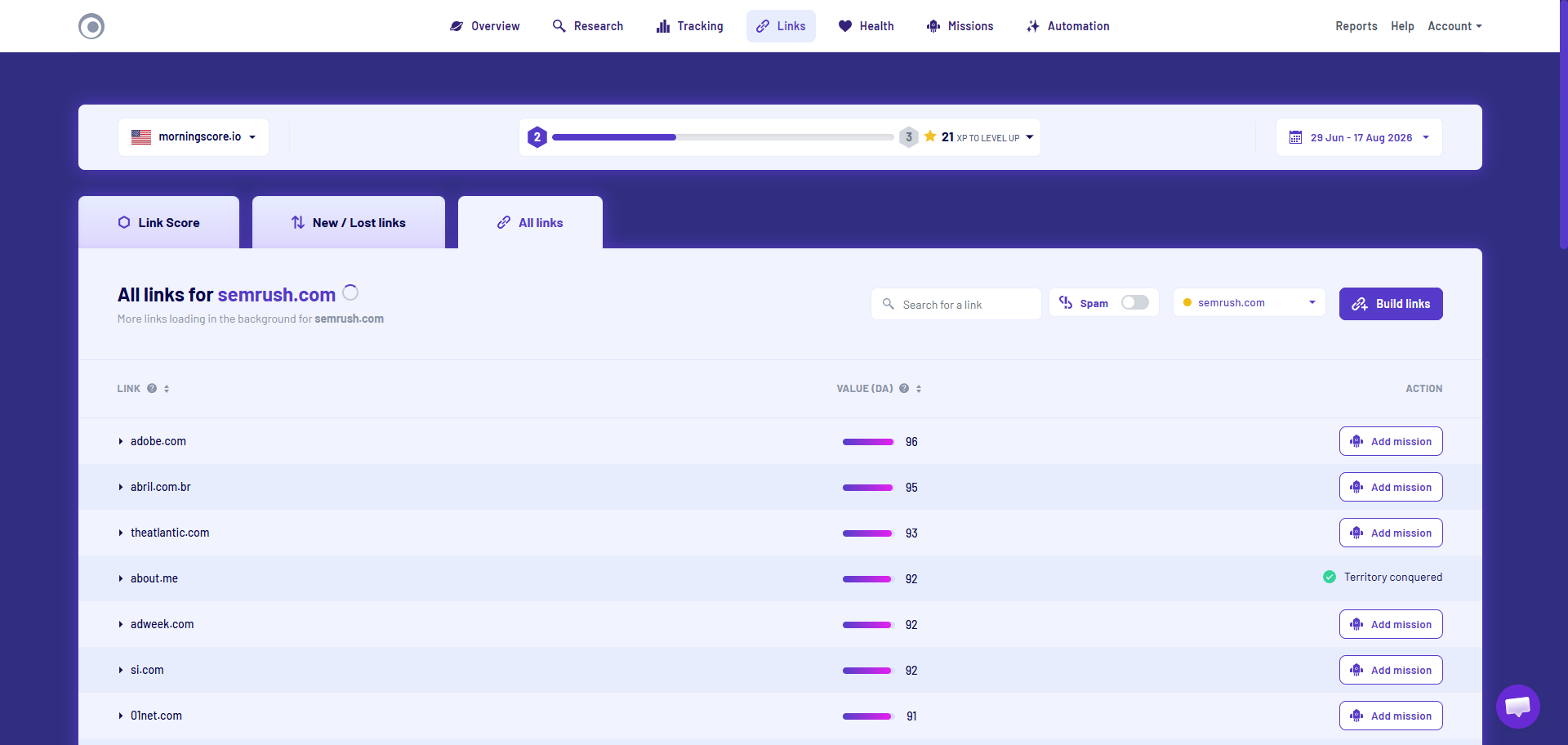
Run your top three competitors through Morningscore’s backlink checker and pull their full link profiles. You’re looking for two patterns:
- Links your competitors share with each other. If three competitors are all linked from the same industry directory, guest post site, or resource page, that site clearly links out to businesses in your space regularly. That’s a near-guaranteed yes if you pitch it right.
- Links only one competitor has. These are worth a look too, but treat them as lower priority. A one-off link might be a personal relationship or a fluke, not a repeatable pattern.
Once you’ve got the list, sort it by relevance and realistic outreach difficulty, not by domain authority alone. A local business directory that links to two of your competitors is an easier, faster win than trying to out-pitch them for a link from a national publication.
Morningscore also flags new links your competitors pick up over time, so you’re not just doing a one-time snapshot. Check it monthly. If a competitor lands a new link from a podcast, a “best of” list, or a partner page, you now have a warm lead for the exact same pitch. They’ve already proven the site says yes to businesses like yours; you’re just next in line.
This is the single fastest way to build an outreach list that isn’t guesswork. Instead of cold-searching for “resource pages in my industry” and hoping something relevant turns up, you’re working from a list of sites that have already said yes to your competition.
Zero-Budget Foundation Tactics (Do These First)
These take under 10 hours total, not weeks. Do them before anything fancier.
Get listed everywhere that matters
Google Business Profile, your industry’s main directory, your local chamber of commerce, any trade association you’re part of. These are low-effort, high-relevance links you’re leaving on the table if you haven’t claimed them yet. Links from local and trade sources also tend to carry more weight for local queries specifically – worth prioritising if local search is part of your traffic strategy.
Ask your suppliers and partners
You already have real business relationships. If you buy from a supplier or refer clients to a partner business, ask if they’ll list you on a “our partners” or “who we work with” page. This is the fastest, most natural link you’ll ever get, and it costs you one email.
Reclaim unlinked mentions
Set up a Google Alert for your business name. When someone mentions you without linking (a common occurrence if you’ve been quoted, reviewed, or featured anywhere), email them and ask for the link. This is a five-minute conversion that most businesses never bother chasing.
Earning Links Through Content
This is where most guides tell you to “create great content” and leave it there. Specifics:
Build one linkable asset
Not ten blog posts. One genuinely useful tool, calculator, or piece of original data. A pricing calculator, a salary benchmark survey for your industry, a template nobody else has published. Small businesses that pull this off get linked to by bigger sites that need to cite a source. You don’t need a research team for this. A well-run survey of 50 customers in your niche beats a generic blog post every time.
Target resource pages
Search operators like intitle:”resources” + [your industry] or “best [your city] [your service]” surface pages that are already built to list businesses like yours. These pages exist specifically to link out. Half the work is already done for you; you just have to find them and ask to be added.
Fix broken links on industry resource pages
Find dead links on relevant resource pages using a browser extension or link checker, then email the site owner pointing out the broken link and suggesting your content as a replacement. This works because you’re doing them a favor, not asking for one.
Outreach That Doesn’t Feel Like Spam
HARO and similar platforms
These connect you with journalists looking for expert quotes. Respond to a handful of relevant queries a week and you’ll land links from legitimate publications over time. This takes consistency, not luck.
Guest posting, done right
Pitch a specific content gap you found on a site, not a templated “I’d love to write for you” email to 200 blogs. Read three of their recent articles first. Reference something specific. This alone puts you ahead of 90% of the pitches editors receive.
One thing to keep in mind: Google’s spam policies flag guest posts with heavily optimised anchor text or low-value content placed primarily for link manipulation. Write for the audience on that site, not for the anchor text. That’s both the ethical and the practical approach.
Podcast guesting
Underused and works well for small businesses. Most podcasts link to guests in show notes. Five to ten podcast appearances in your niche gets you five to ten links from established domains, plus actual audience exposure. This is a channel most link building guides skip entirely.
Local press and award applications
An easy win most businesses ignore. “Best of [city]” lists and small business award programs almost always link every applicant, win or not. Search for these in your city and industry and apply. It costs you a form, not a campaign.
A Realistic 90-Day Plan
| Month | Focus | Weekly time |
|---|---|---|
| Month 1 | Audit, competitor backlink pull, foundation tactics, directory listings, partner asks | 3-5 hours |
| Month 2 | Launch outreach (competitor-shared links, HARO, resource pages, broken link building) | 4-6 hours |
| Month 3+ | Scale whatever’s working, build your linkable asset | 3-5 hours |
Three to five hours a week is realistic for a solo operator or a small team handling this alongside everything else. If a guide tells you this takes 90 days to “master,” ignore it. It takes 90 days to build a repeatable process. The links keep compounding after that if you stay consistent.
Link Building’s New Job: Getting Cited by AI, Not Just Google
Here’s the part almost nobody covers yet. AI Overviews, Perplexity, and ChatGPT search don’t rank pages the way Google’s blue links do, but they still pull from sites with strong topical authority and consistent citation patterns. A backlink profile that signals “this business is a recognized authority in this space” doesn’t just help you rank. It increases the odds that AI tools surface and cite you when someone asks a question in your niche.
Practically, this means the same tactics that build topical relevance for search engines (industry directories, expert quotes, resource page mentions, guest content on recognized sites) also feed your visibility in AI-generated answers. Google’s own guidance notes that links remain a primary discovery mechanism and that descriptive, useful content is what earns genuine editorial links – both points hold whether the end reader is a human or an AI pulling citations. If you’re a small business owner wondering whether link building still matters in an AI-search world, this is the honest answer: it matters more, because now it’s feeding two systems instead of one.
What to Avoid
Paid link networks and PBNs
These aren’t a gray area anymore. Google’s link spam policies specifically target link networks, and the risk of a manual action isn’t worth the shortcut. Google’s 2024 spam updates also added expired-domain abuse and scaled low-quality content to the list of things that can get your site removed from results entirely.
“Submit to 500 directories” services
These produce exactly the kind of unnatural link pattern that gets flagged. If a service promises hundreds of links for a flat fee, that’s the red flag, not the selling point.
Obviously reciprocal link schemes
A natural partner exchange (you link to your supplier, they link to you, because it’s genuinely useful to both audiences) is fine. A “you link to me, I link to you” arrangement with an unrelated business that exists purely for the exchange is not.
FAQs
How many backlinks does a small business actually need?
There’s no magic number. Quality and relevance matter more than volume. A local business with 20 relevant, editorial links from real sites in its market will outperform a business with 200 low-quality directory links.
Is link building still worth it for local businesses?
Yes. Local links (chamber of commerce, local press, local partner sites) are some of the highest-relevance links available and directly support local search rankings.
How long until link building shows ranking results?
Most small businesses see movement within 8 to 12 weeks of consistent effort, though it depends heavily on your niche’s competitiveness and your starting authority.
Can I do link building myself, or do I need an agency?
You can do the foundation tactics and outreach yourself with a few hours a week, which is squarely DIY seo for small business territory. An agency makes sense when you need scale or you don’t have the time, not because the tactics themselves require special expertise.
What exactly is link building for a small business?
It is the process of earning links from other websites to your own site. These inbound links help search engines discover your pages and understand your relevance in a specific market. The value of a link depends heavily on context, trust, and whether it was earned naturally. Read more in Google’s SEO Starter Guide.
Do backlinks still matter for SEO in 2026?
Yes, but they are not a standalone shortcut. Google still uses links to discover pages and assess relevance alongside overall site quality. A few targeted, high-quality links are much more useful than hundreds of random ones. Focus on useful content and real relationships to build a solid inbound links profile.
Should you buy backlinks to improve rankings?
Not if your goal is to manipulate search rankings. Google explicitly identifies buying links for ranking purposes as link spam. Paid sponsorships or legitimate advertising are fine, but those links should always be tagged with a sponsored or nofollow attribute. Check out Google’s spam policies for the exact rules.
Does guest posting still work?
It works if you focus on reaching a relevant audience and demonstrating real expertise. Publishing low-quality articles purely to get followed links is risky and can get your site penalized. Pursue genuine editorial opportunities on sites with actual readers, and make sure your anchor text reads naturally.
Do unlinked brand mentions help AI search visibility?
An unlinked mention is not the same as a backlink, so it does not pass traditional link equity. However, it does build brand awareness and signals topical authority for AI search models. You can often turn these into real links by politely asking the publisher to link the existing mention. Learn more about link-building strategies in the AI search era.
To the moon! 🚀