
 Deutsch
 Dansk
Dansk Svenska
 Nederlands
 Español
 Lietuvos
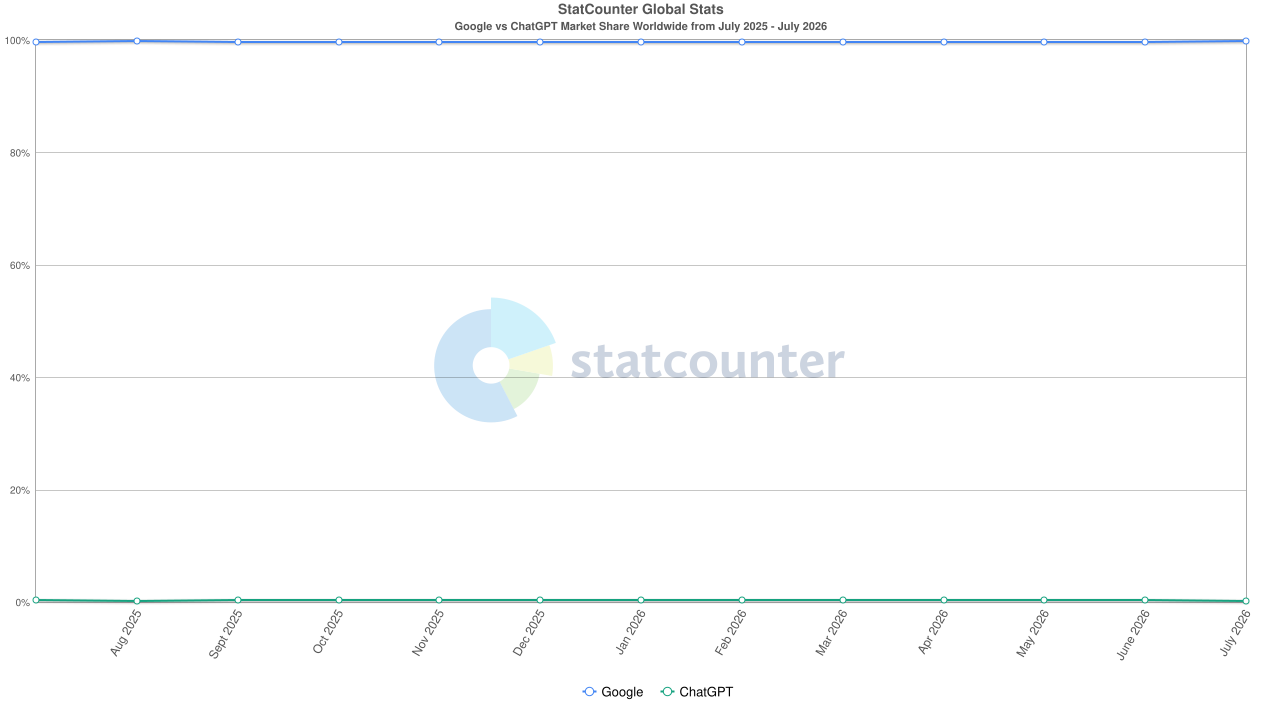
The data points to a clear yes, provided you have the right timeline and budget. Organic traffic from search engines is still the largest traffic provider in 2026, and with Google still sitting at +90% of the search market, SEO is still the most profitable marketing channel for small businesses (source: Statcounter).
Although AI Overviews answer users directly in the SERP and more than half of searches result in zero-click, organic search is the number 1 source of traffic in 2026.
Owners ask the same question every year: can a small shop really compete with giants, or will AI tools swallow search whole? The numbers say something different. Local and niche companies hold the advantage, not the giants, because they can speak directly to a specific customer’s exact need.
But the full truth carries a paradox. SEO pays off enormously for some businesses. It drains the bank account of others. The math decides which side you land on.
Why is SEO worth it for a small business? The real ROI math
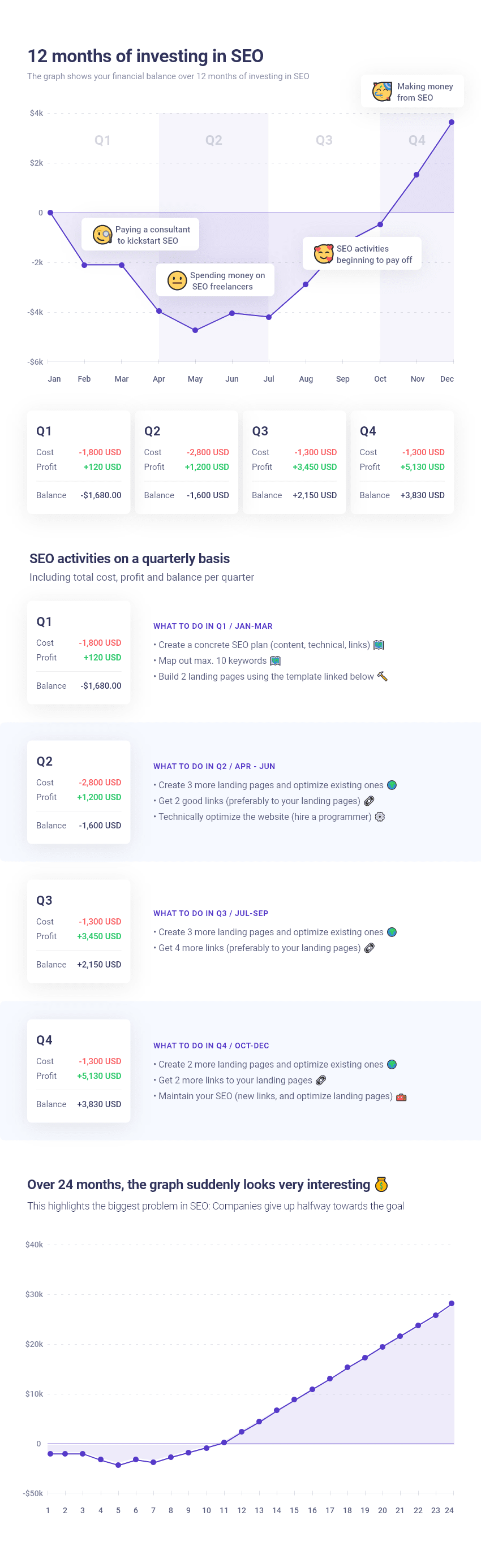
Many guides talk about visibility, but small business owners need to see the financial return. An SEO campaign will yield a positive return from month 11 if we assume that you invest $3,000/month – for example, a retainer to an agency.
Disclaimer: You don’t need to invest $3,000/month in SEO to see profit. Most small businesses invest less than that in SEO with success. The same profit percentage follows the investment.
Every single month that you keep investing in SEO after month 11 will grow your gross profit, and after 2 full years you’ll have a 7x return in profit. Want to get the same results? Then get our SEO tips specifically for small businesses.
Those numbers are even conservative, as we adjusted the results down with nothing less than 30% before we published our study. Just to be safe.
E-commerce stores and software companies also benefit from the compounding effect. You can see this clearly when looking at SEO for SaaS and IT startups. Paid ads get more expensive every year, whereas organic traffic gets cheaper per lead over time. You can learn exactly how to calculate SEO ROI for your specific industry using standard formulas based on your average order value and close rate.
Once you map out your customer lifetime value, you will quickly see what the value of SEO in 2026 looks like for your bottom line. Using Morningscore allows you to track your local keyword positions and estimate your organic traffic value.
You can see exactly how your rankings translate into monetary value based on current click-through rates. The numbers clearly show that organic search is highly profitable, but you must adapt to how people search today.
How AI Overviews and ChatGPT change the search market
Artificial intelligence is changing how users find information, but it is not replacing traditional search engines. Google still processes 8.5 to 9 billion searches per day. ChatGPT processes approximately 25 to 30 million search-like queries daily, while traditional search remains the dominant engine for commercial intent and local discovery.
In fact, ChatGPT, which is still the largest of the LLMs, has insignificant market shares when compared to Google (platform v. platform). Removing all other platforms from the calculation, Google sits on 99,78% of the market share vs. ChatGPT’s 0,22% (head-to-head).
Still, you need to adapt. AI Overviews pull from narrow, authoritative content. A page that chases a broad term like “florist” will lose. A shop that targets “sustainable wedding florist in Boston” will win, because that level of detail answers the exact question an AI model tries to summarize.
You can learn how to use AI for SEO to speed up your own keyword research and content planning and use free versions of AI models to analyze search intent and find long-tail opportunities that larger competitors ignore.
By targeting specific queries, you capture highly qualified traffic that converts at a higher rate. Research shows that long-tail keywords often convert approximately 2.5 times better than broad terms, and you will also face less competition and increase the chances of getting top rankings.
When is SEO worth it for a small business? The six-month timeline
An example: A small business owner in January. She hires an agency, pays the retainer, and waits for the phone to ring. Nothing happens in week one. Nothing happens in week three. By day thirty, she wants to quit.
SEO moves in phases, and owners who quit early die right before the payoff. SEO takes time, and business owners need patience and the right timeline
Month one builds the foundation. Fix the technical issues. Get every page indexed. Find the right keywords to chase. Watch impressions climb in Google Search Console. Fix broken links. Polish the Google Business Profile. Publish the core service pages.
Month two builds local citations. Lock down a consistent name, address, and phone number across the web.
Month three brings the first blog content, the kind that answers informational questions. A few rankings crawl from page five to page three. Traffic stays thin.
Months four through six bring the break-even point. Organic clicks climb. Keywords land on page one. Leads start to trickle in.
By month six, the early work compounds into steady traffic. If your business can’t survive six months without results, walk away from SEO and look elsewhere.
You can read more about how long SEO takes to work to set realistic expectations with your team.
When you should not invest in search engine optimization
Organic search is not a universal fix for every business situation. There are specific scenarios where investing in organic search will waste your money. Knowing when to avoid SEO as a strategy is just as important as knowing how to execute it.

First, skip this channel if you need leads in 30 days to make payroll. Organic search is a long-term game that takes closer to a year to be profitable.
If you need immediate phone calls, you need to run paid ads to jump to the top of the SERP. Second, do not start a campaign if your business has a poor operational reputation. If you have a 2.2-star average on Google, driving more traffic to your profile will not generate more sales. Fix your customer service and product quality first, and drop the old saying “launch crap, but launch” is not the way to go.
Third, avoid hiring an agency if your budget is under $500 per month. $500 retainers are not getting you real business results and monetary growth, but is rather for ongoing maintenance and small fixes to your website that, for most of them, don’t move the needle on SEO.
You are better off reading our DIY SEO for small business guide and handling it yourself. You can optimize your Google Business Profile and fix your on-page content without outside help.
Finally, if you plan to sell or exit your company within the next year, you will not be around long enough to reap the financial rewards. Understanding how much SEO should cost for a small business helps you allocate your marketing budget effectively. If you have the right budget and timeline, you can start building your foundation.
Essential steps to build a profitable organic foundation
You just need to execute the fundamentals consistently, and for that, you don’t need a large marketing or SEO team to grow in organic search. The most critical step for any brick-and-mortar or service company is local SEO. Claim and verify your Google Business Profile, fill out every field, upload photos weekly, and actively collect customer reviews – reviews are also very valuable for AI Search, so that’s a win/win.
Next, focus on your website content. Every service or product you offer needs its own dedicated page, fully described with what you offer, what the user gets out of it, where you provide services, how long it takes, what the price is, and other relevant information.
If you run an e-commerce store, product page SEO is vital to attract buyers when they know what they need. Write unique descriptions, include clear specifications and reviews, and make the pages load fast. On-page optimization is entirely within your control and does not require constant spending, and this alone will take you a long way.
Frequently asked questions about small business search marketing
Many founders have the same questions when deciding where to allocate their marketing dollars. Here are the most common concerns regarding organic search investments.
Do I need to hire an expensive agency?
No. Many companies handle their own optimization using software tools and internal staff. If you have a one-person marketing team, you can manage the basics like content creation and local profile updates. You only need an agency when you want to scale aggressively and have the budget to support a $1,500 monthly retainer.
At Morningscore, we have successfully schooled hundreds of non-experts to be able to handle all SEO aspects themself, so we know that with the right tools and guidance, you are able to skip the expensive agency fees.
Is SEO better than paid advertising?
They serve different purposes. Paid ads provide immediate visibility and stop the second you stop paying. Organic search takes months to build but offers a much lower cost per lead over time. The most successful companies use paid ads for short-term revenue while building their organic presence for long-term profitability, or as an extra layer of marketing.
How often should I audit my website?
You should perform an SEO audit every three to six months. Regular checks help you catch broken links, slow pages, and indexing errors before they cause a drop in your rankings. Or, you can just create a Morningscore account, add your website, and let Morningscore’s SEO checker tell you if or when issues appear.
What is the Morningscore metric?
The Morningscore metric is a simple calculation that shows the estimated monthly financial value of your organic traffic. It calculates what you would have to pay in Google Ads to get the same amount of clicks you currently get for free. This helps you prove the financial value of your optimization efforts to stakeholders.
Ultimately, answering the question if SEO is worth it for a small business comes down to your timeline, budget, and willingness to target specific niches. If you need immediate sales tomorrow, organic search will disappoint you. If you can invest consistently for six to twelve months, it becomes the most cost-effective marketing channel available, and it will even keep delivering results long after you stop investing. Start by securing your local profiles, writing specific content that answers exact customer questions, and tracking your progress with clear metrics.