
 Deutsch
 Dansk
Dansk Svenska
 Nederlands
 Español
 Lietuvos
ACTION_TAKEN: Updated the Jason Barnard external link to the correct redirect target URL with the trailing slash.
Key Takeaways
- You can use AI for SEO to brainstorm keywords, topics, and content outlines without needing deep technical skills.
- New models like GPT-5.4 and Claude Opus 4.6 help you analyze competitors and structure posts with massive context windows.
- Good prompts make the difference – treat AI as a helpful tool, not a replacement for your expertise.
- Focus on creating useful content for people, then let AI support the parts that save you time.
Are you a marketing manager but not exactly an SEO expert? Or maybe you know the basic SEO principles but lack the time and tools to optimize your content? ChatGPT might just become your new best friend in the pursuit of better Google rankings.
AI has become an indispensable tool in many aspects, and it’s here to stay in SEO. Recent data shows that 86% of professionals now integrate AI into their workflows. Embrace this development rather than resisting it.
With tools like GPT-5.4, you can enhance your online visibility and save time. You can optimize your content with precise keywords and targeted content that aligns with user search intent.
But what exactly is AI, and how can it be used in your SEO work?
In this post, we’ll take a closer look at how AI works and how you can use ChatGPT specifically to create effective and engaging content. We want content that ranks high in search engines, not generic, low-value material.
Disclaimer: Most people use ChatGPT incorrectly and end up delivering no valuable content. They only produce poor AI-generated material that fails to move the needle.
Remember: AI isn’t a replacement for your SEO Specialist or your own effort. Tools like ChatGPT and Claude are like a hammer for a carpenter – just tools.
AI technology may seem like a big step, but trust me – modern models make creating effective content simple. Let me show you how to use AI to boost your SEO without diving deep into technical jargon.
Since we founded Morningscore in 2018 in Denmark, we have built AI features for real-time data analysis, automated fixes, and content generation that deliver results for clients such as BambooHR.
What is AI in SEO, and why is it important?
AI, or artificial intelligence, is technology that allows machines to learn, think, and act in ways that resemble human intelligence. Modern systems like GPT-5.4 can analyze data and solve problems quickly and accurately.
For you, this means smart tools that can automate processes and improve decision-making. They open up new ways to optimize your work quickly and efficiently with a sharp focus on results.

AI plays a massive role in SEO in 2026. One of the great benefits is its ability to understand search intent. This helps you produce better keyword research and content mapping.
Danny Sullivan from Google states that SEO principles remain relevant even as AI advances.
Tools like GPT-5.4 and Claude Opus 4.6 generate optimized content and find relevant keywords. They can handle large-scale data, which is perfect for enterprise-level technical SEO tasks.
But there’s a “but”… The output you get is only as good as the input and context you provide. This is known as prompting. If you want a head start, you can read more on how to create prompts for ChatGPT here.
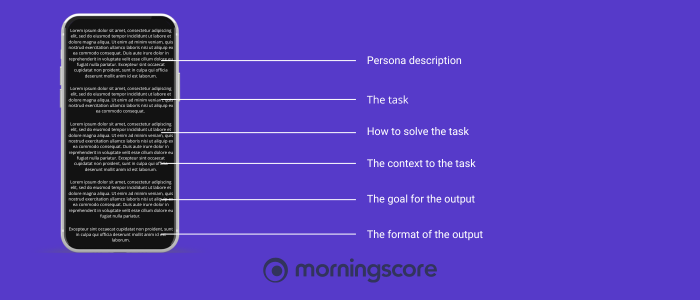
ChatGPT can analyze trends and identify the questions your customers often ask. This provides ideas for content that meets their needs and improves your visibility on Google.
At the same time, AI helps you analyze competitors and their writing style. It assists you in updating and enriching outdated content to improve your quality scores.
AI in SEO allows you to work smarter – not harder. It is about optimizing your strategy so you can spend time on the right things. Using AI for SEO makes your website more relevant, potentially leading to more conversions.
So, how can you use it practically? Let’s dive in.
Terms worth knowing
To understand all the terms used throughout this post, here’s an explanation of concepts:
- AI: Artificial Intelligence designed to mimic aspects of human cognition and reasoning.
- GPT-5.4: The latest advanced AI model from OpenAI, featuring a 1.05 million token context window.
- Claude Opus 4.6: A powerful model from Anthropic optimized for technical SEO and multi-agent workflows.
- GEO: Generative Engine Optimization. This focuses on making content visible in AI-driven search answer blocks.
- Prompting: The text or input you provide to an AI model to guide its response or action.
Research on topics and keywords
One of the first things ChatGPT can help you with is brainstorming relevant keywords. These can boost your visibility on Google significantly.
It’s simple: Ask ChatGPT to suggest popular topics in your industry. It can suggest synonyms and related search terms to create more varied and natural content.
AI tools don’t always have access to live organic keyword data like our keyword research tool. However, they are excellent for generating content ideas and semantic clusters.
You don’t necessarily need AI to perform keyword analysis, but it saves time on tedious tasks. It is great for finding the “seed” ideas for your strategy.
Use this prompt to get suggested keywords:
Generate 10 keywords I can write a targeted blog post about in the [your industry/topic] niche.
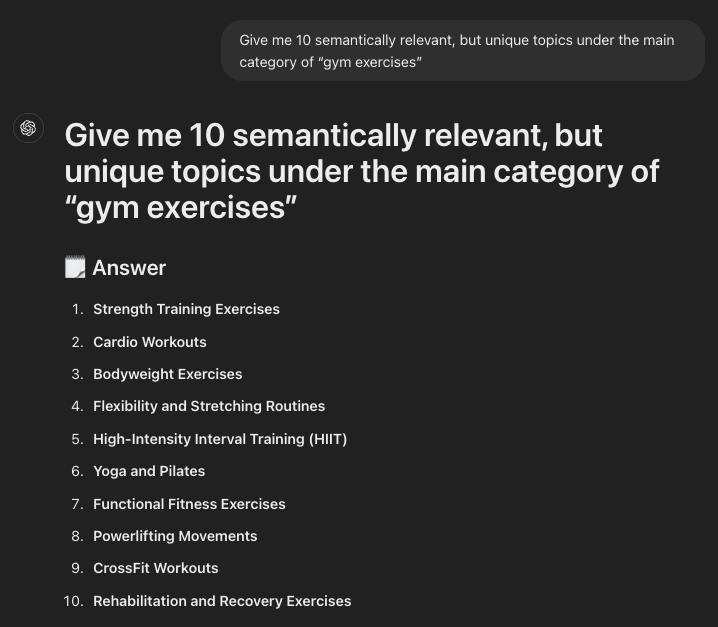
You can ask ChatGPT to provide you with a series of related keywords and topic clusters. This helps you build authority in your niche.
Use this prompt to generate blog post topics:
Give me 10 semantically relevant but unique topics under the main category [topic/keyword].
See more prompts for keyword research here.
Use AI tools for initial SEO content
AI can’t write perfect, original content that provides extreme value without your help. LLMs don’t know what they don’t know, so you must guide them.
However, ChatGPT is particularly good at helping you avoid “writer’s block.” It helps you get started when you are staring at a blank page.
Good content is the key to high rankings. ChatGPT can help you write engaging, informative drafts that your readers actually want to read.
You can use ChatGPT to generate drafts or write explanations that are easy to understand. At Morningscore, we also have an AI writer tool to create fully optimized articles.
The result? Texts that engage your readers and score points with Google.
So, how can you use it? Use AI to generate outlines, content structures, and ideas for headlines.
Once you have a complete article structured with headings, it becomes much easier to write the actual content. It saves a lot of time in the initial planning phase.
Use this prompt to create outlines:
I’m preparing an article titled [‘Your Page Title’]. Draft an SEO-friendly outline that structures the blog post and provides a sequential overview of topics to cover.
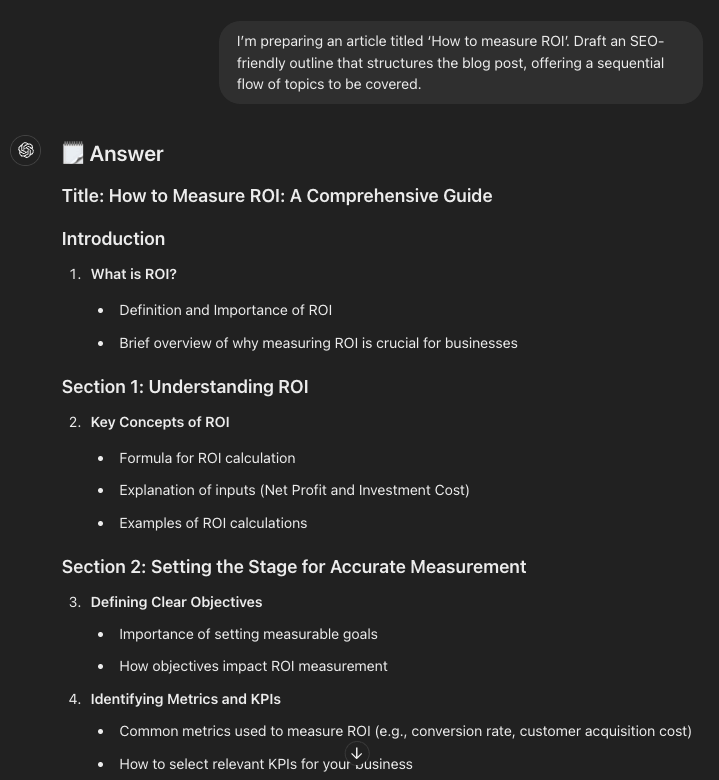
Use AI tools for schema markup ideas or to assist in rephrasing sentences. You can provide entire sections for the AI to rewrite to fit your brand.
Technically, GPT-5.4 can write a complete blog post, but it’s not a good idea to leave it at that. AI tools can still produce “fluff” or generic text if not carefully edited.
You’ll achieve a much better result if you use your AI tool for an outline and write the final content yourself. Or, at least edit the content heavily before publishing.
As an alternative, you could write the content yourself and ask ChatGPT to optimize it. You can ask for grammar corrections or to make the tone more engaging.
ℹ️ Good to know:
- Always review and edit text delivered by AI tools so it aligns with your tone of voice.
- Always fact-check information provided by AI, as 2026 models can still hallucinate.
- Add personal opinions and your own proprietary data to stand out.
- Always convert passive phrases to active ones for better readability.
See more prompts for generating SEO content here.
Specify tone of voice for writing
Have ChatGPT write in a style that suits your website’s universe. This makes the content feel more authentic to your audience.
First, establish a persona for ChatGPT. This is a profile that the AI will identify with, such as an industry expert or a friendly guide.
Always start by defining a persona by writing: “You are an experienced copywriter” or “You are a senior tech consultant.”
Then specify the context and the information the AI should use. Specify the text length and the desired writing style clearly.
Examples of writing style prompts:
- Creative
- Informal
- Academic
- Business
- Journalistic
Examples of tone prompts:
- Funny
- Professional
- Witty
- Bold
- Dramatic
Your prompt might look like this:
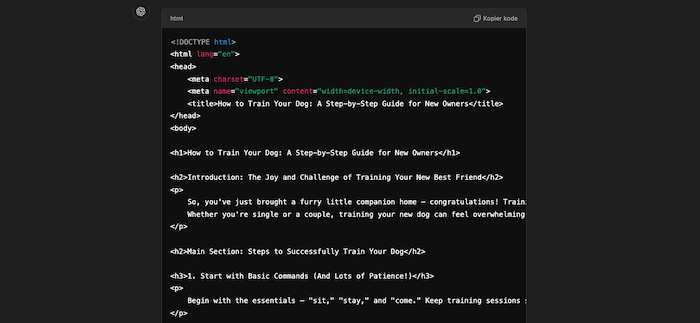
You are a skilled copywriter. Write a blog post explaining how to train a dog. The goal is to educate singles and couples who recently acquired a pet. Ensure the text has an ideal length based on industry standards. Write in an informal style with an engaging tone. Write in the first person with direct language. Always rewrite passive sentences. Create a catchy H1 title. Format the text using HTML and H2 subheadings.
Now you have a piece of content written in a style that suits your audience. It is ready for your final human touch.
Enrich your AI content with expert knowledge
Quality content can be created by both humans and AI. However, the best content always includes unique insights.
If you have used ChatGPT to produce a standard draft, you need to elevate it. You can do this manually or use AI to process expert sources.
One great method is to use videos or podcasts. Find a recording that specifically discusses the topic you’re writing about.
Transcribe the recording and upload the text to GPT-5.4. Ask the AI to enrich your initial draft with specific knowledge from the transcription.
This way, you upgrade standard AI content to high-quality material. It will include original expert insights that aren’t just generic web data.
Jason Barnard advises creating authoritative content that AI systems can quote.
Fact-check AI-generated content

AI can make mistakes, especially when gathering data about specific companies or people. It is crucial to fact-check all content before publishing.
Fact-checking a long post can be time-consuming. You can use AI to help with this by comparing text against known reliable sources.
Find one or two trusted articles on the same topic. Ask ChatGPT to fact-check your draft against these specific sources.
Ask the AI to highlight factual inaccuracies so you can correct them. This makes your workflow much more reliable than just trusting the AI’s memory.
Analyze and compare your competitors’ landing pages
Want to beat your competitors? You need to know what they do well and where they have weaknesses.
By using AI tools, you can easily gain insights into their strategy. Start by looking at their keywords and page structure.
Modern models can handle entire page transcriptions. Use this data to adapt your own landing page and create something even more effective.
Remember, it’s not about copying. It’s about learning and improving your SEO strategy.
Use this prompt to analyze your competitors’ content:
You are my SEO analyst. Analyze the content from the following URLs:
1) [URL 1] / {Content from page 1}
2) [URL 2] / {Content from page 2}
3) [URL 3] / {Content from page 3}
Get help with the “boring” SEO tasks
We all know the less exciting parts of SEO work. This includes checking for repetitions and ensuring the text is grammatically correct.
This is where ChatGPT saves you a lot of time. It often performs better than a human at catching small technical writing errors.
Ask ChatGPT to review your text and provide suggestions for improvements. This may include better word choice or smoother phrasing.
You can quickly make your content more professional. This avoids spending hours proofreading or paying high fees for a proofreader.
ChatGPT vs. Claude

Primary use cases in marketing and SEO
ChatGPT (GPT-5.4)
- Advanced Keyword Discovery: Excellent for finding clusters and optimizing for search intent.
- Content Planning: Provides structured outlines for complex campaigns.
- Technical Automation: Delivers content in JSON or HTML for technical SEO needs.
Claude (Opus 4.6)
- Enterprise SEO: Ideal for processing massive datasets and multi-agent workflows.
- Technical Reasoning: Superior at technical audits and complex data handling.
- Summarization: Excellent at condensing high volumes of research quickly.
Functionality
| Feature | ChatGPT (GPT-5.4) | Claude (Opus 4.6) |
|---|---|---|
| Intelligence | High reasoning with 1M+ token window | Top-tier technical and technical reasoning |
| Content structuring | Detailed outlines and data-driven plans | Summarizes information for easy understanding |
| API Costs | Approx. $1.25-$2 per 1k tokens | Approx. $5/M input and $25/M output |
| Prompt flexibility | Handles complex SEO multi-step tasks | Intuitive interaction and agent workflows |
Should you choose ChatGPT or Claude?
Both tools are effective for marketing and SEO tasks in 2026. GPT-5.4 is great for broad automation and drafting.
Claude Opus 4.6 is often preferred for high-level technical tasks and large data processing. Try both to see which matches your specific workflow.
FAQ
Do you need to be an expert to use AI in SEO?
No, AI tools are increasingly available to beginners. Many affordable solutions make it possible to leverage SEO without extensive technical knowledge.
AI assists with keyword mapping and SEO-friendly text. This allows smaller businesses to boost visibility effectively.
However, the real difference lies in “prompt engineering.” Being able to prompt in a precise way requires some time to learn.
How do you implement AI in SEO?
Implementing AI requires a hybrid approach. Human insight still plays an essential role in strategy. AI should suggest adjustments, but you make the final call.
How does AI help with keyword analysis?
AI identifies user intent much faster than a human. It can group questions into themes like “what” and “how,” which helps target specific audience needs.
What role does AI play in content optimization?
AI uses natural language processing (NLP) to analyze your competitors. It ensures your articles cover topics that others might have overlooked.
Google’s 2026 guidelines clarify that AI-generated content is permissible. The only thing that matters is that the content is helpful and high-quality.
Always edit AI content to add firsthand experience. This helps you demonstrate EEAT (Experience, Expertise, Authoritativeness, Trustworthiness).
Research by Diamante and Sturm shows that expert quotes significantly increase the likelihood of being cited in AI overviews within hours.
Does Google penalize AI-generated content?
No, Google does not penalize you just for using AI. They focus on quality and whether the content is useful for humans.
However, flooding the internet with low-quality content is an issue. If you publish hundreds of poor articles daily, your rankings will likely suffer.
How can AI help with competitor analysis?
AI analyzes backlinks, writing style, and content structure. Just provide the data to ChatGPT and ask it to find gaps in the competitor’s approach.
Can AI be used for link building?
AI can help identify link-building opportunities and automate outreach drafts. However, link building still requires manual effort to be truly successful.
How can small businesses use AI for SEO on a budget?
Small businesses can use the free versions of AI models for basic keyword research. It provides access to analyses that were previously only available to large agencies.
How can AI make SEO content more human-centered?
AI can make complex text easier to read. It can add clear summaries and tailor content to specific audiences, which improves the user experience.
Specify the role and tone clearly in your prompts. This ensures the output feels human-centered rather than robotic.
How can I track brand mentions in ChatGPT?
Tracking mentions in ChatGPT is easy in 2026. You can use a Morningscore account to access the ChatGPT citation tracker and monitor how AI mentions your brand.