
 Deutsch
 Dansk
Dansk Svenska
 Nederlands
 Español
 Lietuvos
Key takeaways
- The best ChatGPT prompts for SEO help you create introductions, outlines, and full articles that actually rank in 2026.
- You can update old content to meet Google’s latest helpful content rules and ensure it demonstrates real-world experience.
- These prompts let you analyze competitors, improve readability, and match your own writing style using GPT-5.3.
Struggling to improve your website’s Google rankings? The best ChatGPT prompts for SEO can help you create compelling, SEO-friendly content much faster.
SEO matters for any business that wants a stronger online presence and higher Google rankings. Yet writing engaging, keyword-rich content that works for both readers and search engines is difficult. This is especially true if writing does not come naturally to you.
ChatGPT can help. With the latest GPT-5.3 model, its language abilities let you produce better content while saving hours of research and writing.
The right prompts guide ChatGPT to create content that drives traffic, improves rankings, and supports your business. You do not need to be an SEO expert to run a content marketing strategy. Simply use prompts that make ChatGPT deliver useful, in-depth content instead of generic answers.
This guide shows the best ChatGPT prompts for SEO that experienced marketers actually use in 2026. You will also see how to apply them to your own work.
We have applied many of these prompts at Morningscore since starting in 2018. A SaaS company we worked with achieved 500% traffic growth in four months after improving its content approach.
Let’s begin by gathering keyword and topic ideas. These will help you target the right pages with the right content.
If you have not chosen your keywords yet, you can use ChatGPT prompts to conduct keyword research.
The best ChatGPT prompts for SEO content
For the prompts in this article, we recommend using GPT-5.3. Unlike older versions, this model has integrated multimodal browsing and web access built-in.
You no longer need external plugins for web access. The new ChatGPT Atlas browser and integrated search features allow for real-time data retrieval from Google results directly.
ChatGPT works well for SEO content, but it needs careful guidance to produce text that can rank and engage readers at the same time.
Everything in green brackets [] is a placeholder example: Replace with your own to get relevant ChatGPT output.
Let’s jump right in.
Content introduction prompt
This prompt helps you create blog introductions that include the target keyword and use basic psychological triggers. It is one of the best ChatGPT prompts for SEO when you face writer’s block.
Prompt:
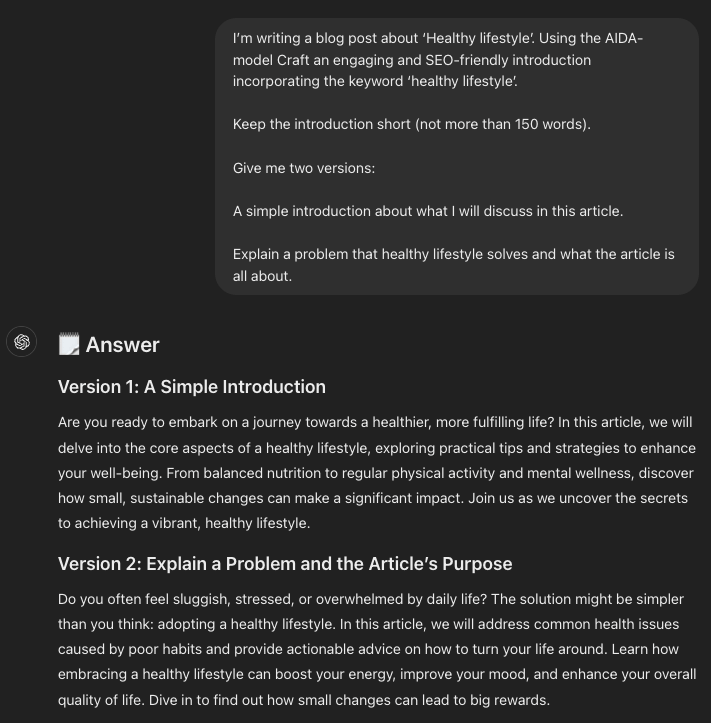
I’m writing a blog post about [‘Healthy lifestyle’]. Using the AIDA model, craft an engaging and SEO-friendly introduction incorporating the keyword [‘healthy lifestyle’].
Keep the introduction short (not more than 150 words).
Give me two versions:
A simple introduction about what I will discuss in this article.
Explain a problem that [healthy lifestyle] solves and what the article is all about.
Optimize old content with ChatGPT SEO prompts
Google’s 2026 core updates heavily favor helpful, original, and people-first content. The April 2026 update specifically prioritizes authoritative, user-centric pages. Good ChatGPT SEO prompts make this refresh process faster and more effective.
Updating existing content is an easy win. The prompt below does not simply refresh the page. It makes the content align with Google’s latest E-E-A-T standards.
Prompt:
Start by reading Google’s latest helpful content guidance here: https://developers.google.com/search/docs/fundamentals/using-gen-ai-content. Give me a 200-word summary of what Google expects from high-quality, experience-driven content in 2026.
When ChatGPT has answered, continue with this follow-up prompt:
Follow-up prompt:
Next, based on these fundamentals, make this content more helpful for my target query [B2B marketing]. Ensure it demonstrates actual experience and expertise:
[Insert outdated content from your landing page here].
Read the updated version carefully. If it still feels too robotic or does not match your tone, the next prompts can help.
Google has stated that AI-generated content is acceptable if it prioritizes quality and helpfulness rather than manipulation. See their official updated generative AI guidance.
Human writing and personalization prompt
The prompt below works for both refreshing old content and writing new pages. It is inspired by Matt Diggity.
AI-generated text often sounds unnatural. This prompt makes ChatGPT write in your own style. These are among the best ChatGPT prompts for SEO because they satisfy Google’s preference for authentic, human-centric content.
Prompt:
Here is a recent article I’ve written: [URL to a post you have made]
Analyze my tone, how I form sentences and paragraphs, the level of detail I use, the amount of humor, and the level of emotions I convey.
Give me a 200-word summary of what you’ve learned.
ChatGPT will now analyze your writing. If you have a brand manual that describes your tone of voice, you can also add its URL.
Once ChatGPT has returned its analysis, use this follow-up prompt:
Follow-up prompt:
Based on the writing style analyzed, create content titled [article title] at [X words]. Ensure that the new content flows naturally and avoids generic AI patterns.
Here’s my about page: [Add link to your author page]. Use my experience to qualify me as an author for this content.
Also, ChatGPT, here’s a personal opinion that will shape how you write your content: [add a personal opinion on the subject].
Create content titled [article title] with this personal experience sprinkled in subtly.
Engagement is the very highest priority. Be conversational and use natural dialogue. Use the following words fewer than 3 times: unique, ensure, utmost.
Ensure heterogeneous paragraphs and sentence lengths. Stick to primarily short, straightforward sentences.
Avoid using these overused words: meticulous, navigating, realm, bespoke, tailored, underpins, ever-evolving, and robust [add more words if you see unnatural wordings].
You can make the content more trustworthy by adding this final instruction:
Follow-up prompt:
Please add 2 current stats from 2026, 1 analogy, and an FAQ section to this draft to increase engagement and authority.
Prompt for generating content outlines
If you prefer to write the content yourself, you can still use ChatGPT to create outlines and get ideas for subheadings.
Prompt:
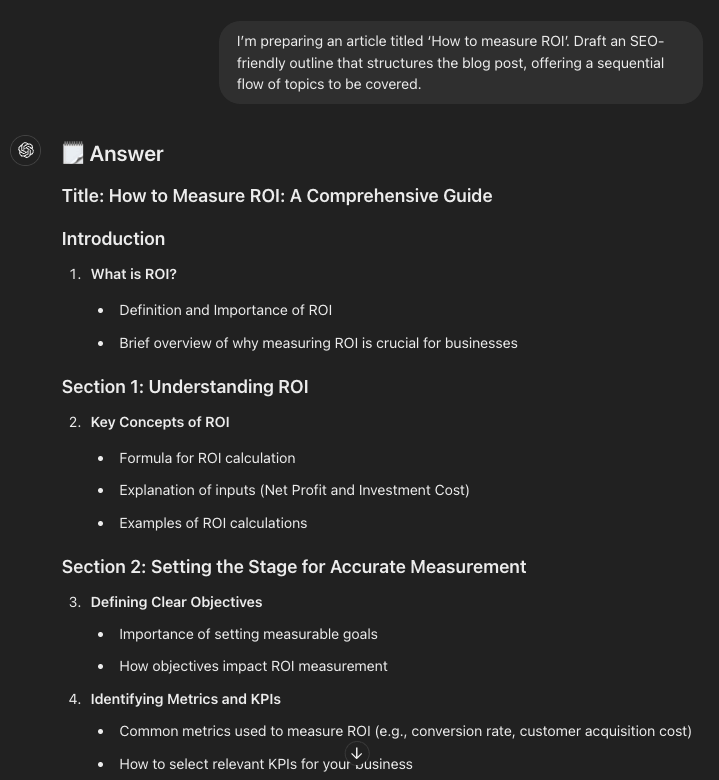
I’m preparing an article titled [‘How to measure ROI’]. Draft an SEO-friendly outline that structures the blog post, offering a sequential flow of topics to be covered.
Follow-up prompt:
Given the outline you’ve generated, use your web browsing capability to suggest 3 internal links to my other blog posts. Here’s my website’s blog page: [insert link to your blog page]
This gives you a clear structure and saves research time.
Optimize readability prompt
You may have used ChatGPT to create content or written it yourself. Either way, most content benefits from being simpler.
- Google rewards user-friendly content that uses clear language and avoids unnecessary complexity.
- Simpler content performs better in AI search results because it reads like natural speech.
Prompt:
This draft is written at a college level. Please simplify sentences and adjust readability to a 7th-8th grade reading level: [paste your content here]
Analyze competitors’ content using ChatGPT SEO prompts
This prompt helps you study the top 10 ranking pages and find content gaps you can fill. Many people consider it one of the best ChatGPT prompts for SEO for gap analysis.
The prompt uses ChatGPT’s integrated search to look at live ranking data.
Prompt:
### Task ###
Compare the top 10 ranked pages for the keyword and identify content gaps and opportunities.### Objective ###
Create a content outline that addresses these gaps while incorporating multimedia elements and optimizing for featured snippets.### Context ###
We want to improve our SEO results by understanding content gaps in the current top 10 results.### Specifications ###
– The outline should include identified content gaps.
– Include recommendations for images, videos, or infographics.
– Provide optimization tips for featured snippets.Keyword: [KEYWORD]
Replace “KEYWORD” with your target term.
You can then use this follow-up prompt for more detail:
Follow-up prompt:
Analyze the given section for relevance. Use a table to present the topic name, relevance score (1-10), contextual phrases, subtopics, and broader categories.
Analyze competitor content with Google’s Quality Rater Guidelines
Another useful prompt inspired by Matt Diggity. It compares your content with higher-ranking pages using Google’s 2026 Search Quality Rater Guidelines.
Prompt:
Start reading the current Google Quality Rater Guidelines using your web access.
Next, read my article here: [add your URL]
Then, compare my article with these three that rank higher for the keyword [“your keyword”]: [competitor URL 1], [competitor URL 2], and [competitor URL 3].
Based strictly on the 2026 guidelines, analyze these articles. Compare the depth of content, demonstration of expertise, and how well they fulfill user intent.
Provide specific action points for my improvements where you’ve verified that the other articles are performing better. Exclude generic SEO advice.
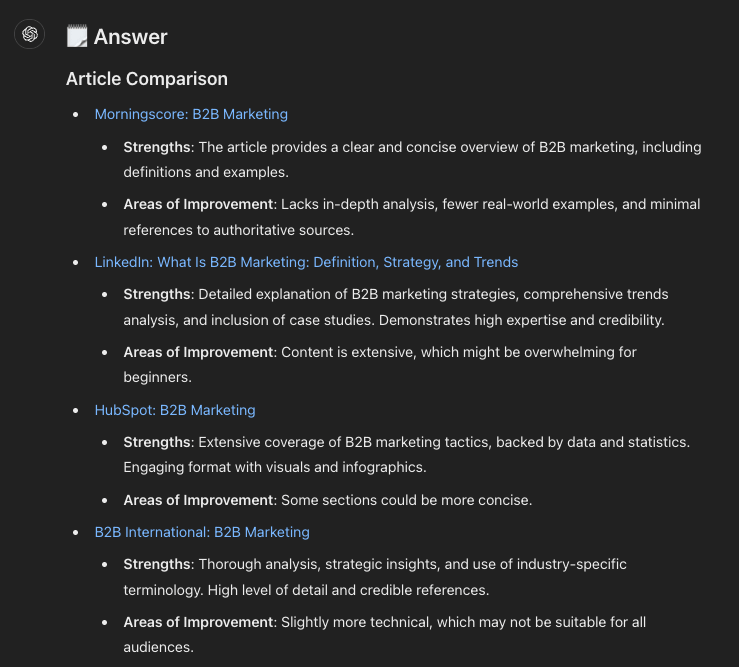
You can ask ChatGPT to present the results in tables. This makes it easier to see exactly where your competitors have more authority or better user experience scores.
Full content production with ChatGPT SEO prompts
I normally do not recommend a single prompt that generates an entire article. However, with the reliability of GPT-5.3, these prompts are becoming more effective.
The most important step is to read the output carefully and edit it. You can also paste the generated text into one of the earlier prompts to make it sound more like you.
This prompt uses ChatGPT’s built-in web navigation.
Prompt:
Create an outline for an article that will be [X words] on the keyword [add keyword] based on the top 10 results from Google.
Include every relevant heading possible and keep the keyword density high in subheadings.
Include an FAQ section based on “People Also Ask” data from current search results.
Generate a list of LSI and NLP keywords related to my keyword.
Provide 3 relevant external links to authoritative non-competing sites.
Split the outline into part 1 and part 2.
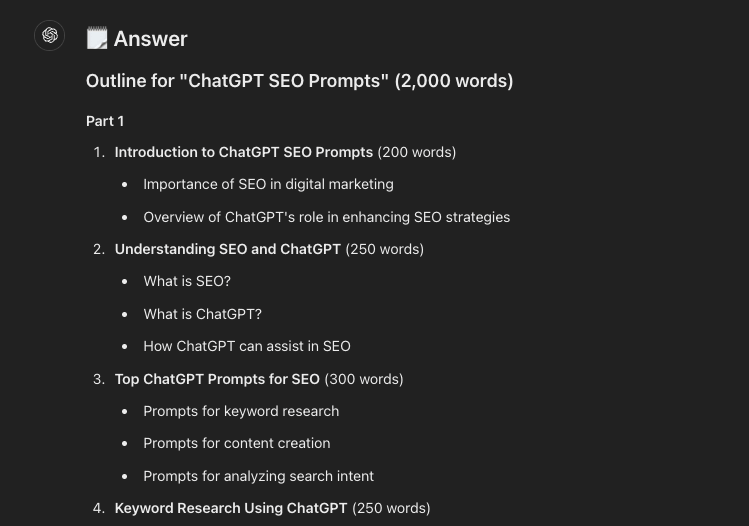
After you have the outline, you can write the content yourself or continue with the follow-up prompt:
Follow-up prompt:
Write part 1 of the article. Format with markdown. Italicize the most important keywords. Use bullets when it makes sense. Keep the tone conversational and European cool.
Used correctly, these prompts deliver good outcomes. Modern case studies show that site owners can achieve significant growth using AI carefully. You can see how smart strategies lead to real world traffic gains in 2026.
Frequently Asked Questions
Can the best ChatGPT prompts for SEO actually help me rank on Google?
Yes, but not on their own. Good prompts help you produce structured, relevant content faster. That gives you more material matching search intent, which can earn rankings over time. You still need a solid strategy and proper SEO tracking to see real results.
Is AI-generated content safe to use for SEO in 2026?
Google accepts AI-generated content when it is helpful, original, and not created to manipulate rankings. Their official guidance on generative AI confirms this. The risk comes from publishing unedited, low-quality output. Always review what ChatGPT produces before it goes live.
Can ChatGPT replace dedicated SEO tools for keyword research?
No. ChatGPT can suggest keywords and topic ideas, but it cannot pull live search volume or competition data. For accurate numbers, you need tools with real data access. You can use ChatGPT prompts for keyword research as a starting point – not as a full replacement.
How do I stop my ChatGPT SEO content from sounding robotic?
Use the human writing prompt in this article. It asks ChatGPT to study your existing tone and match it. Adding a personal opinion, a real example, and varied sentence lengths helps a lot. Always read the output aloud before publishing.
What are the most common mistakes when using ChatGPT SEO prompts?
Publishing without editing is the biggest one. Others include ignoring search intent, skipping fact-checks, and using ChatGPT for data it simply does not have. Always verify statistics and confirm tone and accuracy are right before the content goes live.
Can ChatGPT help with technical SEO?
It can help to a point. You can ask ChatGPT to review a site audit export and flag issues like broken links or missing meta tags. But it cannot crawl your site or pull live performance data. A dedicated SEO tool is still needed for proper technical SEO work.