 Deutsch
 Dansk
Dansk Svenska
 Nederlands
 Español
 Lietuvos
More website traffic means more opportunities to turn visitors into customers, but only if that traffic is relevant. Visibility in the right places, for the right people, is what makes traffic valuable.
Getting more traffic to your website comes down to one core action: making it easy for the right people to discover your site and find what they are looking for. Organic search plays a major role, accounting for 47% of website traffic in one recent SE Ranking study. This makes SEO (Search Engine Optimization) one of the most effective ways to build a steady stream of website traffic.
The challenge is now knowing where to start and what deserves your time. Some improvements are quick wins, while others require more effort but can build traffic over the long term.
The list below takes you through the highest impact areas, from the fundamentals and low hanging fruit to content strategies, search visibility, and other effective ways to attract more relevant visitors.
TL;DR
Website traffic grows when you improve your visibility across search, AI platforms, and other channels where your audience discovers information. Start with your technical SEO foundation, create content that matches search intent, build authority through links and mentions, and keep improving your existing pages. With consistent effort, these activities can build a sustainable source of qualified traffic over time.
Key takeaways
- Focus on relevant traffic, not just more traffic: The goal is to make it easy for the right people to discover your website at the right moment.
- Make sure your website is accessible: Fix technical issues, indexing, mobile usability, speed and site structure before investing heavily in new content.
- Create content that matches what people are looking for: Understand what your audience needs and build useful content that directly answers their questions.
- Prioritize quality over quantity: A smaller number of genuinely useful, trustworthy pages can create more value than constantly publishing new content.
- Get your business visible beyond your own website: Build authority through backlinks, brand mentions, reviews, PR and other channels where your audience discovers information.
- Adapt to how people search today: Optimize not only for traditional search, but also for AI-powered search and other emerging discovery channels.
High-payoff actions to get more website traffic
More traffic starts with being visible in the right places, for the right people, at the right time. This list covers how to get in front of the right people, roughly ordered by impact and time required.
Some opportunities are quick to act on, while others require more thought and ongoing effort. Together, they cover the main ways to build visibility and attract more of the people who are most likely to matter to your business.
1. Claim your Google Business Profile for local search
If your business serves customers in a specific area, local SEO can help you capture searches beyond the traditional blue links. Google reserves a separate set of results, often called the map pack, for local searches like “near me” queries. This section appears above the standard organic results and is where many local customers make their decision.
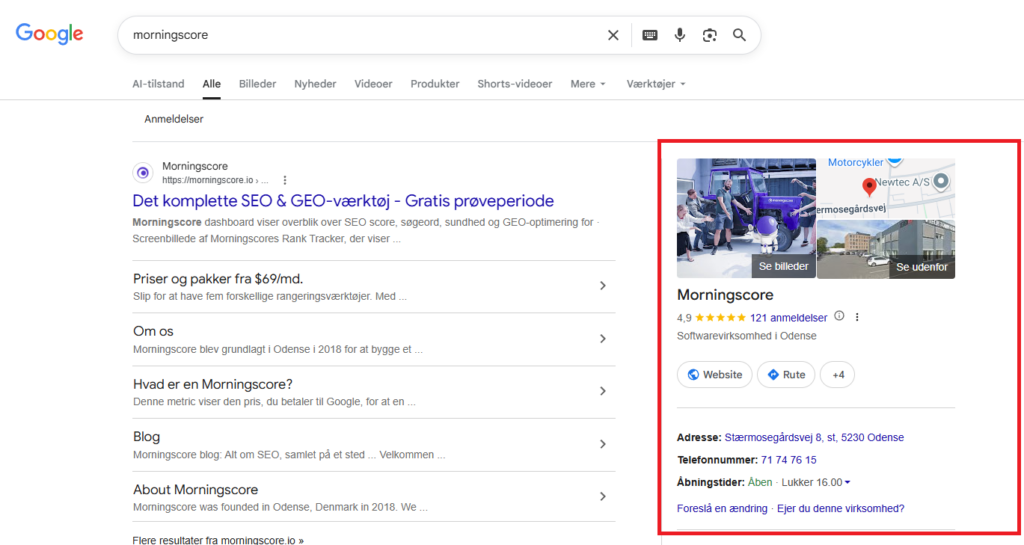
Claim and fully complete your Google Business Profile with accurate hours, categories, photos, and your website link. Encourage customers to leave reviews, since review volume and recency both influence your local ranking. This is one of the fastest wins available to a small business, because it requires no content writing and can start sending traffic within days rather than months.
2. Build your SEO foundation
Strong content cannot compensate for technical problems. Before you publish new pages, confirm that search engines can crawl, understand, and index the website you already have. Most technical improvements only require occasional maintenance, but they continue creating value long after you implement them.
⚠️ Reminder: If your website does not get any traffic at all – check out our guide to solve issues related to no website trafic.
2.1. Secure your website
Run your website over HTTPS and make sure it performs well on mobile devices. These are baseline requirements for modern SEO – not competitive advantages.
Visitors quickly lose trust in websites that display security warnings or break on smaller screens. Search engines also use security and mobile usability as quality signals, making both essential for strong rankings.
Review your site on different devices, screen sizes, and browsers. Fix layout issues, improve readability, and ensure navigation works smoothly on touch screens. Every visitor should have the same experience regardless of the device they use.
➡️Pro tip: Test on actual devices, not just browser emulators. Mobile layout issues often only show up in practice.
2.2. Fix technical errors holding you back
Search engines cannot rank pages they struggle to crawl or understand. Technical issues reduce visibility long before content quality becomes a factor.
Regularly audit your website to identify problems such as:
- Crawl errors: Crawl errors happen when Google cannot access a page on your website, for example because the page is broken, missing, or returning a server error. These issues can prevent Google from discovering and indexing your pages. Find them in Google Search Console and fix the underlying URL or server issue.
- Indexing issues: Indexing is the process Google uses to store and include your pages in its search index. Issues such as accidental noindex settings, incorrect canonical tags, or technical errors can keep pages out of Google’s results. Find these issues in Google Search Console and fix the settings on the affected pages.
- Robots.txt issues: Robots.txt is a file on your website that tells search engines which parts of your site they are allowed to crawl. Incorrect rules can accidentally block important pages from being crawled. Check your robots.txt file by adding /robots.txt to the end of your website address (www.yourwebsite.com/robots.txt), and make sure it does not block important pages that you want Google to crawl.
- XML sitemap issues: An XML sitemap is a file that lists the important pages on your website and helps search engines discover them. A missing, outdated, or incorrect sitemap can make it harder for Google to find your pages. Check your sitemap and submit it through Google Search Console.
- Redirect issues: A redirect is a link or URL that automatically sends you to another URL, for example when a page has moved from /old-page to /new-page. Broken redirects can send visitors to an error page, while redirect chains can send them through several URLs before reaching the right page. Find them with an SEO tool and make sure redirects point directly to the correct, working URL.
- Duplicate pages / canonicalization issues: Duplicate pages are different URLs that show the same or very similar content. A canonical tag tells Google which URL should be treated as the main version when several URLs contain the same content. Find duplicate pages and canonical tags in your SEO tool, then set the correct canonical URL or redirect duplicate pages to the main URL.
- Slow-loading pages / performance issues : A slow-loading page takes too long to display its content or become usable. Slow pages can cause visitors to leave and can hurt your search performance. Check your pages with Google PageSpeed Insights and fix the issues it identifies, such as large images, unnecessary code, or slow server response times.
- Core Web Vitals problems: Core Web Vitals are three measurements Google uses to evaluate how quickly a page loads, how quickly it responds when someone interacts with it, and whether the page moves around while loading. Poor scores can mean a frustrating experience for visitors. Check your scores in Google Search Console -> Core Web Vitals and use PageSpeed Insights to identify and fix the specific problems.
Resolve these issues before investing time in producing additional content. Every technical improvement increases the likelihood that Google can discover, index, and rank your pages efficiently.
Treat technical SEO as the infrastructure that supports every other optimization effort. Without a solid foundation, even exceptional content will struggle to reach its full potential.
3. Build your content strategy
Publishing more content does not automatically generate more traffic. Every page needs a clear purpose and a specific audience. Instead of competing for broad, high-volume keywords from day one, focus on topics your ideal customers actively search for and that you have a realistic chance of ranking for.
A targeted content strategy is an important part of content marketing and can help you attract more qualified traffic over time. Each high-quality page expands your topical authority, creates new internal linking opportunities, and attracts qualified visitors who are more likely to convert.
3.1. Understand what your customers search for (search intent)
Search intent is the primary goal or purpose a user has when typing a query into a search engine.
Understanding and matching search intent is critical because search engines strictly prioritize pages that deliver the most accurate and immediate answer to the user’s specific need. If your content fails to match what the user is looking for (for example, providing a lengthy blog post to someone who simply wants to buy a product), search engines will not rank your page – no matter how well-written it is.
To align your content with search intent, follow these steps:
- Search your target keyword: Enter the specific term you want to rank for into Google.
- Analyze top-ranking results: Examine the top 3-5 search results to identify what users expect:
– If product pages rank: Create a transactional product or landing page.
– If guides or tutorials rank: Write an educational, comprehensive article. - Match and improve the format: Structure your page using the same primary content type, but provide a clearer, higher-quality answer than existing competitors.
By systematically matching search intent, you remove guesswork from content creation and make sure your pages satisfy both search engine algorithms and prospective customers.
⚠️ Reminder: Match the format Google already ranks for that query. A perfectly written article won’t rank for a transactional keyword if Google wants to show product pages.
3.2. Run a competitor keyword gap analysis
Competitor research removes guesswork from keyword research. Instead of brainstorming topics, analyze two or three competitors that already rank for the audience you want to reach. Compare their keyword profiles against your own to identify keywords they rank for that you do not.
These gaps often reveal your best opportunities.
Prioritize keywords that:
- Closely match your products or services.
- Show clear commercial or informational intent.
- Have relatively low competition.
- Support existing content clusters on your website.
A keyword gap analysis turns thousands of possible keywords into a prioritized roadmap based on proven demand rather than assumptions.
Here is an example of how we use Morningscore to find relevant content optimze after.
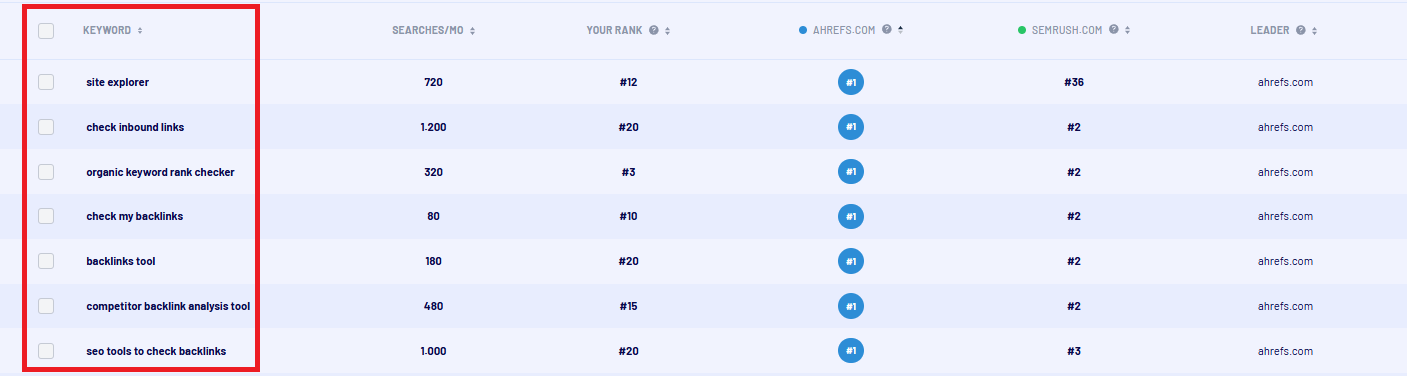
- Start by running a competitor gap analysis to identify high-value keywords where rival sites currently outrank us. (Check the list above to gauge relevance).
- Once we uncover those missed traffic opportunities, we audit our existing pages and optimize the content to beat their rankings.
- If we do not have existing pages on the topic, we create brand-new content to capture that search traffic.
⚠️Remember: Always stay realistic about who your competitors are. Even with high-quality content, massive authority sites will usually hold an advantage. Focus on targeting competitors of a similar size to your own business, where you have a genuine chance to compete and win top rankings.
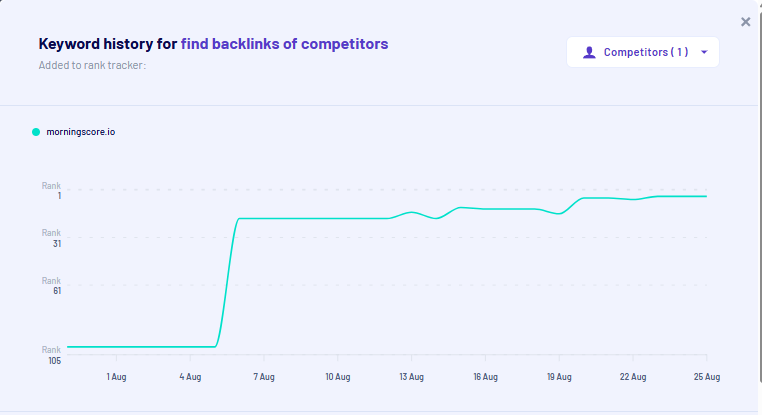
Example from our work: A couple of months ago, we identified that we were not ranking for ‘Find backlinks of competitors’, which has 1,900 monthly searches in the US. We then created a landing page targeting that keyword, which resulted in us ranking 5th two months later – driving relevant traffic to our site from our competitors.
3.3. Target low-competition keywords first
Many businesses target the largest keywords first. Unfortunately, those keywords usually have the strongest competition.
Instead, build momentum by targeting specific, long-tail keywords.
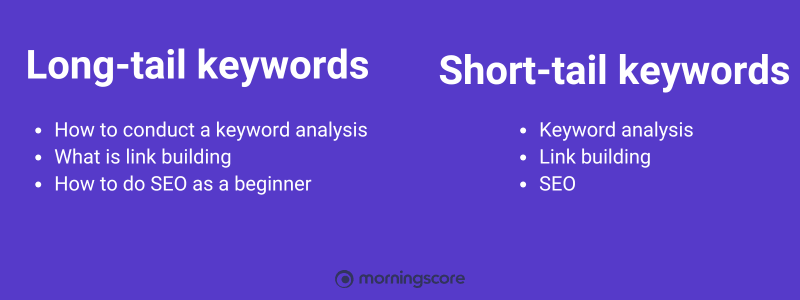
Long-tail keywords are specific, multi-word search phrases that target narrow topics. They attract lower search volumes than broad keywords, but they convert better because they reflect a clear searcher intent. Someone searching for “cheap black mercedes glc in copenhagen” knows exactly what they need, making them far more valuable than someone searching for just “mercedes“.
As your website gains authority, Google becomes more willing to rank your pages for broader and more competitive searches. Each page that ranks for a long-tail keyword increases your overall website authority, making future rankings easier to achieve.
➡️ Pro tip: Long-tail is a stepping stone, not the end goal. Use the authority it builds to go after broader keywords later.
3.4. Turn comparable topics into listicles
A listicle is a page structured as a numbered or bulleted list of distinct, comparable items, each with its own short section, rather than one continuous block of text.
For example:
- 7 Ways to increase website traffic
- 10 Best SEO tools
- 15 common SEO mistakes
Listicles perform well because they match how people search. Queries like “best seo tools” or “ways to increase traffic” naturally call for multiple options rather than a single answer, and a numbered list satisfies that intent. The structure also makes it easier for Google to understand the page and for AI systems to retrieve, compare, and cite individual sections when generating answers.
A well structured listicle gives one article multiple opportunities to appear in search results. Different sections can rank for different long tail queries or be cited independently in AI generated responses, while the format itself encourages concise writing by forcing each section to answer one question. Readers also benefit because they can scan the page and jump directly to the information they need.
Use listicles when the topic is naturally a collection of comparable items, such as tools, tips, mistakes, examples, or alternatives. Avoid them when answering a single complex question or explaining a process that depends on a fixed sequence of steps, since a traditional guide is usually easier to follow.
An example from our own work: In January, we created the page “Best Free Video Transcription Tools“, where our CEO, Karsten, tested 7 free video transcription software tools. It was a relatively simple article sharing personal insights with the internet. Seven months later, that single article brings us 141 monthly visits from the US alone via Google, plus additional traffic from other countries, search engines, and AI chats.
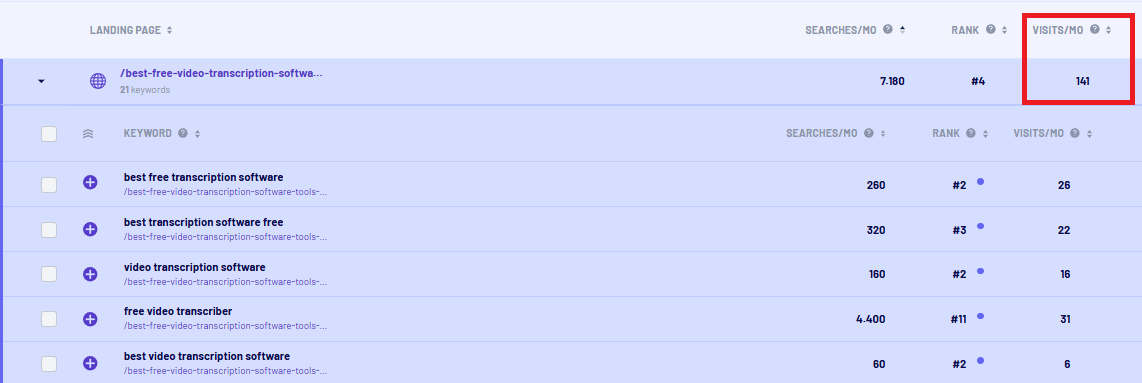
In total, it has generated over 1.3k unique visitors and resulted in 22 sign-ups for our tool (data as of August 26th).
4. Create content
Once you know which topics and strategies to target, it’s time to actually create the content. This is where your plan turns into pages people can read and search engines can rank – but doing it well takes more than just writing. Good content needs to be well-structured, easy to navigate, and genuinely useful to the person reading it, while also being built in a way that search engines can understand and trust. In this section, we’ll walk through what it takes to create content that performs.
4.1. Write good content:
Great content is the foundation that everything else in SEO builds on. You can have perfect technical setup, strong internal linking, and a flawless keyword- & content strategy, but if the actual page fails to satisfy the person reading it, none of that will carry you to the top of search results – and even if it does briefly rank, visitors will bounce straight back to Google looking for a better answer.
Search engines have gotten increasingly good at recognizing that signal, which means content quality has become one of the biggest factors separating pages that rank and hold their position from pages that spike briefly and fade. Writing well for SEO comes down to genuinely serving the visitor: giving them a complete, well-organized answer they can trust and act on, without unnecessary fluff or padding.
Below are the key things to watch for when reviewing or writing a page.
- Do not use keyword stuffing: Is when a keyword is repeated unnaturally throughout a page to try to rank higher. Search engines can easily detect this, and it makes the content harder to read. Use the keyword naturally where it fits, and rely on related terms and phrasing to reinforce the topic instead.
- Watch out for keyword cannibalization: Keyword cannibalization happens when multiple pages on the same site target the same keyword or search intent, causing them to compete against each other and split ranking signals. Make sure each page has a clear, singular purpose.
⚠️Disclaimer: Cannibalization actively hurts you – Google splits ranking signals across competing pages, so both can rank worse than one would alone. - Use semantic keywords: Semantic keywords are related terms, synonyms, and topically relevant phrases that support your main keyword. Including them helps search engines understand the full context of the page and signals that the content covers the topic comprehensively, not just a single phrase.
- Content depth: Refers to how thoroughly a page covers a topic, including the subtopics and questions a visitor is likely to have. Look at what’s already ranking and make sure your page provides at least as much value.
- Content length: Content length is simply how long a page is. Rather than aiming for a specific word count, let the topic and search intent determine how much is needed – some pages need a few hundred words, others need several thousand to fully satisfy the query.
⚠️Disclaimer: There’s no magic word count. Let search intent and competitor coverage set the length – not a fixed number. - Page structure: Is how the content on a page is organized and laid out, from introduction to conclusion. Use headings to break the content into sections, and make sure each section builds naturally on the last so the page is easy to follow.
- Content formatting: Content formatting refers to how the text itself is presented – paragraphs, lists, tables, bold text, and images. Good formatting makes the page easy to scan and helps readers quickly find the information they’re looking for.
- E-E-A-T and personality: E-E-A-T stands for Experience, Expertise, Authority, and Trustworthiness (will be covered later in the text) the qualities search engines look for as signals of content quality. Adding a genuine voice and perspective, rather than generic, interchangeable text, builds credibility with readers and reinforces these signals.
- CTA (call-to-action): A CTA is a prompt that guides readers toward a next step, such as signing up, reading another article, or making a purchase. A clear, relevant CTA turns a page that simply informs into one that also drives results.
- Page experience and readability: Make sure the content is easy to read, the main information is easy to find, and unnecessary pop-ups, ads, or other elements do not interfere with the content.
Example of good an bad content
Good content example
“If you’re choosing a running shoe, start with where and how you run. Road runners usually benefit from lightweight shoes with good cushioning, while trail runners need more grip and protection. Your foot shape and running style also matter, so look for a comfortable fit rather than choosing a shoe simply because it is popular. If possible, try the shoes on before buying.“
Why this is good:
✅ Natural keyword use: “running shoe” is used naturally rather than repeatedly.
✅ Semantic keywords: Includes related terms such as road runners, trail runners, cushioning, grip, foot shape, and running style.
✅ Content depth: Answers several relevant questions instead of giving only a basic definition.
✅ Clear structure: Information follows a logical order.
✅ Useful and actionable: Gives the reader practical advice.
✅ Personality/trust: It speaks directly to the reader and avoids generic language.
✅ No unnecessary length: It provides enough information without padding.
Bad content example
“Looking for the best running shoes? Our running shoes are the best running shoes for running. Running shoes are important because you need good running shoes when you run. The best running shoes have running shoe cushioning and running shoe comfort. Buy the best running shoes today to get the best running experience!”
Why this is bad:
❌ Keyword stuffing: “running shoes” and “best running shoes” are repeated unnaturally.
❌ Poor semantic coverage: It barely discusses anything beyond the main keyword.
❌ No content depth: It doesn’t explain how to choose a shoe or address the reader’s needs.
❌ Weak page structure: The sentences simply repeat the same idea.
❌ Little value: The reader learns almost nothing useful.
❌ Generic voice: It sounds like text written primarily for search engines.
❌ Weak CTA: “Buy today” is not supported by useful information that would help the reader make a decision.
Good content is the combination of relevant keywords, thorough coverage, clear structure, and a genuine voice, all working together to answer what the visitor came for. Get these fundamentals right, and the rest of your on-page and off-page SEO efforts have something solid to build on.
4.2 Improve your internal linking
Internal links are hyperlinks that target another page on the same website. They help search engines understand how your content connects, distribute authority across your website, and guide visitors toward related information.
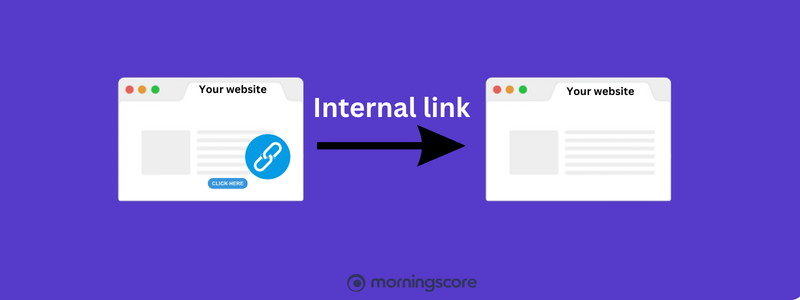
Whenever you publish a new page, link to it from relevant, authoritative pages that already receive traffic. This helps search engines discover the content faster while passing contextual authority.
Use descriptive anchor text that clearly explains what readers will find after clicking the link. Instead of generic phrases like “click here” or “read more,” describe the destination using natural language.
A logical internal linking structure also improves user experience. Visitors can explore related topics without returning to search results, increasing engagement and helping search engines understand your site’s hierarchy.
Clear internal connections make it easier for both users and search engines to navigate your content.
4.3. Fix on-page issues
Once you have chosen the right topics and created your content, the next step is to make sure each page is properly optimized for the search query you want to rank for. On-page SEO covers the elements directly on a page that help search engines understand its topic, relevance, and structure, while also making the page more useful and easier to navigate for visitors.
Review your pages for common on-page issues such as:
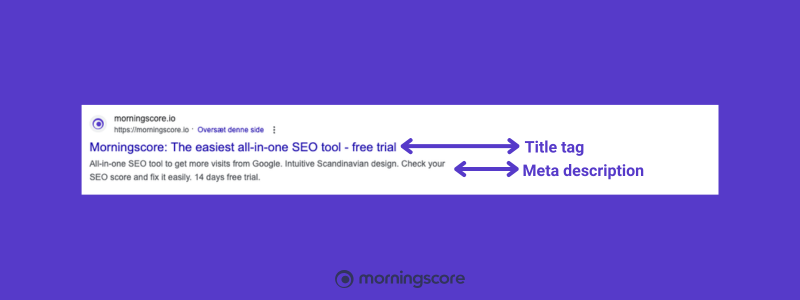
- Title tags: Title tags are the titles search engines show in results pages. Keep them clear, relevant, and between 150–160 characters, so they fully describe the page without getting cut off.
- Meta descriptions: The short description shown below a page title in search results. Make sure each page has a relevant, unique description that accurately explains what visitors will find on the page. It should be 160 characters, compelling and include a CTA.

- Headings: Headings are the titles used to divide your content into sections, such as H1, H2, and H3 headings. They help readers scan the page and help search engines understand how the content is structured. Make sure the page has one clear H1 for the main topic (is your websites title) and use H2 and H3 headings to organize the sections underneath it (sidetitles).
- SEO-friendly URL structure: The web address of each page, also called slug. Keep URLs short (under 75 characters), readable, and relevant to the page topic, and avoid unnecessary numbers, parameters, or confusing structures. “Etc. use ‘/what-is-an-airplane’ instead of ‘/dhdjfh8u94w9ghsdg’.”
- Oversized images: Images that are larger than necessary for the space in which they are displayed. Compress them with tinypng.com and resize them before uploading them to reduce page weight and improve loading speed. Try and keep them under 100kb
- Broken links: Links that lead to pages that no longer exist or cannot be reached. They create a poor user experience and can make it harder for search engines to navigate your website. Find broken links with an SEO health tool and update or remove them.
- Alt tags: Text that describes an image for search engines and visitors who cannot see the image. Add concise, descriptive alt text to meaningful images and avoid adding keywords that do not describe the image.
- Low Page Score: A low Page Score indicates that a page has several SEO or performance issues that need attention. Use an SEO audit tool to identify the specific problems and fix the highest-impact issues first.
Working through these on-page issues will steadily improve how search engines and visitors experience your pages. Start with the highest-impact fixes – title tags, meta descriptions, and broken links usually make the biggest difference – then handle the rest as ongoing maintenance.
If you have a larger website or aren’t working with SEO full-time, fixing all of this manually can be time-consuming – that’s why Morningscore created a SEO plugin that makes solving these issues much easier.
4.4. Refresh and update your existing content on a schedule
Publishing new content should not come at the expense of improving pages that already perform well.
Every article gradually becomes outdated – statistics change, screenshots become obsolete, competitors publish new information, and search intent evolves.
Review your most valuable pages on a regular schedule.
During each update:
- Replace outdated statistics and references
- Add new insights and examples
- Expand sections that lack depth
- Improve internal links
- Refresh screenshots and visuals
- Remove outdated recommendations
- Update the publication year when appropriate
Refreshing existing content often produces faster ranking improvements than publishing entirely new articles because Google already understands the page and has historical performance data.
Treat every successful article as an asset that deserves ongoing investment rather than a one-time publication.
For example, we regularly update our article “Best SEO Tools” article. Every year, we update the text and year, re-test all the tools for new features, and add any new or improved software. This keeps the article stays fresh, relevant, and valuable to readers – which Google rewards with strong rankings, ultimately driving more traffic.
👀 Insight: Updating an old page often outranks a new one faster – Google already trusts the URL and has historical performance data to build on.
5. Match what Google rewards
Google aims to rank the most helpful and trustworthy content for every search. Focus on creating content that demonstrates real experience, answers users’ questions clearly, and provides unique value. These qualities align with Google’s ranking systems and improve your chances of earning visibility in both search and AI-powered results.
5.1 Write from experience
Google wants to rank content that demonstrates E-E-A-T (Experience, Expertise, Authoritativeness, and Trustworthiness). While E-E-A-T is not a direct ranking factor, it reflects the qualities Google looks for when evaluating whether content is credible, accurate, and helpful.
The strongest way to demonstrate E-E-A-T is through first-hand experience. Instead of repeating information that’s already available, explain how you solved the problem, what worked, what didn’t, and what others can learn from your experience. These original insights make your content more valuable and much harder for competitors to replicate.
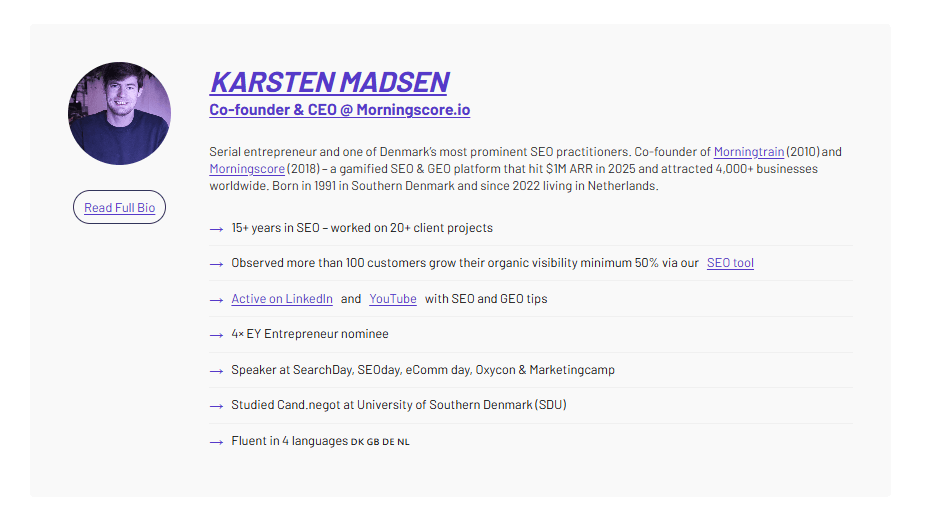
You should also make it clear who created the content. Publish articles under a real author rather than your company name alone, and include an author profile that highlights the person’s role, experience, qualifications, and expertise on the topic. This helps readers understand why they should trust your advice and provides search engines with additional signals about the credibility of your content. For example, our CEO, Karsten, has a bio under articles he has written, showing his experiences and expertise – at the same time this gives authority and trustworthiness.
Support your content with reliable sources whenever appropriate, keep your information accurate and up to date, and make it easy for users to verify who is behind your website. Together, these signals strengthen your site’s E-E-A-T and improve its ability to compete for high-value search queries.
👀 Insight: E-E-A-T isn’t a ranking factor Google checks directly – it’s a proxy. Named authors with real credentials are a trust signal humans and algorithms both respond to.
5.2 Answer questions immediately
Users click search results because they want answers, not introductions. Structure your content using the inverted pyramid: give them the main answer immediately, then expand with context, examples, and supporting details.
This structure improves the user experience and makes your content easier for search engines to understand and index. Avoid burying key information several paragraphs down the page. The faster users find what they are looking for, the more useful your content becomes.
5.3 Publish original research whenever possible
Original research gives your website something no competitor can copy.
If your business collects proprietary data, turn it into reports, surveys, benchmarks, or industry studies. Original statistics attract backlinks, earn media coverage, and give other websites a reason to cite your content instead of someone else’s.
Not every business has unique data to publish, but when you do, treat it as a competitive advantage. Original research strengthens your authority and creates assets that continue earning links and citations long after publication.
⚠️ Remeber: Only worth it if you have proprietary data. Otherwise it’s wasted effort – put the resources into content instead.
6. Optimize for AI Search and LLMs
Optimization for AI search, often referred to as GEO (Generative Engine Optimization), follows many of the same principles as traditional SEO because AI systems rely heavily on content that already ranks well in search. The difference is that platforms such as ChatGPT, Google AI Overviews, Perplexity, and Gemini generate answers by extracting and citing information from multiple sources rather than presenting a list of links.
To increase your visibility, structure your content so search engines and AI systems can easily understand, extract, and cite it.
6.1 Make sure AI crawlers can access your site
The most important thing to be found in AI search is making sure the bots behind it can access your pages. ChatGPT, Claude, Perplexity, and others all send automated bots to read websites before referencing them in an answer. If a bot can’t reach your page, none of your content, keywords, or authority matters – the page simply doesn’t exist for that AI system.
Almost every website has a file called robots.txt. It’s a simple text file that tells bots which pages of your site they’re allowed to visit. It’s usually set up once, when the website is built, and rarely looked at again. The problem is that AI bots are new, and old versions of this file were written before they existed – so many websites block them without anyone deciding to.
On top of that, AI companies often use two separate bots: one that reads your site generally, and one that checks a specific page in the moment someone asks a question. Your site can allow the first and block the second without you knowing, which means an AI can be aware your business exists but still can’t open your page to answer someone’s question.
How to check:
-
- In your browser, go to yourdomain.com/robots.txt
- AI bots have their own names, similar to a username. Use Ctrl+F (or Cmd+F on Mac) and search for: GPTBot, ClaudeBot, and PerplexityBot.
- If you find one, check the line right below it. It will say either “Allow” (the bot can visit your site) or “Disallow” (the bot is blocked).
- Found “Disallow” next to any of these? That bot is blocked. Ask your developer or hosting provider to remove that rule.
- Don’t find any of these names at all? That’s normal – it usually means no rules have been set for AI bots, and they’re free to visit.
- If your site uses Cloudflare, there’s one more place to check: log into Cloudflare -> go to Security -> look for a setting about blocking AI bots or scrapers. This can block AI bots even if your robots.txt file allows them
A five-minute check that can remove a silent ceiling on your AI-driven traffic.
⚠️ Reminder: Check BOTH robots.txt and Cloudflare bot settings. Robots.txt can allow a bot while Cloudflare still blocks it.
6.2 Structure your content with Atomic Answers
AI models don’t read pages the way people do. They identify the most relevant passage, extract it, and use it to answer a question. Make that process easy, and structure your content around clear questions and answer each one immediately. Keep the initial answer concise, then expand with examples, explanations, or supporting details.
For example, instead of opening with a long introduction, answer the question in the first paragraph:
What is an airplane?
An airplane is a powered vehicle with fixed wings that flies through the air. It carries people and cargo across long distances and connects communities, businesses, and cultures around the world.
While this builds on the same “answer-first” logic covered earlier in section 5.2, the execution for AI is slightly different. Section 5.2 uses the inverted pyramid to keep human readers engaged as they scroll down a page. For AI models, an atomic answer must function as a complete, independent unit of information so LLMs can easily extract, process, and cite it when pulled out of context.
6.3 Get visible on UGC-platform (Reddit and Quora)
UGC (User-Generated Content) platforms like Reddit and Quora are online communities where real users ask questions, compare options, and seek authentic advice. Platforms like these have become some of the primary training grounds and primary live-data sources for modern AI models. LLMs (Large Language Models) and AI search engines heavily prioritize UGC content when answering user prompts, frequently citing these community threads to summarize real-world consensus, product recommendations, and first-hand experiences that traditional marketing pages cannot provide.
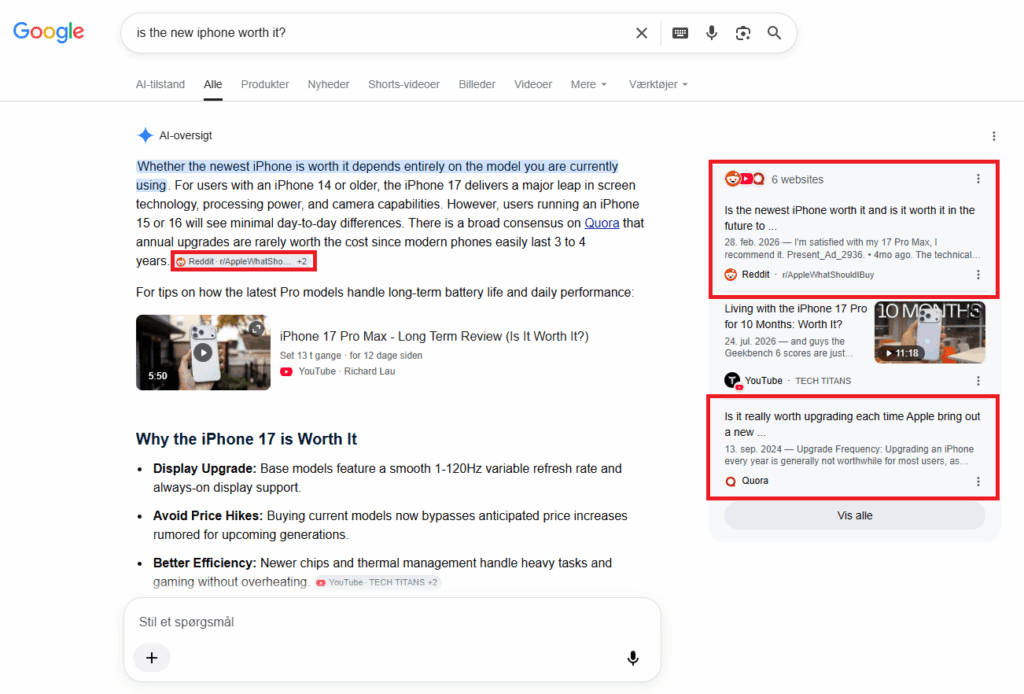
To build visibility within AI responses, monitor the discussions in relevant subreddits and Quora topics, identify recurring questions, and contribute where you have genuine expertise. Don’t lead with a link or try to sell your product. Focus entirely on helping people solve problems. Your presence in AI search results comes as a result of consistently adding value and establishing community trust, not promoting yourself.
6.4 Build a strong presence on review platforms
Review platforms do more than influence purchasing decisions. They also provide independent signals that help search engines and AI models evaluate your business’s credibility.
Claim your profiles on the review platforms that matter in your industry and keep them up to date. Encourage satisfied customers to leave honest reviews, respond to feedback, and maintain accurate business information across every platform.
Strong reviews won’t replace great content or backlinks, but they reinforce your reputation and make it easier for both users and search engines to trust your business.
Some relevant platforms to get reviews on:
- Google Business Profile: Essential for local visibility and often the most important review source for businesses serving a geographic market.
- Trustpilot: Suitable for businesses across almost every industry and useful for building customer trust.
- G2: Valuable for SaaS and B2B software companies.
- Capterra: Useful for software businesses comparing solutions.
- Tripadvisor: Important for hotels, restaurants, attractions, and travel businesses.
- Yelp: Still influential for local businesses, particularly restaurants, services, and retail.
- Clutch: Ideal for agencies, consultancies, and IT companies
- Glassdoor: Primarily an employer-review platform, but a strong employer reputation can also contribute to overall brand credibility.
- Apple Maps / Bing Places: Worth keeping accurate alongside Google, particularly because their business information feeds other discovery experiences.
- Industry- or country specific directories relevant to your company.
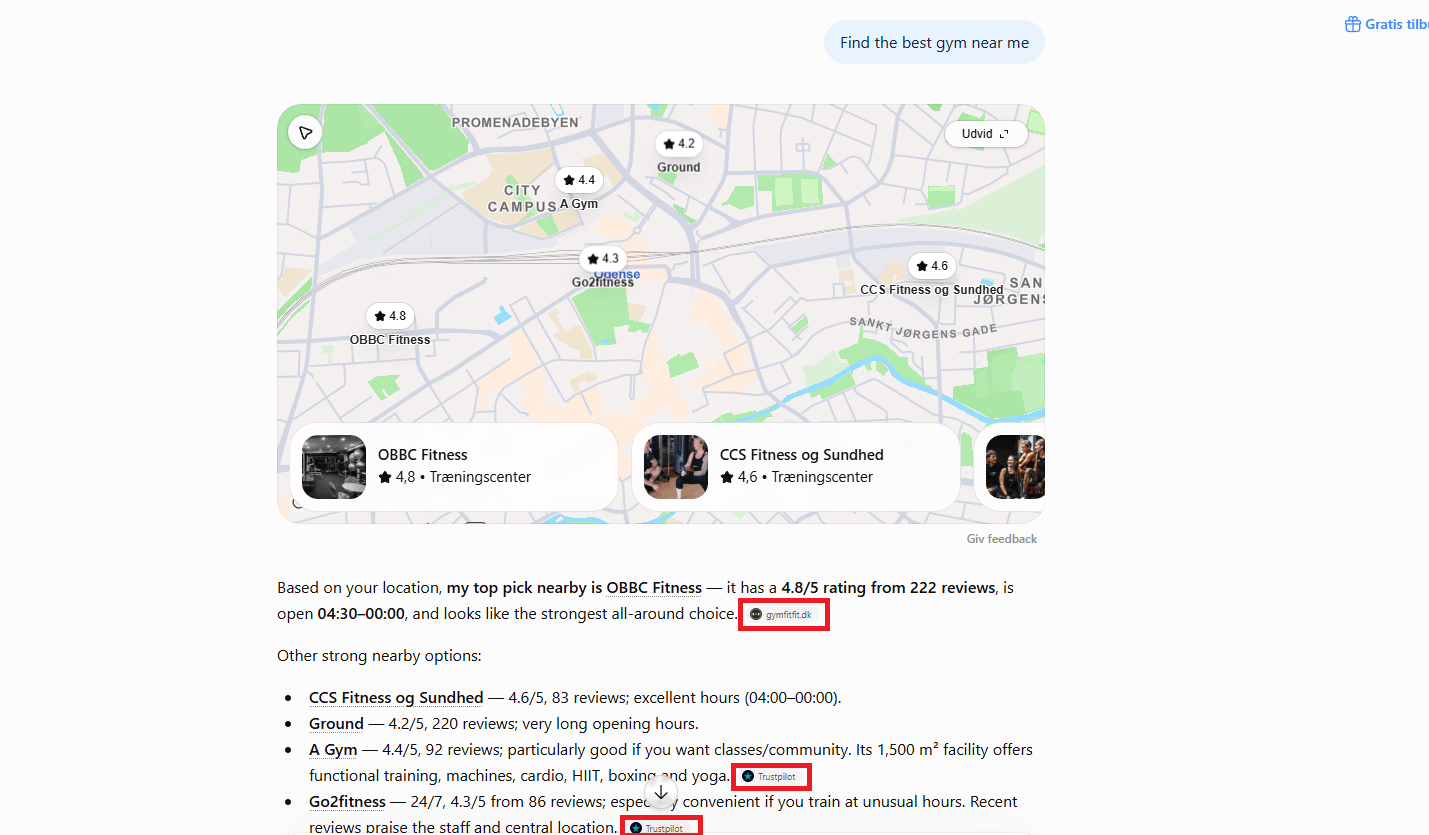
Here is an example of how ChatGPT uses both Truspilot and and a local Danish industry platform in their answers.
7. Earn backlinks
Search engines treat links from other websites as a vote of confidence, and pages with more quality backlinks tend to rank higher. You do not need hundreds of links, just a handful from sites that are genuinely relevant to your industry. While there are many types of backlinks, we will focus on the highest-quality ones.
7.1 Guest post and pitch digital PR
Guest posting and digital PR are two of the most reliable ways to earn editorial backlinks.
A guest post is an article you write for another website. In return, you typically receive an author bio and one or more contextual backlinks. Digital PR works differently. Instead of writing for the publisher, you give them a reason to write about you – whether that’s original research, proprietary data, a case study, an expert opinion, or a newsworthy story.
The common denominator is that you’re earning coverage instead of creating links yourself.
Start by creating something another website would actually reference. A survey with 2,000 responses, a benchmark report, or a unique dataset gives journalists and editors a reason to mention your business. Once you have that asset, identify the publications your audience reads and pitch a story that fits their editorial focus. Generic outreach emails rarely work because they ask for coverage without offering anything worth publishing.
⚠️ Reminder: Outreach before you have something worth covering rarely works. The asset (data, research, story) has to exist first – journalists don’t cover companies, they cover stories.
7.2 Get featured in listicles and comparison pages
Listicles and comparison pages are articles that compare products within the same category, such as ‘Best affordable cars’ or ‘Top 10 restaurants in Copenhagen’.
They often rank well because they help users evaluate their options before making a purchase, and they are already far along in the buyer’s journey. If your competitors are consistently featured while your business is missing, you’ve identified an opportunity.
Contact the publisher with information that genuinely improves the article, such as a feature they’ve overlooked or an outdated comparison they’ve made. If no useful comparison exists in your niche, publish one yourself – as mentioned in 3.4 of this guide.
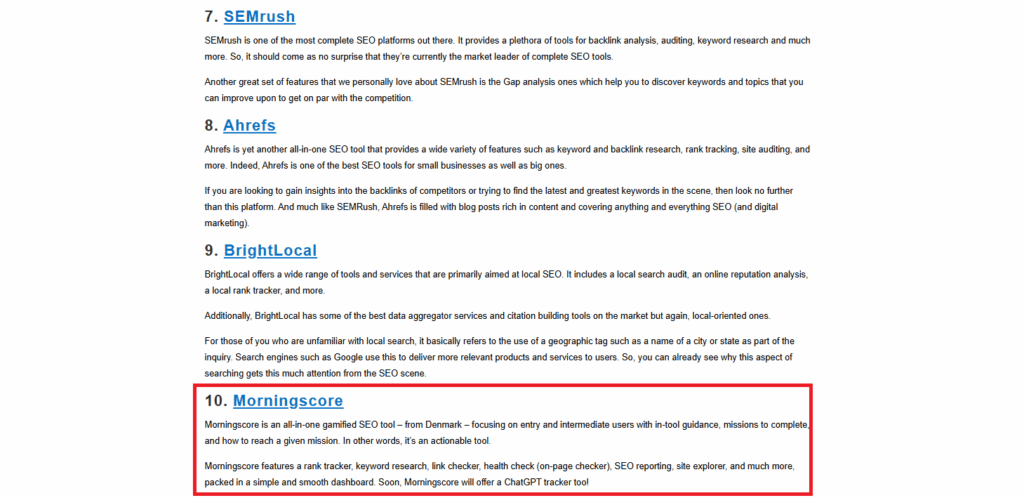
Here is an example where we reached out to the owner of the listicle, who then included us in the post. This gave us great PR and a backlink, while ensuring we didn’t lose ground to our competitors. At the same time, the author got a stronger, more in-depth article that creates value for them and their traffic.
8. Build brand mentions and PR
Brand mentions and digital PR increase your visibility beyond your own website by getting your business featured on trusted third-party platforms. This includes industry publications, podcasts, newsletters, interviews, conference talks, expert roundups, and other authoritative sources where your audience already looks for information.
These mentions help search engines and AI models understand that your business is recognised and discussed within your industry. While backlinks remain the stronger ranking signal, unlinked brand mentions also reinforce your authority by showing that other trusted sources consider your business worth referencing.
Focus on creating stories, research, insights, or expertise that publishers want to feature. Every mention strengthens your brand’s credibility, expands your reach, and complements your backlink profile – even when it doesn’t include a link to your website.
👀 Insight: Unlinked mentions still count for something. AI models and search engines increasingly read brand mentions as a trust signal even without a clickable link.
9. Diversify into alternative content channels
Your website does not have to be the only place people first encounter your business, and some of the most reliable traffic sources bring people in through a side door rather than a search result.
9.1 Publish video content on YouTube
YouTube is the world’s second-largest search engine, and Google regularly includes videos directly in its search results. Instead of treating YouTube as a separate marketing channel, use it to extend the reach of content you’ve already created.
A simple workflow is often enough:
- Identify articles that already perform well in search.
- Turn each article into a short, informative video covering the same topic.
- Link to the article in the video description.
- Embed the video back into the article.
This approach helps you reach a wider audience without creating two completely different content strategies.
9.2 Build a free tool or resource
Most articles provide information that users read once and move on from.
Useful resources such as calculators, templates, checklists, guides, or other interactive tools solve a specific problem repeatedly. Because they provide practical value, people are more likely to share them, link to them, and return to them when they need help again.
Examples could be:
- Budget calculators
- Planning templates
- Checklists
- Comparison tools
- Cost estimators
- Industry guides
- Counters like word counter (see example under), calorie counter etc.
9.3 Start an email list you own
Unlike search engines and social media platforms, an email list is an audience you own. Every subscriber has chosen to receive updates from your business, giving you a direct communication channel that isn’t affected by algorithm changes or declining organic reach.
Use your newsletter to distribute new content, announce product updates, share industry insights, or promote webinars and events. As your list grows, email becomes one of the most reliable ways to bring engaged users back to your website and generate recurring traffic.
9.4 Paid advertising for immediate visibility
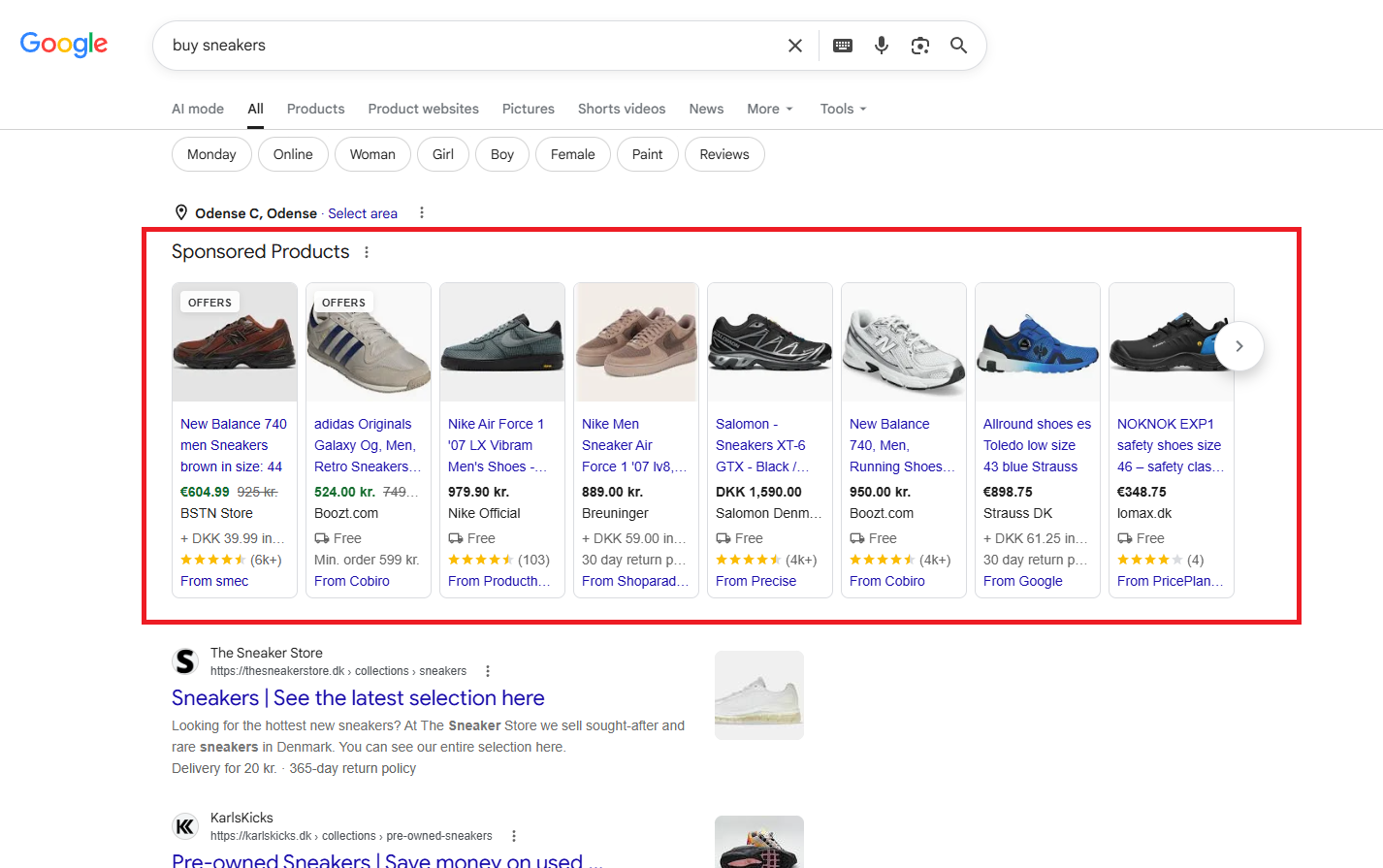
Paid advertising means paying platforms such as Google, Facebook, Youtube etc. to show your website to potential customers. Instead of relying on your pages appearing naturally in search results, you pay to have your ads displayed when people search for relevant keywords or meet specific targeting criteria.
The main advantage is speed. Paid ads can generate traffic almost immediately, making them useful when you want to promote a new product, reach a specific audience, or drive traffic while your organic visibility is still growing. You can also control your budget, target specific keywords, and measure exactly how many visitors and conversions your campaigns generate.
The downside is that paid traffic depends on your budget. Once you stop paying, the traffic usually stops as well. Competitive keywords can also become expensive, and poorly targeted campaigns can quickly waste money without generating valuable visitors.
9.5 Social media as a way to build traffic and your brand
Social media allows you to reach potential customers where they already spend their time. By sharing useful, entertaining, or relevant content, you can build an audience and create additional opportunities for people to discover your website and business.
There are many different social media channels, and the right ones depend on your target audience and business:
- Facebook: Useful for reaching broad audiences, sharing content, and building a community around your brand.
- Instagram: Well suited for visual content, products, behind-the-scenes content, and building brand awareness.
- LinkedIn: Particularly useful for B2B businesses, professional content, and establishing expertise.
- TikTok: Can help businesses reach new audiences through short, engaging video content.
- Pinterest: Can be effective for visual products and content where users are actively looking for inspiration and ideas.
Social media is also a valuable channel for strengthening your brand and interacting directly with customers. Answering questions, responding to comments, sharing customer experiences, and participating in relevant conversations can build trust and make your business more recognisable. While these activities may not result in immediate website clicks, they can strengthen customer relationships, increase brand awareness, and influence future purchasing decisions.
The main advantage of social media is the ability to build an audience and maintain an ongoing presence around your brand. The downside is that it requires consistent effort and content creation, while the amount of website traffic generated can vary significantly between platforms and industries.
➡️ Pro tip: Focus on the platforms where your target audience is most active instead of trying to be present everywhere. Consistent, useful content is more valuable than posting on every channel without a clear purpose.
10. Measure and iterate
You cannot improve what you do not measure, and search behavior is changing quickly enough that a strategy worth reviewing once is worth reviewing again in a few months.

10.1 Diagnose your performance
Before you start optimizing your website, you need to understand where your SEO stands today. A diagnosis helps you identify what is already working, what is underperforming, and which issues should be fixed first.
Open an SEO tool and review your websites current situation. Check which pages rank, which keywords generate clicks, whether your important pages are indexed, and if there are technical issues affecting your visibility. Look for pages that rank on page two, pages with high impressions but low click-through rates, and content that has little or no organic visibility. These are often the easiest opportunities to improve.
The goal is not to analyse every metric, but it is to build a prioritized list of issues and opportunities before you begin making changes.
Choose an SEO tool that fits your business and the way you work. Morningscore is one option, but depending on your needs, tools like Google Search Console, Ahrefs, or Semrush may be a better fit. Compare the different platforms in our guide to the best SEO tools.
10.2 Monitor performance and improve your strategy
SEO is not a one-time project, but a long-term endeavour. Search results change constantly as competitors publish new content, Google updates its algorithms, and search demand shifts. Regularly reviewing your SEO performance helps you spot new opportunities before your competitors do.
Set aside time to review your website on a weekly or monthly basis. Focus on questions like:
- Which keywords or pages are gaining visibility?
- Where are competitors improving or losing ground?
- Which content deserves to be updated or expanded?
- Are there new keyword opportunities within your existing topics?
- Which SEO activities are creating the biggest business impact?
- Is our strategies working and what needs to change?
The goal is to understand what is changing in your market and use those insights to refine your SEO strategy. Over time, this helps you prioritize the right projects, react faster to competitors, and uncover new growth opportunities instead of simply maintaining your rankings.
Instead of switching between multiple reports, use one platform to keep track of your rankings, competitors, opportunities, and overall SEO progress. A clear overview makes it easier to spot changes, prioritize your next actions, and stay focused on the work that creates results.
A real-world example: How we get creative
I want to finish this list with a real example of how we apply some of the principles above. Our SEO foundation is well optimized, and we’re constantly creating relevant content, but we’re also competing with much larger companies with significant resources dedicated to SEO and marketing.
So, how can a small company like ours stand out and attract traffic?
One answer is to think beyond our own website. For examle, our CEO, Karsten, created an AMA (Ask Me Anything) in a relevant Reddit thread in r/SEOgaps, answering questions about SEO and what it takes to build a business.

This is a simple but effective way to demonstrate several important SEO and GEO principles:
- E-E-A-T: Showing that Karsten is a real person with genuine expertise and first-hand knowledge of the topic.
- Brand mentions: Getting Morningscore mentioned naturally in relevant conversations outside our own website.
- Social media and UGC platforms: Using an established platform like Reddit to reach an existing audience and participate in relevant conversations.
- AI visibility: Creating useful, trustworthy information on platforms that AI systems can discover and potentially use as sources.
- Contributing value to the wider internet: Providing useful and informative answers, even when the content is not published on our own website.
- Engaging with relevant people: Taking part in conversations with people who genuinely have an interest in SEO, the industry, and potentially Morningscore.
- Building brand awareness: Putting our company and expertise in front of a relevant audience without relying solely on traditional marketing channels.
- Building a backlink: Even though links from Reddit are typically nofollow and don’t pass traditional link equity, they still give interested readers a direct path back to Morningscore and can generate traffic.
This is a good example of how SEO and GEO can extend beyond your own website. By thinking creatively about where and how you show up online, you can build authority, increase brand visibility, and create new opportunities to drive relevant traffic to your website.
Why these strategies matter today
Where website traffic actually comes from
There is no single source of website traffic. People discover businesses through search engines, social media, referrals, content, AI platforms, local listings, and other channels. Each channel works differently, and the right mix depends on where your potential customers spend their time and how they search for what you offer.
For most businesses, organic search is one of the strongest places to focus. Many business owners often spend hours every week creating social media posts in hopes of driving website visits. The data shows this is usually a poor investment of time. In practice, social media accounted for under 10% of website traffic on average in 2025, well behind organic search, according to SE Ranking’s 2025 traffic study.
Search is particularly valuable because it puts your business in front of people who are already looking for something you offer. Unlike paid advertising, where traffic stops when you stop spending, a strong organic presence can continue bringing relevant visitors long after the initial work is done. You can use a SEO traffic checker to see exactly how much organic traffic your competitors get from Google. This helps you set realistic benchmarks for your own site.
How website traffic has changed
Zero-click search: The way search generates website traffic is changing in recent years. Search remains a major traffic source, but more searches now end without a click to a website. In the first four months of 2026, 68% of Google searches ended without a click, according to a study reported by Search Engine Land. This means users increasingly get their answers directly on the search results page, which can mean less traffic reaching websites.
AI search: At the same time, AI is becoming a new source of website referrals. Contentsquare’s 2026 benchmark found that AI referred traffic grew by 632% year over year, although it still accounted for only 0.2% of total visits. While AI referrals still make up a small share of total traffic, their rapid growth suggests they could become a much more important source of discovery over time. That makes it increasingly important to understand what AI platforms look for when deciding which businesses and content to surface.
For businesses, this means the path to a website is changing, but the fundamentals still matter. Your website needs to be visible where people are looking, offer content that matches what they are searching for, and give them a reason to visit. These foundations make it possible to benefit from both established and emerging traffic sources.
Setting realistic expectations for traffic growth
One of the biggest mistakes small business owners make is expecting immediate results from organic search. Unlike paid advertising, where you pay for every click, SEO builds compounding value over time. According to Arthur Camberlein, a senior SEO specialist at Shopify, most sites can expect to see measurable results from their SEO efforts within three to six months.
If you need a structured approach, a 3 month SEO plan can help you focus on the right tasks each week. During the first month, you fix technical issues and update existing content. In the second month, you publish new pages targeting specific keywords. By the third month, you start building authority and monitoring your initial ranking movements. You can read more industry data on timelines in our article covering how long does SEO take to work.
Frequently Asked Questions
Which of these should I do first if I only have an hour a week?
Start at the top of the list and work your way down. The right starting point depends on where you are today, what you want to achieve, and how much time and effort you are willing to invest.
How long does it take to get more traffic to my website?
Organic SEO takes three to six months to yield measurable results. Initial ranking movements for low-competition keywords usually happen in the first one to three months, but significant traffic growth requires consistent effort over half a year.
Should I focus on social media to drive website traffic?
Data shows that organic social media drives only about 10% of average website traffic, compared to 47% for organic search. While social media is good for brand awareness, SEO offers a much higher return on investment for traffic generation.
What is Generative Engine Optimization?
Generative Engine Optimization is the process of structuring your content so that AI search engines like ChatGPT and Perplexity can easily read and cite your facts. It involves using clear headings, concise answers, and original data.
Should I do SEO myself or hire an agency?
You can do SEO yourself if you have the time and are willing to learn the basics. For many small businesses, there are plenty of SEO improvements you can make without hiring an agency. Our DIY SEO guide walks you through the key steps to get started and improve your website’s visibility. If your website is larger or you want to move faster, working with an SEO specialist or agency can help you identify and prioritize the biggest opportunities.
Is SEO worth it?
Yes, SEO can be a worthwhile long-term investment for small businesses. It takes time to build momentum, but unlike paid advertising, organic traffic can continue bringing visitors without paying for every click. For a deeper look, read our guide on whether SEO is worth it for small businesses.
Does Reddit actually count for SEO?
Yes. Reddit threads frequently rank on page one of Google for informational and long-tail queries, and AI search tools cite Reddit as a source when they want a candid, non-marketing answer. Genuinely helpful participation in relevant subreddits can drive both direct and search traffic.
Do unlinked mentions of my brand help my SEO?
They can. While backlinks remain the strongest authority signal, search engines and AI models also recognize repeated, unlinked mentions of a brand name as an indicator of trust and relevance, particularly when those mentions come from credible, topically related sources.
How do I know if my SEO is working?
You should track your organic clicks and impressions in Google Search Console. You can also use a site explorer tool to check your keyword rankings and compare your traffic sources against your competitors.
What are the most common SEO mistakes?
Common SEO mistakes include focusing on traffic instead of the right traffic, overlooking technical issues, targeting overly competitive keywords, and expecting immediate results. Small businesses can avoid many of these pitfalls by understanding the most common SEO mistakes small business owners make and focusing their efforts on the areas that have the biggest impact.
Take the next step for your website
More organic traffic is only valuable when it brings the right people to your website. By targeting the right search terms, creating content that matches search intent, fixing technical issues, and building your website’s authority, you can increase your visibility and attract more potential customers.
SEO takes time, but the results can create lots of value. The work you do today can continue bringing qualified traffic, leads, and sales long after your pages are published.
If you want a clear plan and expert guidance to turn these strategies into consistent growth, start your Morningscore Journey. It’s a structured 12-month SEO & GEO growth program designed to help you build visibility, stay ahead of changes in search, and turn SEO into a long-term growth channel.