 Deutsch
 Dansk
Dansk Svenska
 Nederlands
 Español
 Lietuvos
Key Takeaways
- Keyword cannibalization happens when multiple pages target the same keyword – splitting authority and making all of them rank lower than they should.
- You can spot it using Morningscore, Google Search Console, or a simple site:domain.com search on Google.
- The best fix is usually adjusting internal links or merging competing pages into one strong, authoritative page.
- 301 redirects, canonical tags, and noindex are available as last-resort options if other fixes don’t work.
Having multiple landing pages targeting the same keyword can seem like a good idea. And it kind of makes sense as you would think that you would be able to create multiple great pieces of content and rank with all of them to gain extra visibility in the SERPs.
Unfortunately, targeting the same keyword with multiple landing pages is causing more harm than good. Your rankings will suffer from keyword cannibalization as you will actually compete against yourself.
In this post, I’ll tell you what keyword cannibalization is, how to identify it, and most importantly, how to deal with it.
What is keyword cannibalization?
Imagine you have a website that sells different types of shoes. Now, let’s say you have two web pages: one specifically about running shoes and another about athletic sneakers.
Both pages are trying to rank high on search engines like Google for keywords related to shoes.
Here’s where the problem arises: if both pages are optimized for the same keyword, like “best shoes for running,” they’re basically competing against each other.
When someone searches for that keyword, search engines get confused about which page to show first because they’re both targeting the same thing.
This confusion is what we call “keyword cannibalization.” It’s like having two chefs fighting over who gets to cook the same dish.
Instead of one page ranking really well for that keyword, you end up diluting your efforts, and neither page performs as well as it could if they were targeting different keywords.
So, to avoid this SEO disaster, you need to make sure each page on your website targets unique keywords by performing a proper keyword analysis.
That way, each page can shine bright in the search results, attracting the right audience and maximizing your chances of getting those clicks and conversions.
Keyword cannibalization in reference to SEO happens, for example, by:
- Publishing similar content targeting the same keyword
- Publishing a new page that is replacing an existing one without redirecting the “old” page
- Not optimizing your sub-categories for search
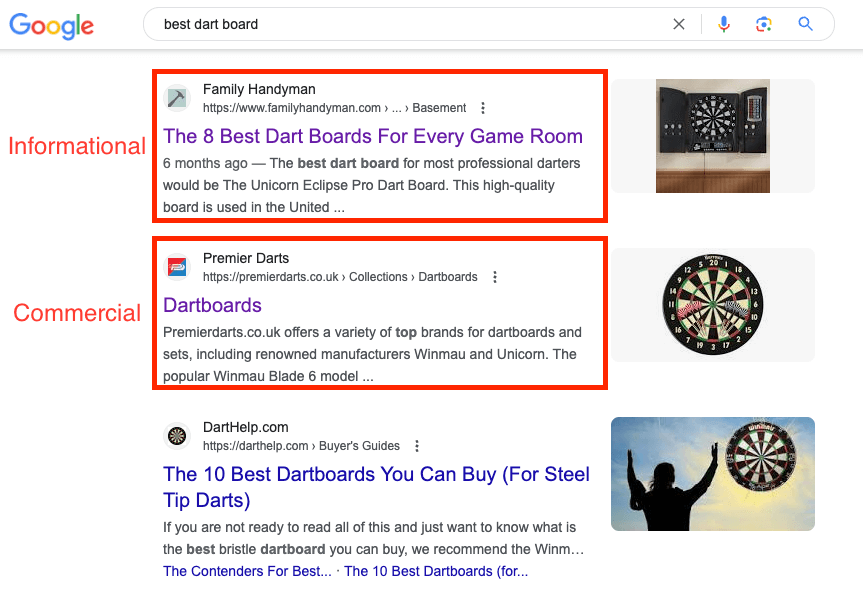
Important note: You can target the same keyword on multiple pages if the search intent differs in the SERPs. If you see both informational and commercial pages in the SERPs, you are able to rank with multiple pages without the consequences of keyword cannibalization.
Here is an example of a keyword with multiple search intents: “best dart board” shows both informational pages and commercial pages, which “allows” you to have two pages targeting that keyword with different intentions because users are looking for both guides/tests and webshops to buy from.
The negative consequences of keyword cannibalization
As mentioned previously, keyword cannibalization can have some serious negative effects on your SEO without you even noticing that there is a problem.
In some cases, you’ll see that you have two results shown in the SERPs ranking #7 and #8.
Not too bad, right?
Double visibility enhancing the chances of getting a visitor.
This is an issue, though – and chances are that you haven’t realized the issue yet or that you have just noticed it because you are reading this post.
The practical effect, in this case, is that you would likely have a higher Google ranking if you had just a single authoritative page for this keyword.
So, instead of two pages ranking #7 and #8, you might miss out on having just a single page ranking #3, which would likely get you a better CTR and more traffic.
You are missing out on traffic, probably leading visitors (unintentionally) to the wrong page, and seeing more rank fluctuations and other issues.
But why is that? Let’s dig into it.
You’re splitting the page authority

When you have two or more pages targeting the same keyword with the same intent, you have practically created an additional competitor, which is yourself.
Your pages are competing for ranks in the SERPs, and first of all, Google isn’t necessarily ranking the correct page higher, which leads visitors – potential leads – to the wrong page.
The next issue is that the two pages now have to share the authority of this subject, which divides the authority into two, and both of your pages end up ranking lower than they would if you just had a single page.
Does it make sense?
If not, let’s take a simple example to provide some context.
Say you are going to your local bookstore.
Looking at the books in stock about the subject you are searching for, what would you choose?
A single book covering the whole subject, or multiple books about the subjects that might overlap in content for large parts of the books?
You would likely choose the single book option with all of the information in it rather than reading three books that are roughly about the same thing.
This is how Google would rate your multiple landing pages targeting the same keyword, and none of them will be the best result for Google to show the user as there are other sources with all of the content on just a single page – because that is what users want. Online as well as in the bookstore.
Sharing backlinks and similar anchors
When it comes to SEO, links are still an important factor. When you are trying to rank two pages for the same term, you are forced to split the link value and build backlinks for both pages.
The result: you’ll have two mediocre pages based on backlinks instead of one strong authoritative page.
Building, say, 15 links to one page and 20 links to another page could have been targeted at just a single page receiving 35 backlinks and a lot better performance in Google Search.
Since you have produced two similar pages, one of the multiple pages will be the more comprehensive one which you would likely prioritize more anyway – and is more likely to get “natural” incoming links.
Lastly, you will use the same anchors for internal as well as incoming external links for both pages, leading visitors and Google to different sources for the same subject. This leads to wrongly ranked pages and sends potential leads to the wrong page, causing you to miss out on conversions.
Google will get it wrong

Google is complex and is backed by a strong and clever set of algorithms. The issue regarding keyword cannibalization is that Google still understands what pages are about based on content and keywords.
If you are in a reality where all of your pages are targeting the same keyword, then Google will try to understand the content and rank the pages that it guesses is the best fit for the search query.
If your content is too similar and/or matches the same intent, there is a 50/50 chance that Google picks the wrong page to display, which leads to lower CTR, lower conversions, and lower traffic numbers.
Do not rely on Google being smart and hope they will pick the correct page.
Do not give Google that dilemma to choose between.
Take control of your website and make the decision yourself rather than expecting Google to pick the right page.
Waste of crawl budget
When it comes to Google crawling and indexing your landing pages, they are working with a so-called crawl budget.
What is that?
A crawl budget is the number of times that Google’s crawler visits your website in a certain time period.
When you have multiple pages targeting the same keywords, you are basically wasting the crawl budget for your site.
Why should you care?
The most critical point here is that you could potentially end up with your most important page not being indexed at all; hence, it will not be displayed in the SERPs.
With recent Google algorithm updates – including the March 2026 Core Update and the February 2026 Discover update – we have seen that Google is not only “punishing” bad content and affiliate sites, but these updates have also reinforced the importance of clear content hierarchy and relevance.
Our experience also shows that Google is holding back on crawl budgets.
Way fewer landing pages are being indexed amongst our users, which is just another reason to only publish quality pages – and only one page per keyword.
The bigger a website, the more careful you need to be looking into crawl budget to make sure that your important content pages are being indexed.
How to identify keyword cannibalization issues
There are several ways of identifying keyword cannibalization, and it differs from tool to tool which features are available to help you identify affected pages.
How to identify keyword cannibalization using Morningscore
Identifying content issues with keyword cannibalization is quite simple, but it takes a little more than just looking at a keyword.
First, you need to sign up for Morningscore (14 days free trial – no credit card required).
Now, let’s look at how to identify keyword cannibalization step-by-step:
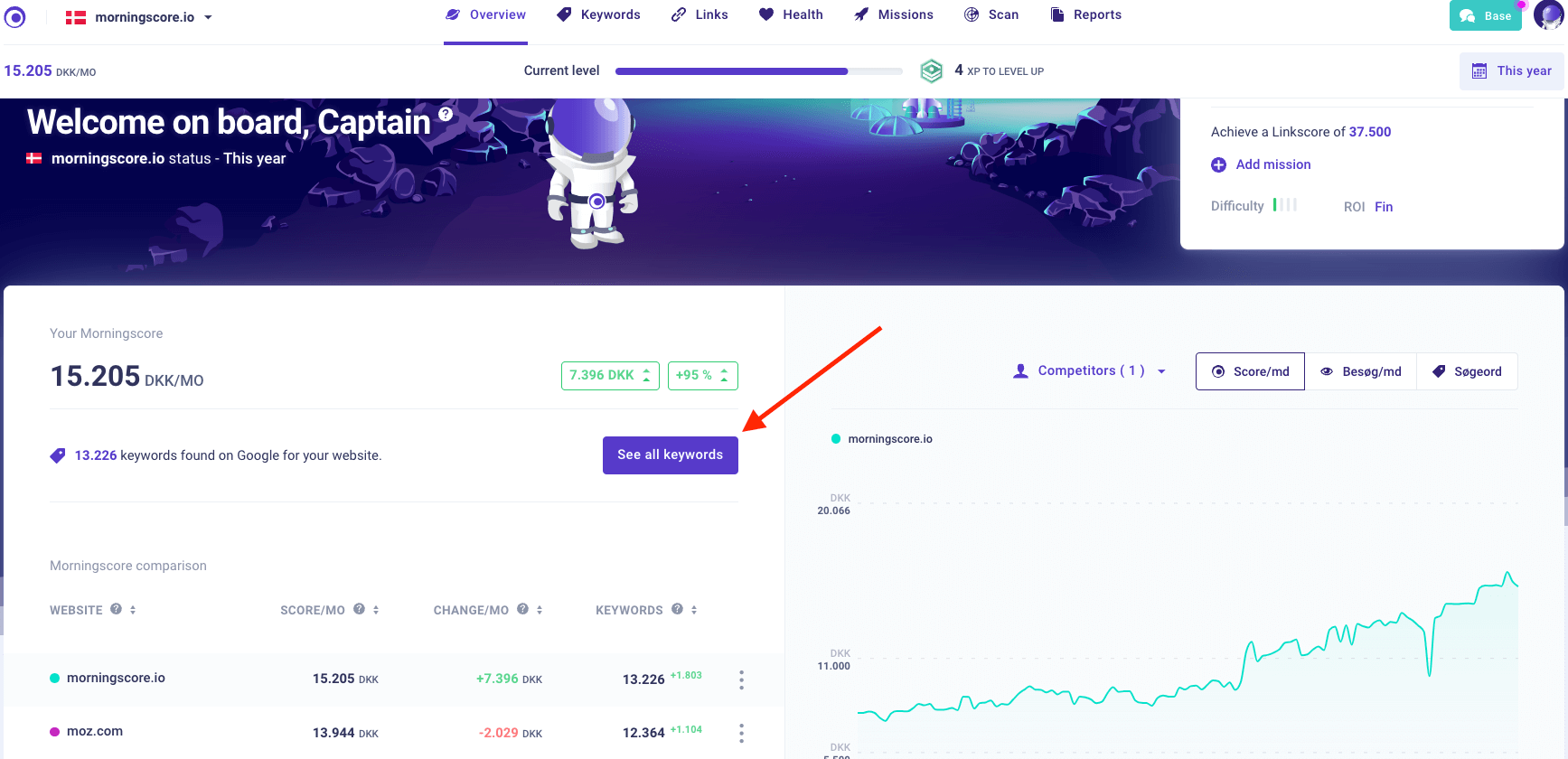
- From your “overview” click on the button “see all keywords”.

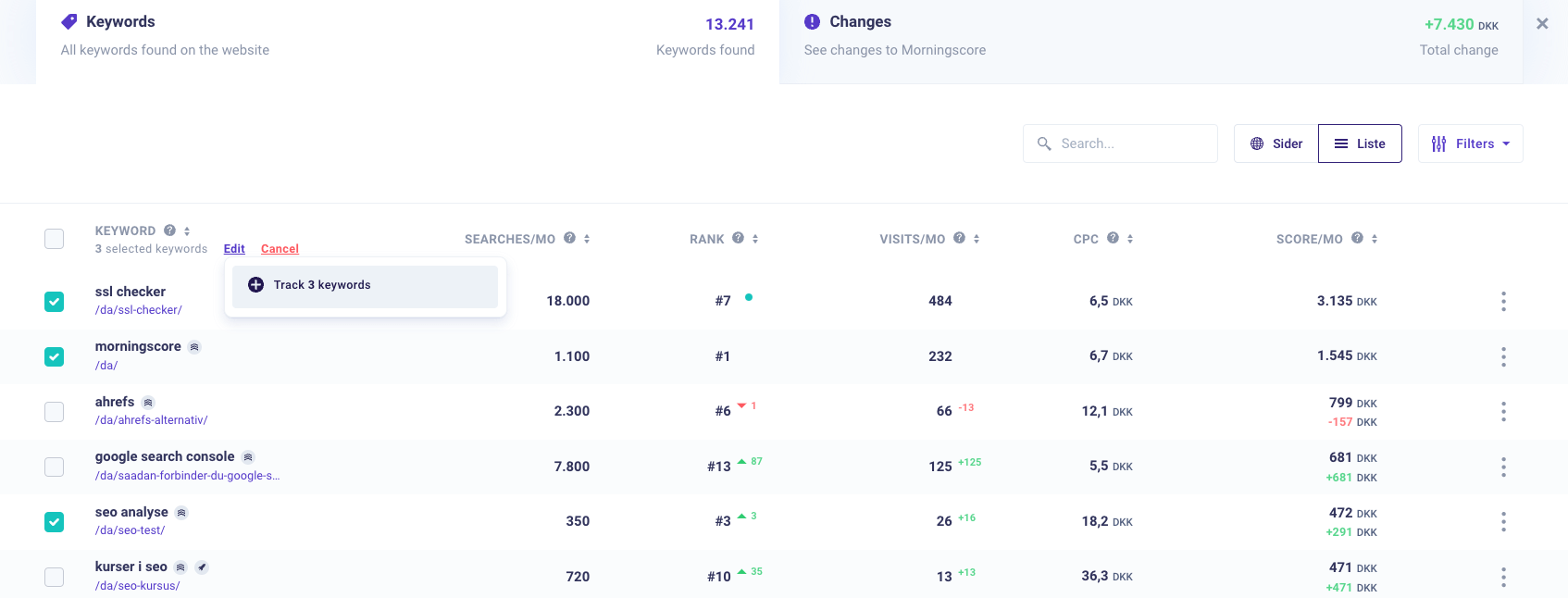
- Find your most important or valuable keywords that you are currently ranking on and add them to your rank tracker.
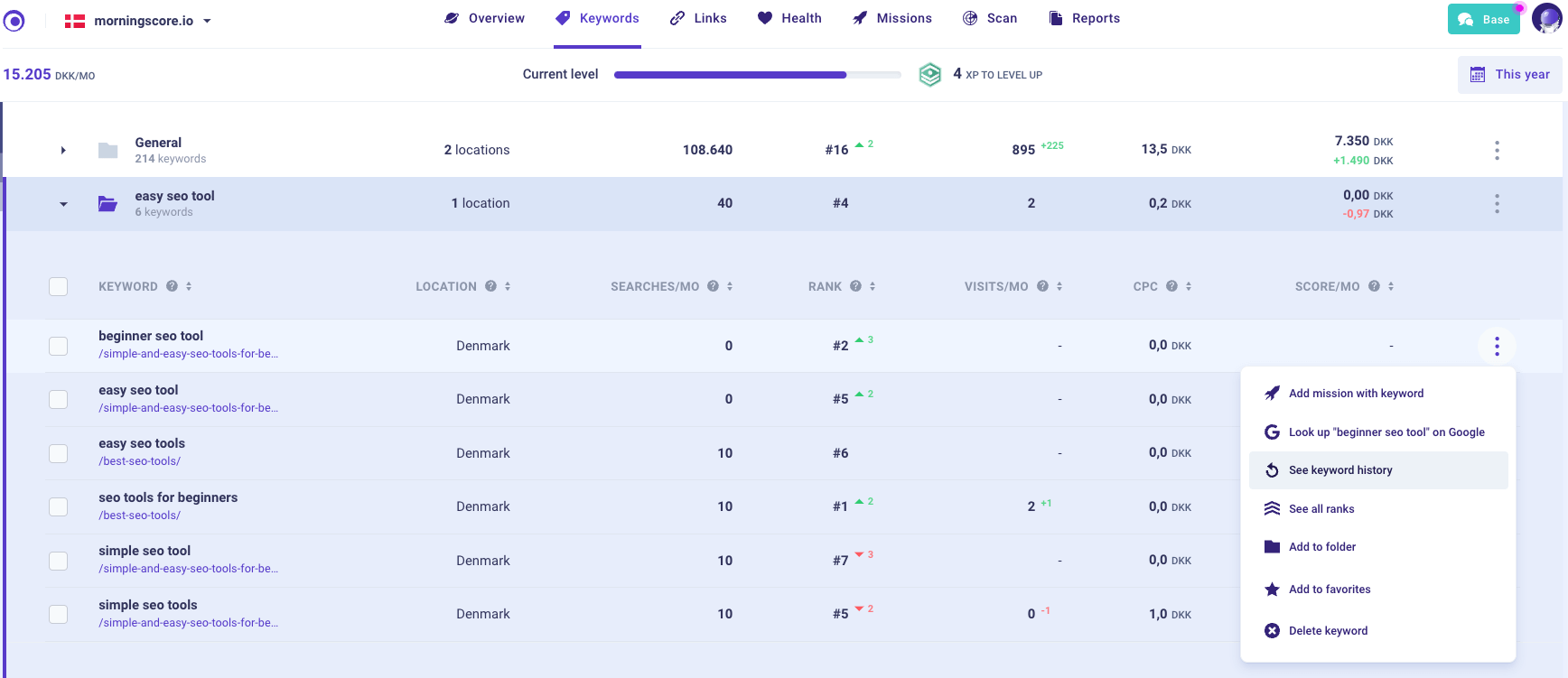
- Navigate to the keyword rank tracker, find your keyword, and click “see keyword history”
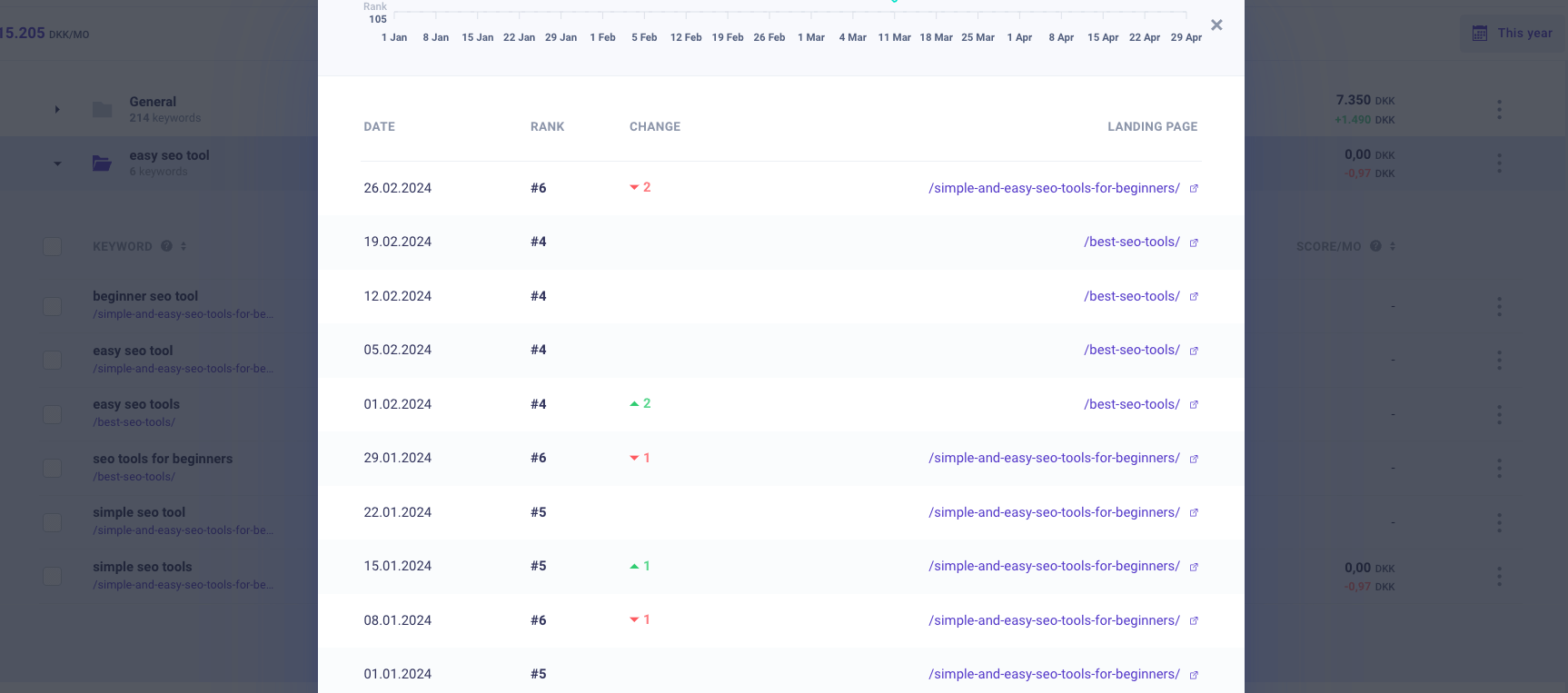
- Check if the landing page changes over time
Following the steps above is just one of the ways to identify whether you have issues with keyword cannibalization for your keyword.
In the example shown with the steps, I am looking at the keyword “beginner SEO tool“.
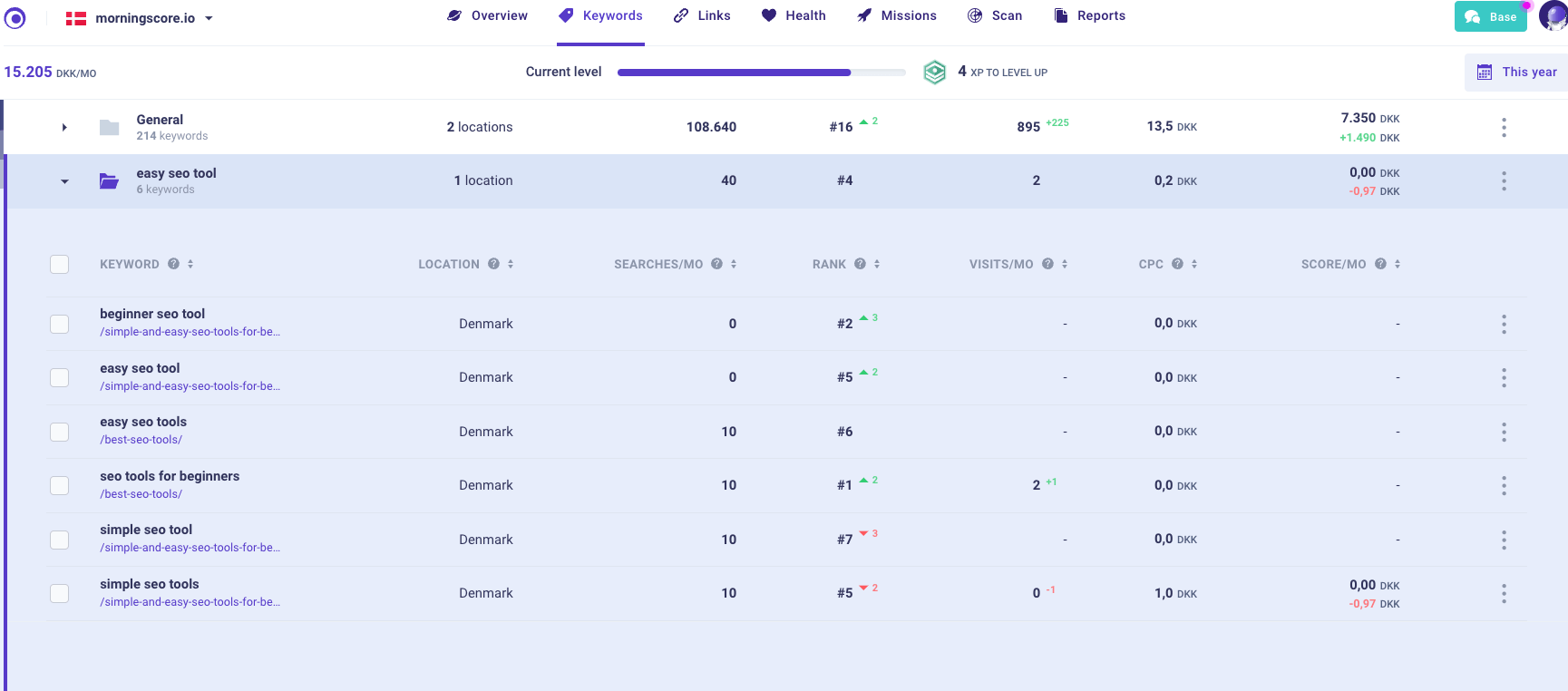
Looking at the rank history for that keyword reveals that the top-ranking landing page was /simple-and-easy-seo-tools-for-beginners/ which changed to be /best-seo-tools/ and then back to /simple-and-easy-seo-tools-for-beginners/.
The fact that the top-ranking page is changing reveals that I have potential issues with keyword cannibalization. It shows that I have two competing pages which Google has had issues choosing between in the SERPs.
Another way of checking is even more simple but only gives you an overview of the current situation today.
By looking at all of your keywords in Morningscore, you will see a landing page under every keyword ranking within the top 20 on Google.
I’m often asked by Morningscore users how they can change the landing page for a keyword.
The answer is: You can’t.
You can’t edit and change the landing page shown for a keyword in Morningscore. The landing page shown below the keyword is the highest-ranking landing page as of the latest update (daily updates for tracked keywords).
So, if you see a “wrong” landing page, it’s most likely because of keyword cannibalization.
Google has decided to rank a “wrong” page because you have more than one page relevant for the keyword and they have tried to figure out which one is the best fit.
Sometimes they are wrong.
How to identify keyword cannibalization using Google Search Console
If you are looking for a free tool to help you detect issues with keyword cannibalization, you can use Google Search Console. Google has improved its cannibalization detection in recent updates, making it easier to spot overlapping pages and content competition directly within the interface.
- Go to your Google Search Console account. If you don’t have one, you can follow our Search Console guide here.
- Click “search results” in the menu below “performance”
- Find a keyword to check, click on it, and a filter will display at the top
- Click “pages” to see the URLs getting clicks and impressions
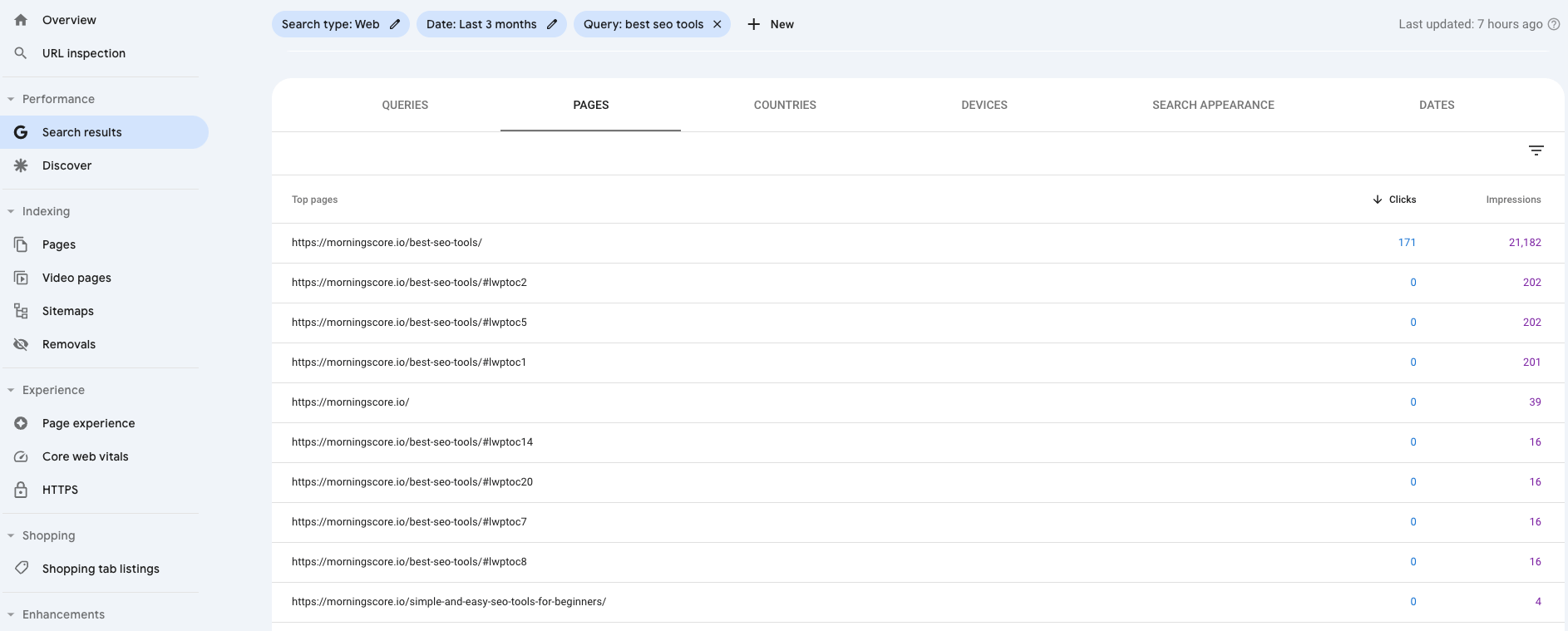
If there is more than one URL, chances are that you have some issues with keyword cannibalization.
If more than one URL is getting hits, it means that more than one page is or has been displayed in the SERPs.
You should look into every page and analyze the search intent. If they have overlapping search intent, that is an issue and you should edit the “wrong” page so it does not match the same search intent.
How to manually identify keyword cannibalization
You can even check and analyze for keyword cannibalization without any SEO tool. To find overlapping pages, you need to navigate to Google and do the following:
Search: “site:domain.com keyword”. By using this command, you ask Google to show you all the pages on the domain that are ranking for that keyword.
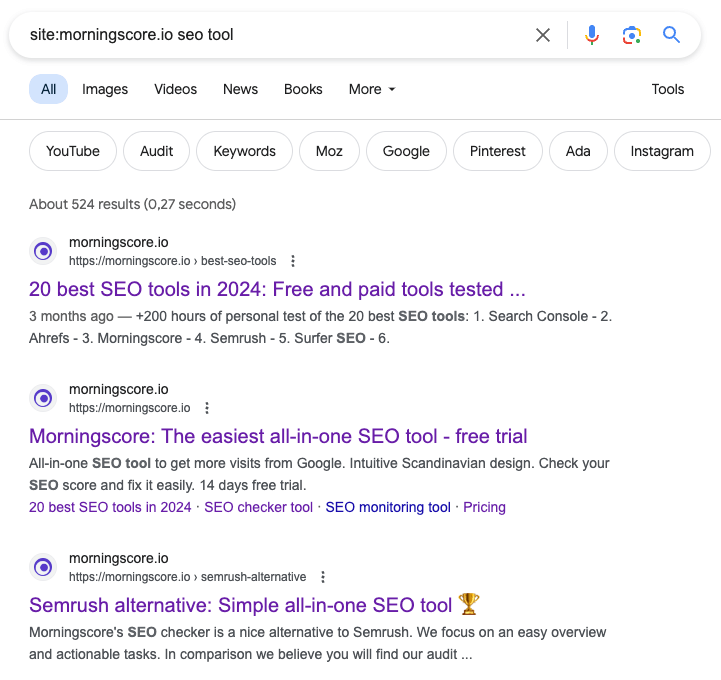
Analyze the results and check if any of your pages seem to overlap, directly targeting the same keyword or the same search intent.
If you have keyword cannibalization issues, we’ll look into how to deal with them next.
How can you fix keyword cannibalization issues?
A single fix that resolves all problems regarding keyword cannibalization doesn’t exist. It takes a little testing of different things to straighten things out.
Optimize internal links
This is always my go-to solution to fix keyword cannibalization in cases where Google simply ranked the wrong page highest.
Google has tried to pick the best fit, but sometimes they are wrong. To help them understand the hierarchy of importance, you can link internally on your website to the correct page using the keyword anchor.
This way, you are telling Google across your website that queries around that subject should lead to that page – the page you refer to yourself.
To identify internal link opportunities, you can simply do a “site search” on Google like this:
site:domain.com keyword
With the command above, you’ll see all the pages that are somewhat ranking for the keyword. These are the main pages that should definitely link to your favored page. Go to every page and link to the right page from them.
Update your content / merge pages
If multiple pages rank for the same keyword, it means that you have either similar content or content targeting the same search intent on the same subject.
This causes problems for you; hence, you should decide which page is the best fit.
From here, you should consider whether the other pages add any value as standalone content or if you could benefit from adding that content to the main page, deleting the old page, redirecting it, and merging the two into one single comprehensive page.
If that is not an option, you should rewrite and retarget the content even more specifically towards its subject and keep it “on its own path.” Use the affected keyword less on that page and make sure the intent of the page is for a different query.
Let’s take an example:
If you have two pages currently ranking for “outdoor shoes,” you can choose to keep both pages but update the “wrong” one for “hiking shoes” instead as a sub-category to the main category “outdoor shoes.”
This way, you keep both landing pages and target two different keywords instead of competing for the same one.
Re-structure your site hierarchy
Another solution you can try is to restructure your site. This can be a simple operation or very tricky, depending on your current structure.
To help Google understand the hierarchy, you should set your main page at the top of the pyramid and the other related pages below it as submenus.
Create an umbrella with your main page on top and make it authoritative and at the top of the hierarchy.
301 redirects, canonicals & noindex
This solution should be the very last step and only if nothing else is working. Generally, these solutions aren’t recommended as they are not a real solution but rather a quick fix.
If your cannibalized content keeps competing against each other and your most authoritative page is suffering, you can choose one of the three following things:
- 301 redirects: By redirecting the least authoritative page, you consolidate the two pages into the primary page. This will permanently move the secondary page, and you won’t get any value from that one individually. Your primary page can potentially increase in rank, but there are no guarantees.
- Canonical: If the content on the two pages is very similar, you can, instead of just redirecting it, keep the page online (you might use it for lead generation and your primary page for purchase conversions) by adding the canonical tag to the page to tell Google that this page is a copy of the primary page.
- Noindex: To remove the page from Google’s index and prevent it from showing in the SERPs, you can set the page to noindex. This way, you will keep the page online for users to access – again, you might use the page or see good conversions from existing website traffic when they visit this page.
Conclusion
In conclusion, resolving issues of keyword cannibalization is crucial for maximizing the effectiveness of your website’s SEO efforts.
By understanding what keyword cannibalization is and its negative consequences, you can take proactive steps to identify and address these issues.
Using tools like Morningscore and Google Search Console can help you pinpoint instances of keyword cannibalization, while manual methods provide additional insights.
Once identified, implementing solutions such as optimizing internal links, updating or merging content, and restructuring your site hierarchy can effectively mitigate keyword cannibalization.
By taking these steps, you can streamline your website’s SEO efforts, improve search engine rankings, and ultimately drive more traffic and conversions.
Commonly Asked Questions about Keyword Cannibalization
Is keyword cannibalization always a bad thing?
Not necessarily. You can target the same keyword with multiple pages if the search intent is different. For example, Google might show both an informational guide and a product category for the same term if users are looking for both. It only becomes a problem when two pages with the same intent compete for the same spot.
How many pages targeting the same keyword is too many?
There is no fixed number, but having more than one page for the same intent often leads to distributing authority too thinly. If you notice your rankings fluctuating between two similar URLs, it is a sign you have too many pages competing. It is usually better to have one strong, authoritative page than several mediocre ones.
Should I use a 301 redirect or a canonical tag to fix the issue?
Use a 301 redirect if the “wrong” page has no unique value and you want to merge its strength into a main page. A canonical tag is better if you need to keep both pages live for users but want to tell Google which version is the primary one. You can learn more about how redirects work to choose the best option for your site.
Does keyword cannibalization waste my crawl budget?
Yes, having many similar pages can lead to a waste of crawl budget. Google only spends a certain amount of time crawling your site. If it is busy looking at duplicate or overlapping content, it might miss your new or more important pages, which can keep them from being indexed at all.
How can I find cannibalization issues using Google Search Console?
Open your Performance report and look at individual queries to see which pages are getting clicks. If you see multiple URLs appearing for the same keyword with similar impressions, you likely have a cannibalization issue. You can also use a “site:domain.com keyword” search on Google to see how they rank your pages manually.
Can internal linking help resolve keyword cannibalization?
Yes, optimizing internal links is one of the most effective ways to show Google your content hierarchy. By linking from the “wrong” page to your preferred landing page using the target keyword as anchor text, you signal which page is the true authority. This helps Google understand which URL should rank highest in search results.