
 Deutsch
 Dansk
Dansk Svenska
 Nederlands
 Español
 Lietuvos
Most businesses spend between $2,500 and $3,200 a month on an SEO agency, according to recent industry surveys on agency retainers. But if you run a small business, local shop, or a growing startup, you might not need to spend that money at all.
Deciding between an SEO agency vs DIY SEO comes down to your budget, your available time, and how fast you need to grow. As the SEO Lead at Morningscore, I talk to business owners every week who feel stuck between paying high agency retainers and trying to figure out Google algorithms on their own.
The truth is that most small businesses can handle their own search optimization if they follow a clear process – a playbook they can follow, which we provide at our Morningscore Journey.
Let’s look at the real costs, the exact tasks you should do yourself, and when it actually makes sense to hire outside help.
TLDR: A quick guide to your search strategy decision
If you have less than $1,000 a month to spend, you should do your own SEO.
Claim your Google Business Profile, write content based on your actual expertise, and use a self-serve SEO tool to track your progress.
If you have a marketing budget over $3,000 a month, need complex technical fixes, or want to scale aggressively across competitive national keywords, hire an agency.
For many companies, a hybrid approach works best. You write the content, and an agency handles the technical audits and link building.
The worst outcome is doing nothing at all. If you are completely new to this, check out our guide on SEO for beginners to learn the basics in an afternoon or get our best SEO tips for SMBs.
The true cost of SEO: Real economics data

Let’s look at the actual numbers.
Hiring an agency is a direct financial cost.
Doing it yourself costs less in cash but requires your time.
According to a pricing survey cited by Aergos, the most common monthly retainer for small to mid-size businesses sits between $500 and $5,000 a month, with an average of approximately $3,200.
Mid-market companies often spend $5,000 to $10,000 per month on agency retainers. Compare that to doing it yourself.
| Approach | Monthly Cash Cost | Time Commitment | Best For |
|---|---|---|---|
| Full-Service Agency | $1,000 to $5,000+ | 1 to 2 hours | Companies scaling fast with budget |
| DIY with industry-leading tools | *$200 to $400 | 10 to 30 hours | Founders with time and SEO skills |
| DIY with Morningscore | **$69 to $99 | 5 to 15 hours | Small businesses needing guided tasks |
* Ahrefs Lite plan + Brand Radar AI Basic + Content Kit to reach the Morningscore included funcionality = $278
** The price for the Lite and Business subscription at Morningscore.
If you value your time at $150 an hour, spending 15 hours a month on optimization tasks creates a hidden opportunity cost of $2,250. You have to weigh that against the cash you save.
However, if you use simple tools that tell you exactly what to fix, you can cut that time commitment in half. Understanding these numbers is critical when you calculate SEO ROI for your business.
When DIY SEO makes perfect sense for your business
You don’t need an agency to rank for local search terms.
The most impactful task you can do right now is claiming and optimizing your Google Business Profile. This free platform is the most effective way to appear in local searches.
You can upload photos, respond to reviews, and update your business hours in a few minutes a week. Google Search Console is also a genuinely useful free alternative that shows you exactly which queries bring people to your site.
Another massive advantage you have over an agency is your first-hand experience. Google uses a concept called E-E-A-T, which stands for Experience, Expertise, Authoritativeness, and Trustworthiness. When you write a blog post about your specific industry, you include real examples and nuances that a freelance writer at an agency simply doesn’t know.
Take one of our customers, Charlotte Karlsson, as a real-world example. She ran a small e-commerce store and felt overwhelmed by agency quotes. Instead of outsourcing, she decided to use her deep product knowledge.
She wrote detailed buying guides answering the exact questions her customers asked in store. By following a step-by-step guide to DIY SEO for small businesses, she optimized her titles and tracked her progress.
Within a few months, she went from 100 to 1,000 monthly organic clicks. She didn’t need a technical background, just her own expertise and a clear checklist.
Local SEO is not the answer for all SMBs, as they are not all locally targeted. But IF you run a local business, you should 100% do your own SEO and skip the cost of an agency.
The hidden costs and challenges of doing SEO yourself

While doing it yourself saves cash, it requires discipline, time, and understanding of search engines and the algorithms. Serious optimization takes 10 to 15 hours per week during the initial setup phase.
After that, you still need to dedicate 10 to 20 hours a month to maintain your momentum and to continue growing other keywords. You also have to consider the cost of software. Stacking tools like Ahrefs, which starts at $129 a month, and Semrush can quickly add up to $200 or $400 a month with all the add-ons on top.
To keep software costs down without compromising quality or data, you should track website visitors with Google Analytics, use Morningscore for keyword tracking, research, competitor information, and AI content tools with Search Console as an extra layer. That is basically the tool stack you need to do SEO for a small business. Nothing more, nothing less. That’s $69 a month in total software cost.
Also, you might make mistakes that cost you traffic. Ahrefs found in a recent study that only 1.74 percent of newly published pages reach the top ten within a year. While that number includes millions of unoptimized pages, it shows that ranking requires specific, intentional effort. If you aren’t willing to learn the basics of on-page optimization, doing it yourself will just waste your time.
When you should hire an SEO agency instead
There comes a point where doing it yourself stops making sense. If your website has thousands of pages, you will face technical issues that require specialized knowledge. Fixing crawl budgets, implementing complex schema markup, and managing large site migrations are tasks for professionals.
Search is also changing fast. AI answer engines like ChatGPT, Perplexity, and Google AI Overviews add a new layer of complexity to SEO.
Optimizing for AI platforms requires a deep understanding of entity relationships and technical structure that goes beyond basic keyword placement. Do not let that scare you.
LLM optimization – also called GEO, AIO, AI SEO – is an extra layer of SEO. It’s not a new discipline. Good SEO is what makes you visible in search engines, and if your business is likely not used in the LLMs’ training data, they will have to search the internet for information, and without doing SEO, you are not visible in the search engines where LLMs do their searches, just like you are not visible when potential customers search them.
The hybrid SEO model: Splitting the workload
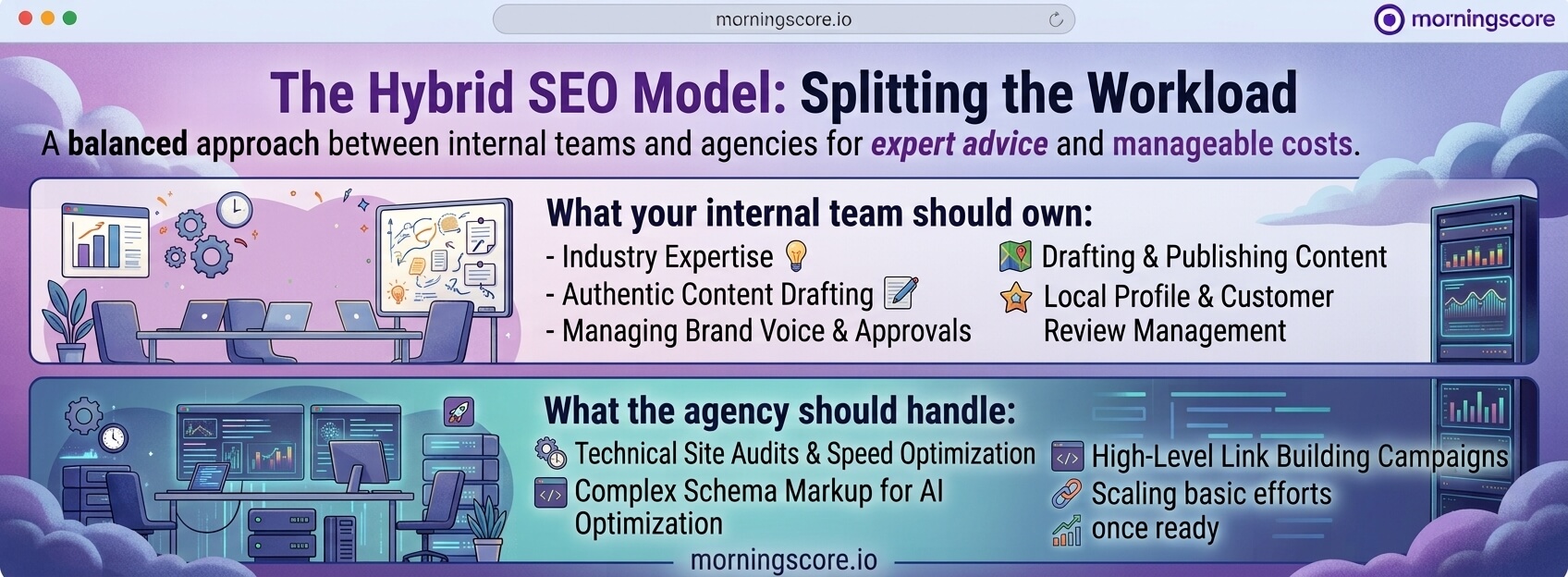
Many successful companies use a hybrid model where you don’t have to choose a strict path between an SEO agency vs DIY SEO. This approach keeps costs manageable while giving you access to expert advice. If a hybrid between DIY and an agency is for you, I recommend you split it like this:
What your internal team should own
You or your internal team should handle industry expertise and content drafting. You know your product best. You should also manage approvals, brand voice, local profile updates, and customer review management. Writing your own content ensures authenticity.
What the agency should handle
The agency should take care of technical site audits and speed optimization. They can also manage complex schema markup for AI search engines and execute high-level link building campaigns. You can handle basic link building for small businesses internally before handing it off to an agency for scale.
How the right SEO tool supports the gap
If you decide to take the DIY route, you need a system that tells you what to do. This is where Morningscore comes in. We built Morningscore to be an all-in-one platform that feels like a game. It gives you clear, prioritized tasks. You can track your local rankings, check your competitors, and scan up to 25,000 pages for health issues. Our Lite plan starts at just $69 a month, making it a highly cost-effective alternative to a $2,000 agency retainer, who are anyway just using the same tool and gives you the information straight from here.
Consider Fenerum, a B2B SaaS company. They knew their product inside out but lacked a clear search strategy. Instead of hiring an agency, they used Morningscore to identify low-hanging fruits.
The tool pointed out missing meta descriptions and broken links. By fixing these specific issues and tracking their target keywords, Fenerum achieved great results in record time without spending thousands on external consultants. If you are looking for the best SEO software for small businesses, a tool that provides guided tasks is essential.
Fenerum case in numbers:
- +500% organic traffic growth
- 4 months to impact
- Took advantage of low-hanging fruits pointed out by Morningscore
- More demo requests
DIY SEO vs. Outsourcing to an Agency
DIY SEO
Advantages
- Lower direct cost: Saves cash by eliminating expensive monthly agency retainers.
- Full strategic control: Retain 100% authority over strategy, messaging, and site content.
- Immediate execution: Go straight from idea to implementation without waiting for agency approvals.
- In-depth product knowledge: Leverage your unique industry expertise for authentic content.
- In-house skill development: Build valuable, long-term internal digital marketing capabilities.
Disadvantages
- Massive time commitment: Requires 10–15 hours weekly for setup and 10–20 hours monthly for upkeep.
- Risk of technical errors: Mistakes in site architecture or indexing can severely drop rankings.
- Outdated tactics: Easy to follow bad advice or black-hat strategies that trigger search penalties.
- Trial-and-error delays: Time spent learning basics delays seeing measurable traffic gains.
Typical DIY Tasks
- Identifying low-hanging keyword opportunities using entry-level tools.
- Writing title tags, meta descriptions, and on-page headings.
- Drafting and publishing blog posts using internal product expertise.
- Interlinking related pages across the website to build topic authority.
- Compressing images for faster loads and writing descriptive alt text.
Outsourcing to an Agency
Advantages
- Instant expertise: Access dedicated teams of technical, content, and link-building specialists immediately.
- Time savings: Frees your internal team to focus strictly on core business operations and product growth.
- Advanced tech stack: Leverage enterprise-level SEO software without paying hundreds in monthly tool costs.
- Faster ROI: Experienced agencies execute proven frameworks that skip the trial-and-error phase.
- Comprehensive technical fixes: Complex issues like schema markup, crawl budgets, and site speed get resolved correctly.
Disadvantages
- Higher financial cost: Requires a significant recurring monthly retainer ($1,000–$5,000+).
- Onboarding friction: Takes time to educate the agency on your brand voice, audience, and industry nuances.
- Variable agency quality: Low-cost agencies may rely on spammy tactics or generic, low-quality content.
- Less direct control: Campaign changes and strategic pivots require communication loops and sign-offs.
Typical Agency Tasks
- Conducting full technical audits to resolve deep crawl, indexation, and site speed errors.
- Implementing advanced schema markup for rich snippets and AI search engines.
- Executing high-tier backlink outreach and digital PR campaigns at scale.
- Running competitor gap analyses across thousands of keyword data points.
- Providing strategic multi-channel reporting, revenue attribution, and rank-tracking insights.
Real case: Cancelling a $2,340/month agency to do it himself
Not every agency story ends in disaster, but that doesn’t mean it’s worth the price tag. Take the founder behind unmarket.dk, a Danish webshop selling curated vintage, secondhand, and streetwear clothing.
When he started his ecommerce journey, he had zero SEO experience. So when an agency reached out promising major traffic and sales gains, he signed up, paying roughly $2,340 a month, excluding VAT.
The problem wasn’t that the agency failed. The results were what you could call average. The problem was everything around them.
After a few months, he couldn’t clearly see what he was paying for. There was no transparency and no concrete reporting on what had actually been done. The agency couldn’t tell him which pages they’d worked on or which backlinks they’d built. Communication was slow, and despite promises that he’d be involved in the process, he ended the engagement knowing exactly as little about SEO as when he started.
He decided to cancel, not because SEO didn’t work, but because he had no insight into the work being done and no way to verify it was worth the price.
That search for transparency led him to Morningscore. Within a short time, he understood how to run his own SEO and realized it wasn’t as complicated as the agency had made it seem. Just as important, he was finally learning the “why” behind each task.
Looking back, he concluded that the $2,340 a month he’d paid the agency was money he could have saved. Doing it himself got him to the same place, for a fraction of the cost, plus he walked away with SEO knowledge he could keep using going forward.
Today he has top rankings on competitive keywords like “vintage sweatshirt”, “vintage hoodies”, and a long list of other vintage searches.
Actually, he became so skilled that he ended up working at Morningscore alongside me.
Comparing long-term value and investment
Many business owners wonder if the effort is actually worth the time. When you compare the ROI on Google Ads vs SEO, organic search often delivers twice the return on investment over a long period.
Paid ads stop generating traffic the moment you stop paying. Organic content continues to attract visitors for years. We calculated exactly what happens when you invest $3,000 in SEO over a year, showing how a small upfront investment can compound into significant revenue.
Frequently asked questions about search optimization costs
How much time does DIY SEO actually take?
Expect to spend 10 to 20 hours a month during the initial setup phase. Once your foundation is solid, you can maintain your rankings with 5 to 10 hours a month using a guided tool. If you need a structured plan, check out our 3-month SEO plan to boost traffic in just 90 days.
Can a small business really outrank big competitors?
Yes. By focusing on niche, long-tail keywords and local search intent, small businesses can dominate specific areas where large corporations lack relevance.
Do I need to sign a long-term contract with an agency?
Most reputable agencies require a six-month commitment because search optimization takes time to show results. If you want flexibility, a monthly software subscription is a better starting point. You can read more about how long it takes to see results to set realistic expectations.