Deutsch
 Dansk
 Svenska
 Nederlands
 Español
 Lietuvos

“You still need to be in the phone book. If your business wasn’t listed, nobody found you, no matter how good the work was. SEO works the exact same way.”
That’s the starting point Christian Aalykke, Head of Customer Success at Morningscore, uses to open the SEO fundamentals lesson in Morningscore’s Growth Academy.
The analogy is simple, but it gets to the heart of SEO: before someone can find your business through a search engine, search engines first need to find and understand your website.
So, how does SEO work? How does Google find websites, understand what they’re about, and decide which ones to show in the search results?
Let’s break it down from the ground up in this beginner-friendly guide – without the jargon and fancy marketing words.
TL;DR
SEO is about helping search engines understand, find, and trust your website so it can appear in front of the right people. The fundamentals are simple: create relevant content, target the right keywords, earn quality links, and make sure your website is technically sound. Start with what your business is genuinely good at, focus on relevant searches rather than high search volume, and use competitors that already rank to find realistic opportunities. SEO takes time, but strong rankings can generate consistent traffic without paying for every click.
Key takeaways
- SEO stands for Search Engine Optimization, and it is the process of helping search engines understand what a page is about so they can show it to the right person at the right moment.
- Relevance matters more than search volume when choosing keywords.
- SEO relies on three core areas: content and keywords, backlinks, and a technically healthy website.
- The goal is to create useful pages for people, not to optimize for search engines alone.
- SEO takes time, so start with the technical basics, focus on one area, research realistic keywords, and track your progress.
So, how does SEO work? The short answer
Strip away the jargon and SEO comes down to one idea: search engines need fresh, trustworthy information, and they reward whoever supplies the clearest answer to a real question. SEO is the practice of providing such information.
Content and keywords tell the search engine what a page is about. Links tell it who else vouches for that page. Technical setup determines whether visitors and crawlers can actually use it. And user behavior quietly decides whether all of that earns a lasting position or fades back down the results.
Getting this right doesn’t require chasing every new trend. It requires doing the fundamentals properly, because the fundamentals are still what every search engine, and increasingly every AI tool, depends on to find something worth recommending.
If you’re just getting started, our beginner’s guide walks through the process step by step, built specifically for people doing SEO for the first time.
What is SEO
SEO stands for Search Engine Optimization. Strip away the acronym and it means one thing: helping a search engine understand what a page is about, so it can show that page to the right person at the right moment.
The “list” a search engine keeps, the modern equivalent of the phone book, is called an index. SEO is the work of getting a website into that index and earning a position on it good enough that real people actually see it and click. Do that well, and a business gets a steady stream of visitors who are actively looking for what it sells, without paying per click for the privilege.
That last part matters more than beginners usually realize. Paid ads stop the moment the budget runs out. A well-ranked page keeps pulling in visitors for months or years after the work is done. That’s the entire economic case for SEO in one sentence.
Why SEO matters for a business
Before diving into mechanics, it’s worth being blunt about why any of this is worth the effort:
- It drives free, compounding traffic. A page ranking well for a relevant term keeps earning visits long after it’s published, unlike an ad that switches off the instant spending stops.
- It builds trust before people read a word. A high Google ranking signals credibility that a buried result simply doesn’t.
- It reaches people already looking for what you offer. Someone searching “best running shoes” is already interested in finding them, unlike someone who simply sees an ad while scrolling.
- It compounds with everything else in marketing. Backlinks earned through PR, content shared on social media, and mentions in the press all feed back into the same system, reinforcing a site’s authority over time.
None of that happens by accident. It happens because a search engine ran a page through a process, and that process is worth actually understanding rather than treating as a black box.
How does Google decide what to show?
Google doesn’t scan the entire internet fresh every time someone searches. That would take far too long. Instead, picture the internet as a massive shelf of ring binders. Google sends robots out to that shelf, opens the binders, and copies the pages it finds useful into its own filing cabinet. That filing cabinet is the index. When you search, Google isn’t hunting the live web. It’s pulling already-filed documents and ranking them by how well each one seems to answer your question.
Underneath the metaphor, three things are happening in sequence, and every serious explanation of SEO eventually comes back to this order:
- Crawling: Automated bots follow links across the web, discovering pages that exist.
- Indexing: Google decides whether a discovered page is worth storing, and files it under the topics and queries it seems to answer.
- Ranking: When someone searches, Google pulls every indexed page that might be relevant and sorts them by how well each one is likely to satisfy that specific search.
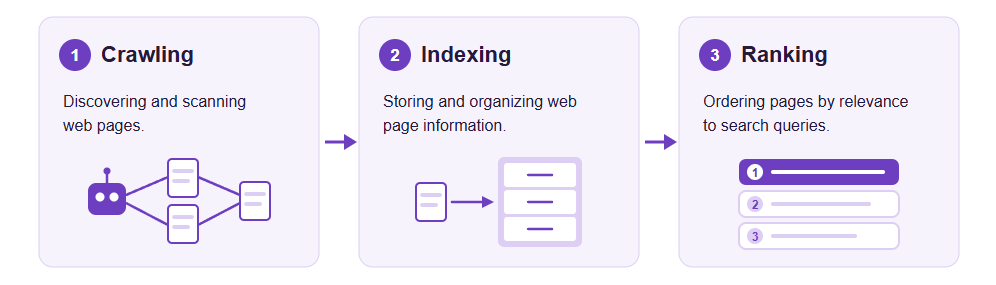
Optimizing a page for Google means making it easy for that robot to move through all three steps correctly. A clear URL, a clear heading, and text that matches what someone is actually searching for all tell the robot which drawer a page belongs in. If those signals are wrong or unclear, Google may not let the page make it into the cabinet at all, let alone rank once it’s there
That’s the whole game, underneath the jargon. Everything else in SEO – content, links, technical setup – exists to influence which drawer a page lands in and how high it sits inside it.
📌Reminder: You can check whether a page is indexed by searching “site:yourdomain.com/your-page-url” in Google. For a more reliable status, use the URL Inspection tool in Google Search Console to see if the page is indexed and whether Google encountered any issues.
How the Google algorithm works
The word “algorithm” sounds intimidating, but it just means a sequence of steps that turns a problem into a solution. A simple example: say it’s evening and you want a slice of chocolate cake. That craving is your input. The algorithm is the sequence you follow to get there – open the cookbook, find the recipe, measure the flour and cocoa, mix, bake at 200 degrees for 45 minutes, cool. The output is cake, arrived at through a defined series of steps rather than magic.
Google runs on the same logic, just at a scale nobody can picture. Google’s ranking systems weigh many different factors and signals, and nobody outside Google knows the exact recipe. But a handful of ingredients stay consistent across almost every serious explanation of how search works:
- Content and keywords: does the page clearly answer a specific search?
- Links: do other credible sites vouch for this page?
- Technical foundation: can machines and humans actually use the page without friction?
A useful shortcut for keeping these straight: everything happening directly on your own pages counts as on-page SEO. Everything happening elsewhere, especially links pointing back to you, counts as off-page SEO. On-page work decides what a page can rank for. Off-page work decides how well it actually ranks against everyone else trying to answer the same question.
Search intent: what is the searcher looking for?
Not every search means the same thing, and a page built for the wrong intent will struggle no matter how well it’s optimized. Search intent generally falls into four buckets:
- Informational: someone wants an answer or an explanation, like “how does SEO work.”
- Navigational: someone already knows where they want to go, like “Morningscore login.”
- Commercial investigation: someone is comparing options before deciding, like “best SEO tools for beginners.”
- Transactional: someone is ready to buy right now, like “buy Le Creuset frying pan.”
Google reads intent from the query itself and adjusts what it shows accordingly. Search something like “how to write a meta description” and you’ll likely see an AI Overview or a featured snippet, because the intent is informational and Google can summarize an answer directly. Search “buy a trampoline” and you’ll get a straightforward list of retailers, because nobody buying a trampoline wants a conversational detour first. Matching a page’s content to the right intent is one of the most overlooked fundamentals in SEO, and it’s worth doing before writing a single sentence of copy.
🔍 SEO insight: Search intent determines what content you should create. Search for your target keyword on Google and study the pages that rank. If the results are mostly guides, create an informative article. If they’re product pages, users are likely looking to compare or buy.
SEO content and keywords
Content is everything on your pages that a visitor can read, watch or use, such as text, images and video. Keywords are the specific words and phrases people type into search engines that you target with that content.
Why content and keywords come first
A page has to tell Google what it’s about before Google can decide who to show it. Search for e.g. “sofa” online, and the top results all repeat the same word: in the URL, the title, the heading, the description.
Look closer at those top-ranking pages, and the repetition goes further. “Sofa” can show up more than a hundred times, in every heading, every product name, every description. That sounds like keyword stuffing, but it isn’t. Google isn’t just counting how often the word “sofa” appears. It’s also looking for semantic keywords: related words like fabric, cushions, and armrest that show the page actually covers the topic, not just the term.
A page that covers those related words alongside “sofa” signals depth. That combination, not the raw repetition, is what tells Google the page understands what it’s about.
This is also where keyword research earns its place. Every keyword a page already ranks for is a small piece of real data showing whether the content is actually landing with the right audience. A keyword research tool surfaces that data before you write a single word, so the content gets built around real demand instead of a guess.
How to do keyword research as a beginner
This is where most beginners go wrong first, and it’s an easy mistake to make. Someone opens a keyword tool, spots a term with eight thousand monthly searches, and gets excited because their business sells something adjacent to it.
That excitement is the trap.
Keyword research doesn’t start in a tool. It starts with an honest look at your own strengths. A shop with two display cabinets in stock gains nothing chasing a keyword where every competitor on page one carries three hundred products and a much stronger link profile. Even if that keyword brings a short burst of traffic, the shop still can’t compete once visitors land on the page.
A five-step keyword research process
- List what you’re genuinely strongest in. Start with the products or services you can actually deliver on, not the highest-volume term you can find.
- Search those categories on Google using broad, generic terms. Whoever shows up isn’t necessarily your real-world rival – it’s whoever Google currently trusts for that search.
- Add those sites as competitors inside an SEO tool. Swap competitors when needed; the point is extracting their data, not tracking a rivalry.
- Open their top-performing pages and see which keywords they rank for. A single page ranking for 200+ keywords maps an entire market’s search intent in one view, faster than guessing at terms from scratch.
- Compare that list against your own rankings. Every gap is a keyword worth considering. Every overlap confirms you’re already competing in the right place.
Working through this process page by page, rather than keyword by keyword, tends to surface far more usable ideas. A single well-indexed competitor page, one built around bedside tables or dining chairs or any other specific category, often reveals fifteen or twenty related search terms in one glance: sizes, materials, price qualifiers, style variations. That’s a far richer starting point than staring at a blank list and guessing what people might type.
A competitor analysis tool makes this process fast – not to copy a competitor, but to borrow their years of accumulated search data as a shortcut into your own market. And it’s worth being generous about who counts as a useful competitor here. A site doesn’t need to be a direct rival to be worth studying. If it ranks well in a shared category, even loosely, it holds data worth mining for search patterns.

Why relevance beats search volume
A big search volume means nothing if the page behind it can’t deliver. A retailer with three sofas in stock gains nothing from ranking for a high-volume keyword, like sofa, if every visitor lands, sees a thin selection, and leaves. That traffic looks good on a dashboard and does nothing for revenue. A smaller volume, precise keyword that matches what the business can actually deliver – e.g. “Grey linen 3-seater sofa” – is worth more every time.
Chasing volume you can’t back up buys a brief spike, not a lasting position. The moment a visitor sees the selection doesn’t match the promise, they leave. Google uses aggregated data on how people interact with results, so pages that keep disappointing visitors tend to lose their position over time. Relevance is therefore what keeps a ranking stable months later.
⚠️ Common mistake: Targeting keywords that don’t match your business: A keyword with thousands of monthly searches won’t necessarily bring valuable traffic. Focus on searches that match your products, services, and what your business can actually deliver.
The small details that add up
Ranking well gets a page in front of someone. What happens next, whether they actually click, comes down to a smaller set of details that don’t affect ranking directly but decide whether the ranking pays off at all.
A title tag is the clickable headline shown in search results. A meta description is the short summary underneath it. Neither one directly forces a higher ranking, but both directly influence whether someone bothers to click once a page shows up. Two pages can sit in identical positions and see very different click-through rates, purely because one title tag promised something specific and the other read like filler.
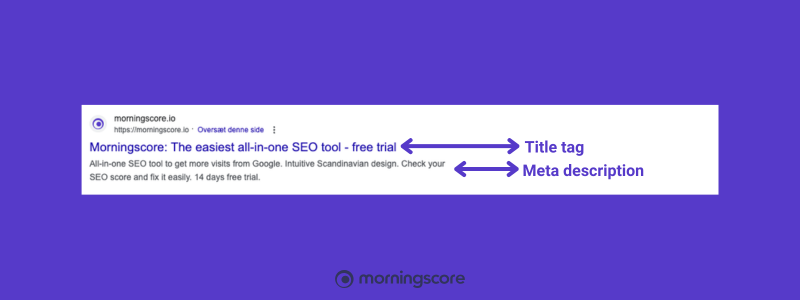
None of these alone will save a weak page, but a clear title, a compelling description, and clean structured data remove friction between someone seeing a page in the results and actually clicking it. A title tag checker and a meta description checker exist specifically to catch the gaps that are easy to overlook on a large site.
Links
Links are other websites linking to yours, which search engines use as a trust signal when ranking pages.

Why backlinks still matter
Content answers one question: “is this page about the right thing?” Links answer a different one: “does anyone else vouch for it?”
Picture two furniture retailers selling near-identical sofas. One gets mentioned only by directory sites nobody really trusts. The other earns mentions from lifestyle magazines and national newspapers. Google reads that gap as social proof. The second retailer looks like the more credible source, so it earns the better ranking, even when the actual page content is comparable.
That’s why backlinks remain one of the most reliable ranking factors in SEO. A link from a trusted site strengthens a page’s position in the index in a way almost nothing else can replicate. It doesn’t need to be complicated, either. A guest post, a supplier relationship, a local news mention, or a genuinely useful resource other sites want to reference all build the same kind of authority over time.
📌 Reminder: Backlinks are not all equally valuable. A link from a relevant, trustworthy website can provide stronger signals of credibility than a link from an unrelated, low-quality site. Focus on earning good backlinks that make sense for your business and audience.
Technical SEO basics
Technical SEO is making sure search engines can crawl, index, and understand your site – covering things like speed, mobile-friendliness, and site structure.
What technical SEO covers
A page can say all the right things and still fail, if nobody can actually use it. A page that takes ten seconds to load, or has no internal links to click through to, loses most visitors before the content matters at all. Multiply that across a thousand visitors hitting the same wall, and Google reads a clear pattern: this page isn’t rewarding to visit.
This is what technical SEO covers: page speed, a clean URL, working internal links, and alt text describing images for anyone, human or crawler, who can’t see them directly. None of it is about what a page says. It’s about whether a page can actually be loaded, read, and navigated in the first place.
An SEO checker scans a site for exactly these gaps, because most of them stay invisible until someone actually measures for them.
💡 Pro tip: Find technical SEO issues before creating more content. Run an SEO audit to identify broken links, missing title tags, slow pages, and other technical issues. Fixing these problems will help search engines crawl and understand your existing content.
Write for people, not search engines
Here’s the piece that ties everything above together, and the one rule worth remembering above all others.
Google doesn’t only judge a page by its content, links, and technical foundation. It also considers how people interact with search results and the pages they visit.
Google’s ranking systems consider a wide range of signals, including aggregated data on how people interact with search results (source). Metrics such as click-through rate, time spent on a page, bounce rate, and whether visitors return to the search results can offer insights into how people engage with a page. While these metrics aren’t all direct ranking factors, they help illustrate why satisfying search intent matters.
A page that delivers on its promise gives visitors a reason to stay, explore, and engage with the content. One that fails to meet their expectations may send them looking elsewhere. That’s why creating genuinely useful content matters more than simply optimizing for search engines.
This is the principle behind one of SEO’s oldest pieces of advice: write for the person searching, not the machine reading your page. Get the technical foundations right, then focus on giving visitors something genuinely worth their time.

Does SEO still matter with AI search?
Everything above explains classic SEO. But a fair question for anyone learning this today is whether it still matters when tools like ChatGPT and Gemini can just answer a question directly.
It still does, and the reason is mechanical rather than sentimental. When a chatbot answers a question, it pulls from two places: what it learned during training, and live information it retrieves when its training data falls short. That live retrieval almost always draws on the same search indexes that traditional SEO targets. If a website was never indexed by search engines in the first place, there’s very little chance it gets cited by a chatbot either.
According to Ahrefs’ analysis of ChatGPT and Google usage data, ChatGPT’s search-style query volume sits at roughly 12% of Google’s, once you account for which ChatGPT prompts actually function as searches rather than requests to write, summarize, or generate something. Google still processes the overwhelming majority of search activity by a wide margin. The same analysis found Google sends around 190 times more traffic to websites than ChatGPT does, since a chatbot answer tends to keep someone inside the conversation rather than sending them out to a source.
None of this means AI search is irrelevant. It means the two systems share a foundation. Search engines find, AI tools interpret and summarize. But both need fresh, real information to pull from, and that information still lives, overwhelmingly, in the indexed web that SEO builds. If you want visibility inside AI-generated answers specifically, an AI Overviews tracker can monitor that layer directly – but it sits on top of solid SEO, not in place of it.
How SEO is measured
One reason SEO feels abstract to beginners is that the payoff isn’t visible the way an ad spend is. Spend a hundred dollars on ads and you can watch the clicks arrive that afternoon. Rank organically for a keyword and the value is real but invisible unless you measure it deliberately.
Here’s how that works in practice. Take the search term “laundry basket” on Danish Google. According to keyword data from Morningscore, September/2026, it gets around 27,000 searches a month, and a click costs about 3.1 DKK (roughly $0.50) in Google Ads. If a retailer ranks second and gets about 10% of those searches as clicks, that’s roughly 2,700 visits a month, worth around 8,400 DKK (about $1,300) in ad spend avoided. Now repeat that calculation for every keyword a site ranks for and add up the results. That’s the logic behind Morningscore’s SEO Score: a running total of what a site’s organic rankings are worth.
None of this happens quickly. Most practitioners point to three to 12 months before meaningful movement shows up, since a search engine needs time to crawl, index, and gather enough visitor behavior to trust a new position. Competitive terms often take longer.
📌 Reminder: Measure SEO progress beyond rankings. Track organic clicks, impressions, keyword positions, and conversions in your analytics tool. Rankings alone don’t tell you whether your SEO efforts are attracting the right visitors or generating business.

SEO for beginners: Where to actually start this week
Everything above is the theory. Here’s the condensed, practical version for anyone opening an SEO tool for the first time and wondering what to click first.
- Start with a full site scan. Before writing anything new, find out what’s already broken. Missing title tags, slow load times, and broken links are often quick wins hiding in plain sight.
- Pick one focus area, not ten. Choose the single product or service category where the business is genuinely strongest, and build out from there rather than spreading effort thin across everything at once.
- Find three real competitors, not aspirational ones. The businesses actually ranking for your target searches today, not the industry giants you’d like to compete with eventually.
- Mine their best pages for keyword ideas. Their ranking pages have already done months of trial and error. Use that.
- Fix the technical basics before chasing new content. A fast, well-structured site makes every future piece of content perform better, so it’s worth doing first, not last.
- Track progress in one place. A rank tracker turns “is this working” from a feeling into a number you can check weekly.
SEO rewards patience more than intensity. A single well-optimized page rarely jumps to position one overnight, and treating it as a quick campaign rather than an ongoing habit is the fastest way to get discouraged and quit before the compounding effect kicks in.

Frequently Asked Questions
How long does SEO take to work?
Most meaningful movement takes 3-12 months, because Google needs time to crawl, index, and gather enough user behavior data to trust a page’s new position. Competitive terms can take considerably longer.
Do I need to hire an agency to do SEO?
Not necessarily. The fundamentals – content matched to intent, a handful of quality backlinks, and a technically clean site – are learnable by anyone willing to work through them methodically. Agencies add speed and specialized expertise, not a secret ingredient beginners can’t access on their own.
Is there an easy way to learn how SEO works as a beginner?
Yes. The best way to start is by mastering the basics – how search engines crawl, index, and rank content – and then focusing on core areas like keyword research, high-quality content creation, and on-page optimization. You will learn all that and be guided step-by-step in our SEO Course designed specifically for beginners.
What’s the single highest-impact thing a beginner can do first?
Fix technical basics and align existing content with real search intent before creating anything new. A site with broken fundamentals wastes the value of every future piece of content built on top of it.
What does a beginner’s first few months of SEO actually look like?
The first stretch is mostly foundation work, not writing: run a full SEO checker scan to catch technical issues, identify a focused area to target, and use a keyword research tool to find realistic terms before publishing anything new. Visible ranking movement tends to show up later, once that groundwork is in place and Google has had time to index it.
How is SEO different from running paid ads?
Paid ads buy a position for as long as the budget lasts, and traffic stops the moment spending does. SEO earns a position that can keep generating traffic for months or years without an ongoing per-click cost, though it takes longer to build and isn’t guaranteed the way a paid placement is.
Do I need to track my rankings over time, or just check once?
Rankings shift constantly as competitors publish, update pages, and as Google adjusts its results, so a single check only shows a snapshot. A rank tracker tracks position over time, which is what actually shows whether an SEO effort is working or stalling.
Are there a lot of SEO tools to choose from?
Yes, over 200 different SEO tools exist on the market today, ranging from free basics like Google Search Console to expensive enterprise platforms. Picking one can feel overwhelming, especially for a beginner. Morningscore’s guide to the 20 best SEO tools reviews and tests the most relevant ones, free and paid, so there’s no need to spend hundreds of hours on research to find the right fit.
Is there a structured way to learn SEO instead of piecing it together alone?
Yes. Morningscore runs Morningscore Journey, a 12-month SEO and GEO growth program that starts with the Growth Academy course and continues with 1:1 strategy guidance, built for exactly this stage: knowing SEO matters but not knowing where to start.