
 Deutsch
 Dansk
Dansk Svenska
 Nederlands
 Español
 Lietuvos
Key Takeaways
- Use on-page SEO prompts in ChatGPT to create better URLs, headers, and meta descriptions.
- Get suggestions for CTA placement, internal links, and content structure to improve user experience.
- Re-organize your text and add multimedia for higher readability and rankings.
Are you looking for a reliable on-page SEO prompt to boost your website’s Google rankings effortlessly?
Our team at Morningscore has worked with these tools since we started in Denmark in 2018.
In this post, we’ll explore the best ChatGPT prompts for on-page SEO. These prompts help you create title tags, optimize your content, and streamline your SEO work.
You will learn how to write engaging meta descriptions, use keywords naturally, and improve both user experience and content depth. The goal is higher rankings on Google.
Google’s official guidance says AI-generated content must prioritize user value and show expertise to perform well.
Before you start on-page SEO, do keyword research with the best prompts for identifying keywords or jump straight to the ChatGPT content prompts.
Or stay right here and see how ChatGPT can improve your on-page SEO.
ChatGPT prompts for on-page optimization
On-page SEO is the most important part of your SEO.
Without proper on-page SEO, you can forget about link building or your technical SEO. There is nothing valuable on your page for users.
To help you sort out your on-page SEO, I’ve collected some of the best SEO prompts for you to use.
Everything in green brackets [] is a placeholder example: Replace these with your own to get relevant ChatGPT output.
URL analysis on-page SEO prompt
First things first: The URLs.
Yeah, I know. They are not the most exciting part of SEO, but they are important nonetheless.
The URL structure connects your pages. They need to be short, descriptive, keyword-rich, and use hyphens to separate words.
Make ChatGPT create a proper SEO-friendly URL for you with the following prompt:
Prompt:
I’m writing a blog post about [subject]. What would be the best URL for this post? And why?
My domain is [your domain]
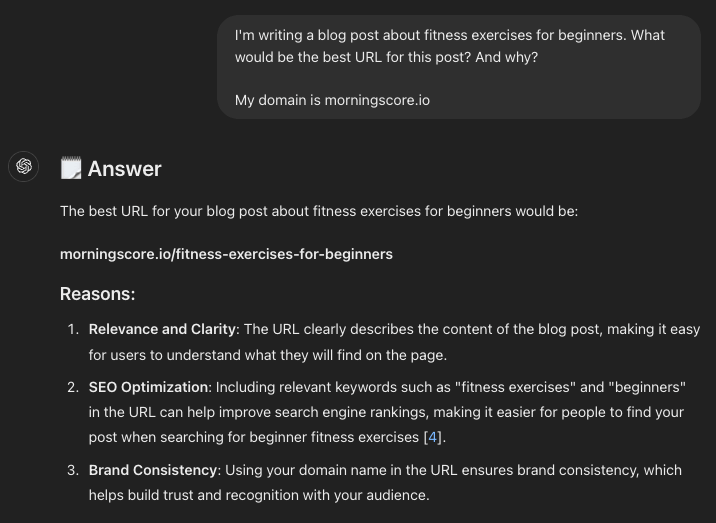
The example above is quite straightforward. You would probably have come up with the same answer faster than typing the prompt.
Still, if you have pages with less clear subjects and struggle to choose the right URL, this on-page SEO prompt can help ChatGPT suggest a good one.
We have used similar prompts on our own blog with decent results.
Header optimization and best SEO prompts
A page header is one of the most important on-page elements in your content.
Search engines use headers to understand the content, structure, and subject. Well-optimized headers help your rankings.
ChatGPT can help you create SEO-friendly headers. This prompt creates headers and gives you an outline for the post:
Prompt:
I am planning to write a comprehensive guide about [subject]. It should cover [subject], [subject], [subject], and more. How should I structure my header tags for SEO?
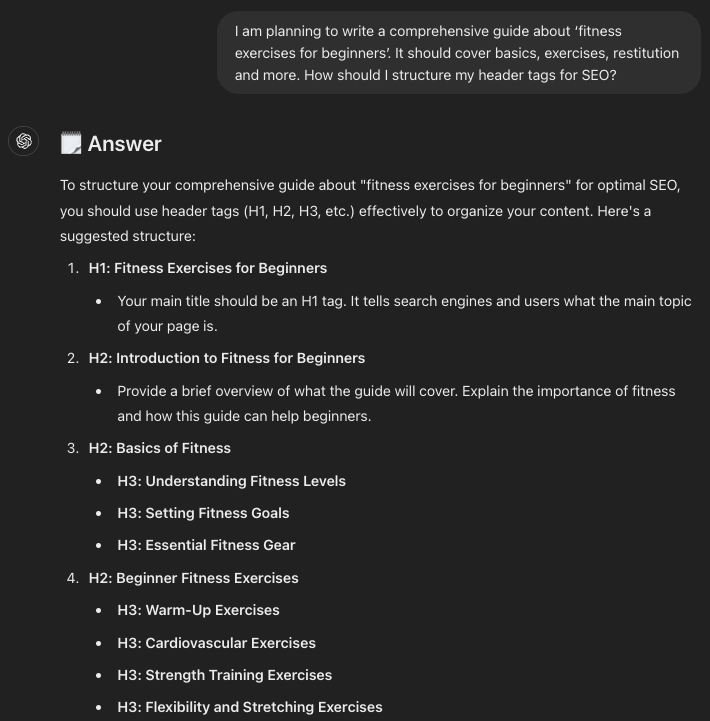
If you already have a finished article without optimized headers, use this prompt to let ChatGPT improve them:
Prompt:
I want you to optimize the headers of this article based on the primary keyword [“add your keyword”]:
[paste your content]
Meta description optimization
Prompt:
Create a meta description and title for this content, including the keyword [keyword]. Make it easy to read and add a CTA. The meta description cannot exceed [X] words:
[Add your content]
A case study reported a 501% increase in clicks and a 513% rise in impressions within 30 days after using AI for titles, headers, and meta descriptions.
CTA optimization prompt
When you have managed to get people to your page, you also need to make them convert, whether it is a soft or hard conversion.
A CTA is not a direct ranking factor. However, well-placed CTAs can increase engagement, time on site, and the number of pages visited. These things matter for rankings.
Get ChatGPT to suggest CTA placements in your content with these best SEO prompts:
Prompt:
I want to maximize sign-ups on my [‘SEO course for beginners’] landing page. Where should I strategically place CTAs?
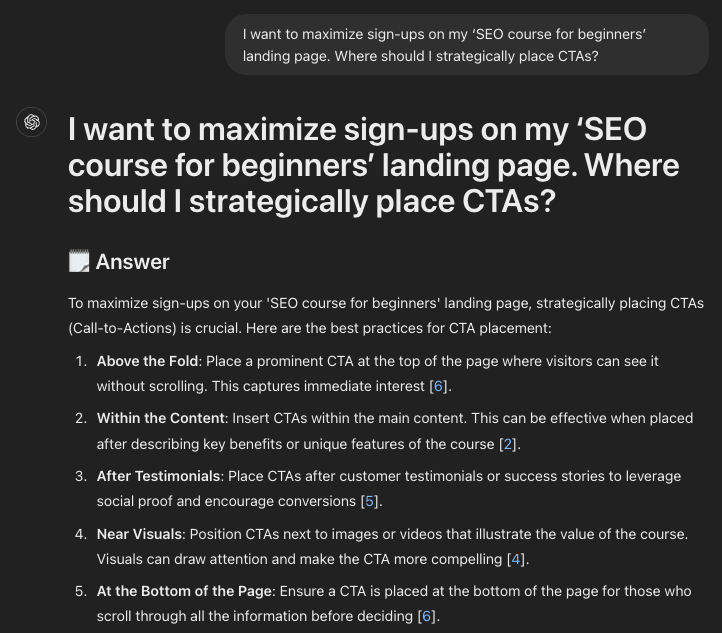
If this feels too general, follow up by pasting your actual content and asking ChatGPT to suggest exact places for CTAs:
Follow-up prompt:
In the following content, where should I place the CTAs based on your answer?:
[add your content from your landing page here]
Link structure on-page SEO prompts
Internal links are also an important part of your on-page SEO.
They guide Google’s crawlers to your pages and help connect topic clusters. This builds topical authority in a subject.
Do you find it hard to decide where to add internal links or what to link to? Here is an on-page SEO prompt that can help:
Prompt:
Analyze this page’s link structure: [add URL] and suggest 5 relevant sites or pages I should link out to for improved topical authority and click-through rate, including internal links.
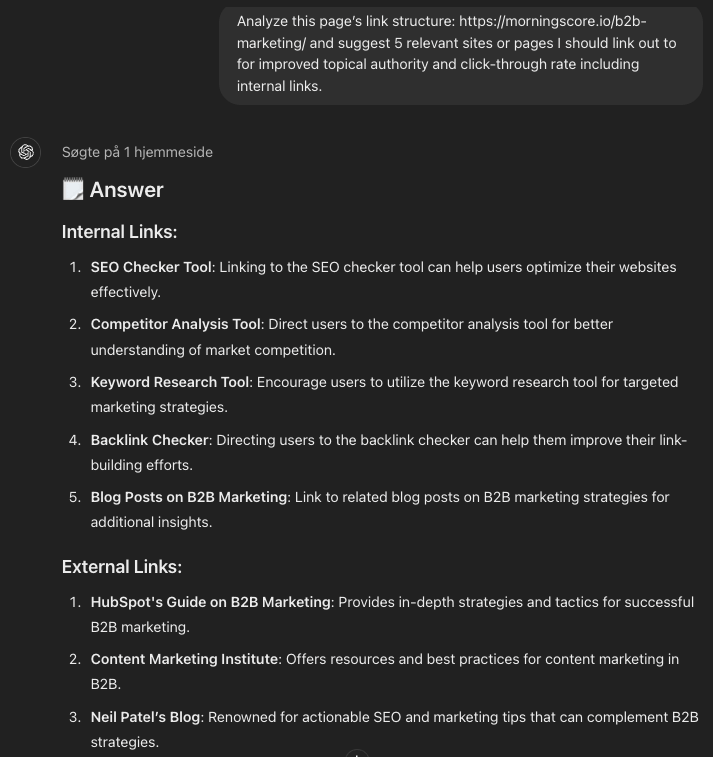
If you have already added many internal and external links, you can ask ChatGPT to check for irrelevant ones or other issues:
Prompt:
Identify issues with this page’s internal linking and structure that could negatively impact crawl accessibility and equity distribution: [add URL].
Organize page content prompt
User experience and readability are ranking factors. They also help keep visitors engaged.
If your pages are a wall of text, they become messy and difficult to read. You need to structure the content into smaller, skimmable sections.
This is how you ask ChatGPT for help with specific on-page SEO prompts:
Prompt:
Help me re-organize the content structure of this post into logical, digestible sections for better SEO and UX: [insert URL]
Multimedia suggestions prompt
Images, videos, and other media create a better user experience and support SEO.
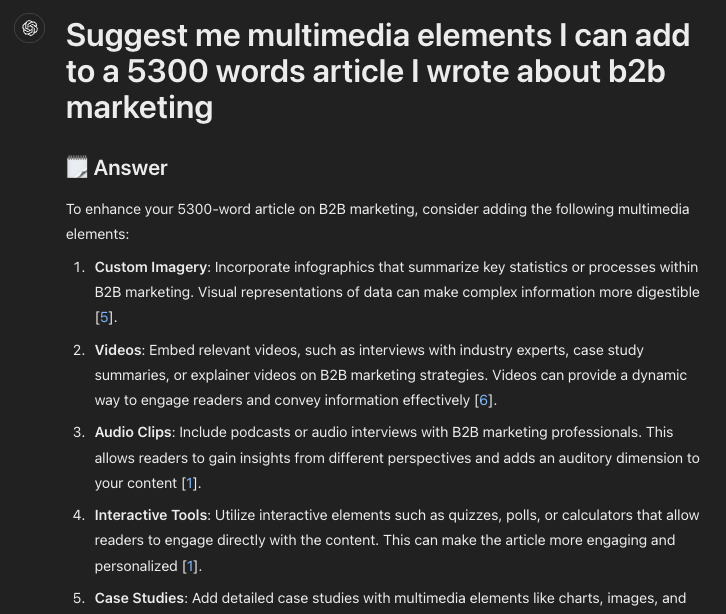
Here is how to get ChatGPT to suggest multimedia you can add to your blog posts:
Prompt:
Suggest multimedia elements I can add to a [X] words article I wrote about [blog title/subject].
Check grammar
Correct grammar matters for readability. Content with grammar mistakes is harder to read, and many people struggle to get it perfect.
If you are a born writer, you have likely already pointed out several places where I have poor grammar in this post – because I did not use the following best SEO prompts for proofreading.
Prompt:
Check the grammar of the following content and point out the issues [add your content here]
Frequently Asked Questions
How do I write effective on-page SEO prompts for ChatGPT?
Start with a clear goal. Prompts that target one task at a time – like writing a meta description or suggesting header tags – work much better than broad requests. Include your keyword, your page topic, and any limits like word count. The more context you give, the more useful the output.
How specific do my prompts need to be?
Very specific. Vague prompts give vague results. Think of it like briefing a writer. Tell ChatGPT the keyword, the audience, the tone, and the goal. Adding your actual content or URL makes the output far more relevant and saves editing time.
Is ChatGPT reliable for creating SEO content?
It can be – with human oversight. ChatGPT is good at generating outlines, meta descriptions, and keyword ideas quickly. But it can also produce generic or inaccurate content. Always review the output before publishing. Human review is the step that keeps quality high.
Can ChatGPT replace human SEO experts?
No. SEO involves strategic decisions, understanding user intent, and adapting over time. ChatGPT can speed up tasks, but it does not replace judgment. It works best as an assistant, not a replacement. Human expertise is still essential for a solid SEO strategy.
Will AI tools like ChatGPT make SEO irrelevant?
No. SEO is changing, but it is not going away. AI tools make it faster to create and optimize content. But high-quality, well-structured pages still matter – maybe more than ever. Traditional SEO and AI work best together, not against each other.
Where can I find more best SEO prompts for other parts of my workflow?
We have guides covering other areas of SEO. Check out the best prompts for keyword research or the best ChatGPT prompts for SEO content creation. Both are practical starting points if you want to take AI further in your SEO work.