
 Dansk
Dansk Deutsch
 Svenska
 Español
 Nederlands
Many SEO tools allow for local SEO tracking, which is essential in 2026 as nearly 80% of local mobile searches lead to a direct inquiry or visit. According to AIOSEO, 46% of all Google searches now have local intent, and 86% of users consult Google Maps for business details. Examples of top-rated platforms include Morningscore, BrightLocal, Semrush Local, Local Dominator, and SE Ranking. Recent shifts in search, such as the March 2026 AI and entity-based ranking updates, have made these specialized tools even more critical for maintaining visibility. Whitespark’s 2026 Local Search Ranking Factors Report confirms that relevance, proximity, and prominence-augmented by AI-are now the primary signals for winning the local pack.
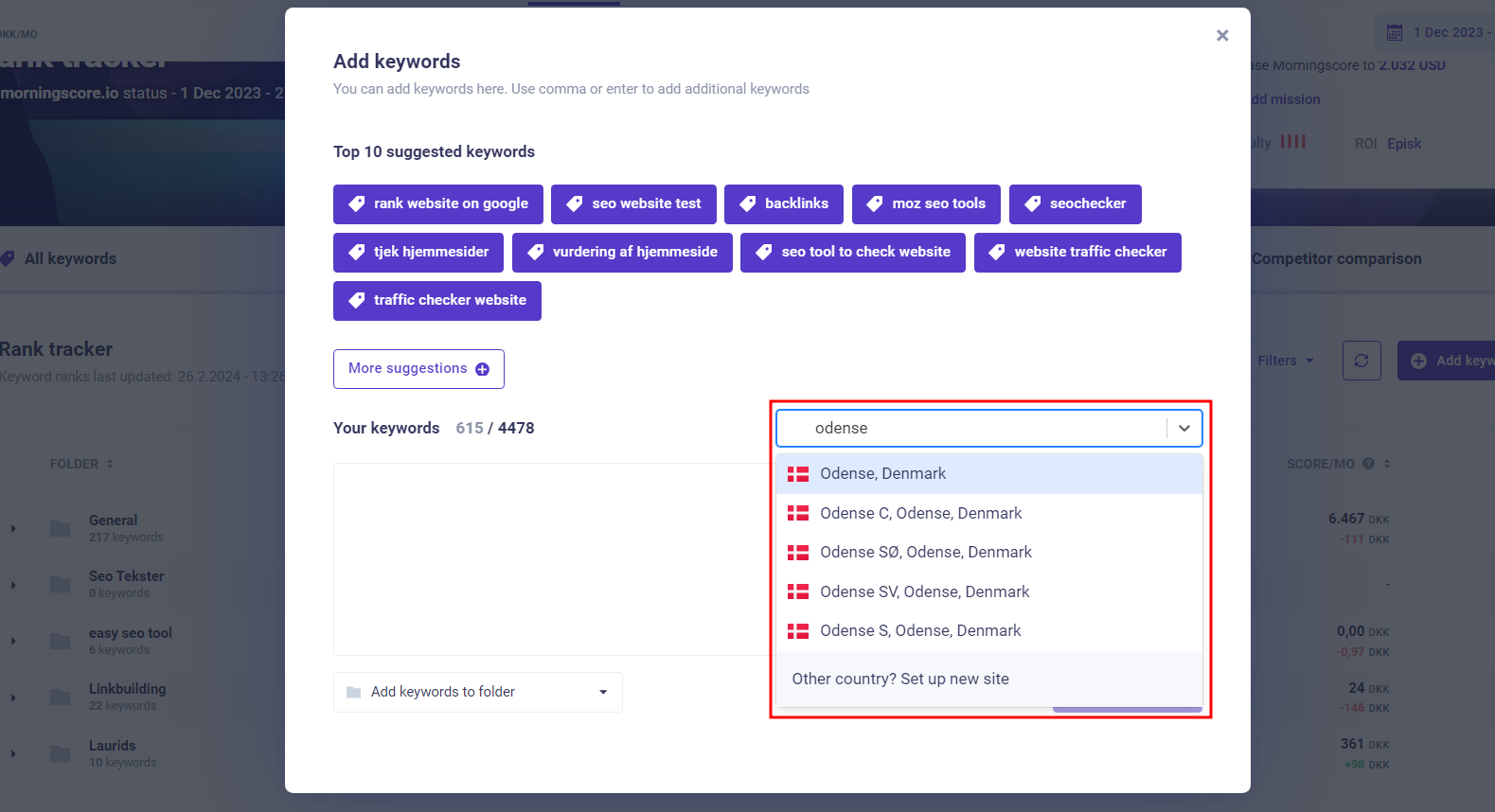
Morningscore’s local rank tracker, updated to version 4.0 in late 2025, can track keywords on state, city, and neighborhood levels. It allows you to specify a precise geographic target area for keyword tracking. In our experience, tracking at a neighborhood level is often the “micro SEO” strategy needed to outperform larger competitors. This version also introduces the SEO Score and organic traffic valuation metrics, which are particularly useful for businesses that strictly generate customers from within a specific local region or town. We have found that the organic traffic valuation metric provides a much clearer ROI picture for small business owners who need to justify their local SEO spend.
While Morningscore offers an all-in-one experience, other tools have specific strengths:
- BrightLocal: A favorite for its “all-in-one” local dashboard. It focuses on citation audits and Google Business Profile monitoring with plans starting at $39/month per location.
- Whitespark: Founded by Darren Shaw, this tool is highly recommended for its precise geolocation rank tracking and citation management. Expert voices like Shaw emphasize that precise tracking is the foundation of local visibility.
- Semrush Local: Provides daily rank monitoring and expanded API integrations for granular tracking in 2026. It is widely recognized for detailed competitive analysis.
- Moz Local: Endorsed by industry experts for reliability, it excels at local listing management and ensuring data consistency across the web.
- GeoRanker: Specializes in geolocation-specific rank tracking, which we’ve found helpful for businesses monitoring dense urban centers across multiple regions.
- Local Falcon: Specializes in GEO-grid heatmap visualizations to see exactly how rankings change across different blocks in a city.
Expert Miriam Ellis suggests that successful local strategies must go beyond just tracking-they must incorporate local metrics into GMB profiles and content. This is backed by real-world data; for example, Northeast Medical Group achieved an 893% YoY traffic increase by targeting long-tail local keywords and leveraging expert quotes, a strategy that heavily relies on accurate city-level tracking. Similarly, Visit Atlantic City saw a 661% increase in organic traffic by optimizing “Things to Do” content for their specific local market.
To track local keywords with Morningscore:
- Create a free trial: Start by creating a free trial account on the Morningscore website. No credit card required.
- Add your website: Input your website URL into the rank tracker to begin the setup.
- Add keywords and locations: Add the keywords you want to track and specify the exact neighborhood, city, or region you want to monitor.
- Analyze results: The tool will track your keyword positions in the specified locations and provide an SEO Score to reflect your local performance compared to competitors.
Morningscore’s rank tracker also provides insights into competitor activity and identifies keyword gaps within your local SEO strategy to help you capture more of the growing $83.9 billion local search market. Following Google Search Central guidelines, we recommend regular analysis of this data to refine your GMB profile and ensure your content remains locally relevant as AI-driven search behaviors evolve.
Frequently Asked Questions
How can I track local keywords by city or state accurately?
To track local keywords in specific cities or states, you should use tools that utilize GPS coordinates, IP spoofing, or geo-grid technology. These methods simulate a searcher’s actual location to provide the most precise data. Modern rank trackers like Morningscore and Nightwatch are typically accurate within 1-2 positions, though Google’s frequent algorithm updates can cause minor daily fluctuations.
What is the difference between local pack and organic keyword positions?
Local pack rankings refer to the “Map Pack” results influenced by your Google Business Profile, proximity, and relevance. Organic rankings are the standard web listings appearing below the map. According to Search Engine Land, local pack results depend heavily on GMB signals, while organic results are driven by traditional SEO factors like content quality and backlinks.
Is it possible to track keyword positions in cities at a zip code or neighborhood level?
Yes, many advanced tools now support hyperlocal tracking at the zip code or neighborhood level. This is often achieved through geo-grid technology, which maps out rankings across a specific grid of a city. This “micro SEO” strategy is particularly effective for businesses in dense urban areas where rankings can change significantly from one block to the next.
Why do my local keyword rankings fluctuate so often?
Rankings are rarely static because Google constantly updates its algorithms and personalizes results based on user behavior. Fluctuations can also be caused by changes in local competition or updates to Google Business Profiles. Experts at Moz suggest focusing on long-term trends rather than daily shifts to get a true picture of your local SEO health.
Can I track keyword positions in multiple cities simultaneously?
Most professional local SEO tools allow for multi-location tracking, enabling you to monitor your performance across several cities or regions from a single dashboard. This is essential for franchises or service-area businesses that need to maintain visibility across an entire state or country. You can set up specific tracking for each city to compare how your SEO strategy performs in different markets.
How often should I check my local keyword rankings?
For most local businesses, a weekly or biweekly check is sufficient to monitor progress and identify trends. However, you may want to increase monitoring frequency during a new marketing campaign or immediately following a major Google core update. Regular analysis helps you refine your content and GMB profile to stay ahead of local competitors.