
 Deutsch
 Dansk
Dansk Svenska
 Nederlands
 Español
 Lietuvos
Key Takeaways
- You can increase sales without spending money on marketing or advertising, but it requires more time investment and typically has longer payback periods than paid strategies.
- Ten proven strategies include crafting transformational messaging, optimizing conversions, creating SEO content, building referral loops, using AI chatbots, earning PR exposure, automating emails, making guest appearances, producing YouTube videos, and engaging on social media.
- Focus on providing value first through content and building credibility to attract customers organically rather than relying on traditional advertising.
- Consider reinvesting even small profits (starting at $1/day) into marketing to accelerate growth and complement free strategies for faster, more scalable results.
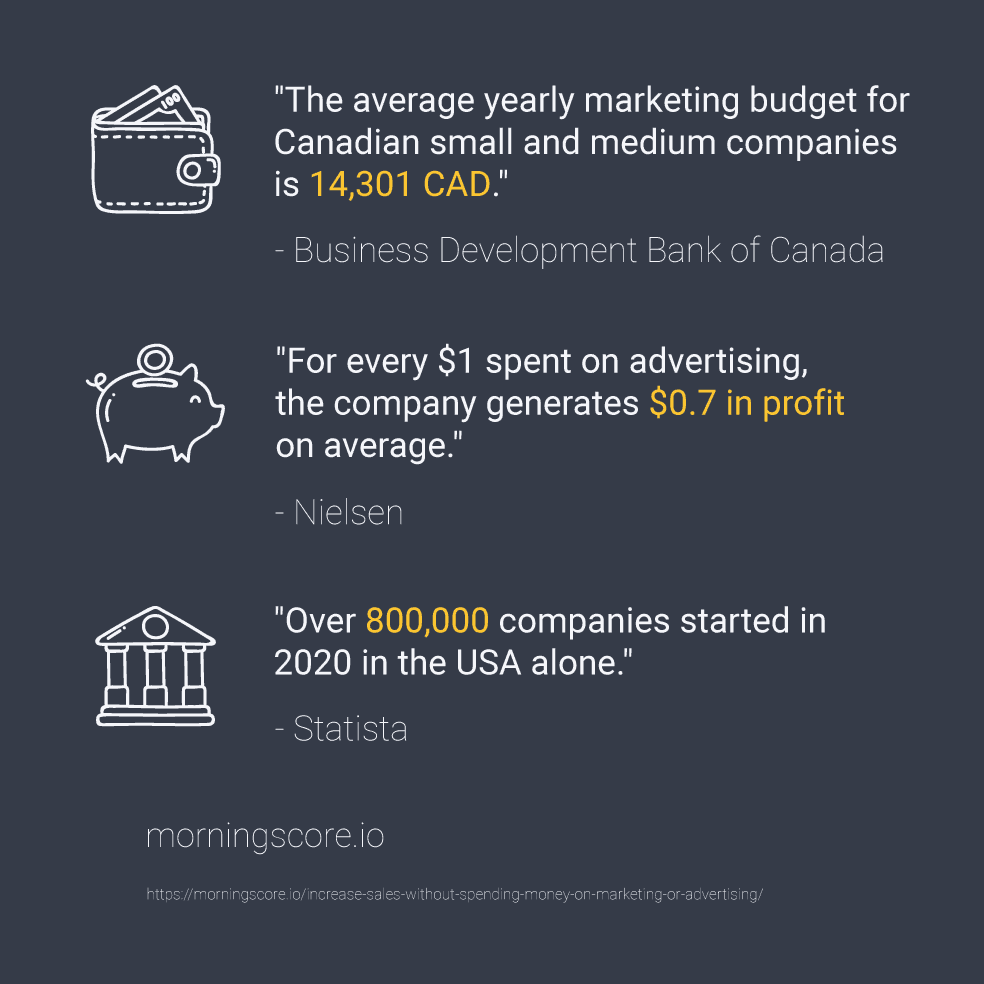
Many business owners wonder how to increase sales without spending money on marketing or ads. The average marketing and advertising budget of a small company in Canada was roughly 14,301 CAD per year in 2019 (source). For many companies, even such budgets can often be overwhelming.
Additionally, according to a study by the research media Nielsen, for every $1 spent on advertising, the company generates only $0.70 in profit. These numbers showcase the real risk decision-makers in small companies have to take when it comes to growing the business. And for some, that risk is simply too big to take. To mitigate that, many companies turn to free marketing strategies with the hopes of gaining exposure and customers.
While growth for companies on tight budgets is possible, relying solely on free marketing requires more time investment, typically has longer payback periods, and can slow down the critical early-stage growth. Yet, although limited, companies with small budgets still have opportunities for growth.
Generating sales without spending money on marketing or advertising comes with some limitations as they are often not as scalable as paid ones. However, they are still very viable for companies that do not have infinitely deep pockets when it comes to their ad spend. With that, let’s look at some customer acquisition strategies that companies of any size can incorporate without having to spend more money.
Here are 10 original ways to increase sales on a tight budget:
1. Craft a transformational copywriting message to increase sales without ads
In the modern world, it’s easier than ever to start a company. Countless digital and physical tools help business owners realize their dream. However, this comes with a caveat. The easier it is for you to do something, the easier it is for your competitors, too.
According to current market data, brands with clear, differentiated positioning can significantly boost customer retention and sales. Strategic branding efforts, combined with transparent value propositions and proof such as testimonials, are central to competitive advantage in 2026. So the real question here is, why should people buy from your company and not a competitor?
Additionally, the average consumer’s attention span continues to decrease – meaning that it’s getting increasingly harder to harness their attention and convert them into a customer. Market trends show that 70% of brand interactions are digital, with rapid social media responses increasing customer satisfaction by 74%.
What does that mean for you? It’s rather obvious that for you to increase your sales, your company needs to stand out, create deeper relationships with customers, and build a loyal group of followers.
Crafting a transformational copywriting message is the first strategic step that can consequently be the biggest game-changer in all of your company’s efforts. Your biggest threat nowadays is not excluding potential customers. Instead, it’s being ignored – among all the noise everyone else is creating.
To succeed with modern positioning, you need to create the perfect message that resonates with your customers and WOWs them. Think of it as a manifesto, the deeper, underlying reason why they should care about what you’re doing. The critical factor is to pick an enemy, a real and risky enough threat your customers are facing – and how not taking action will worsen their lives. To give you a practical example, let’s examine the company Drift.
At its core, Drift is a website chat system.
“How exciting, huh?! There are millions of those!” Well, exactly!
So the question is, how could Drift differentiate themselves from all the noise in their competitive space? How can they stand out from the crowd chanting “we’re better than competitor X” or “we’re the fastest/best/most loved/cheapest chat system”?
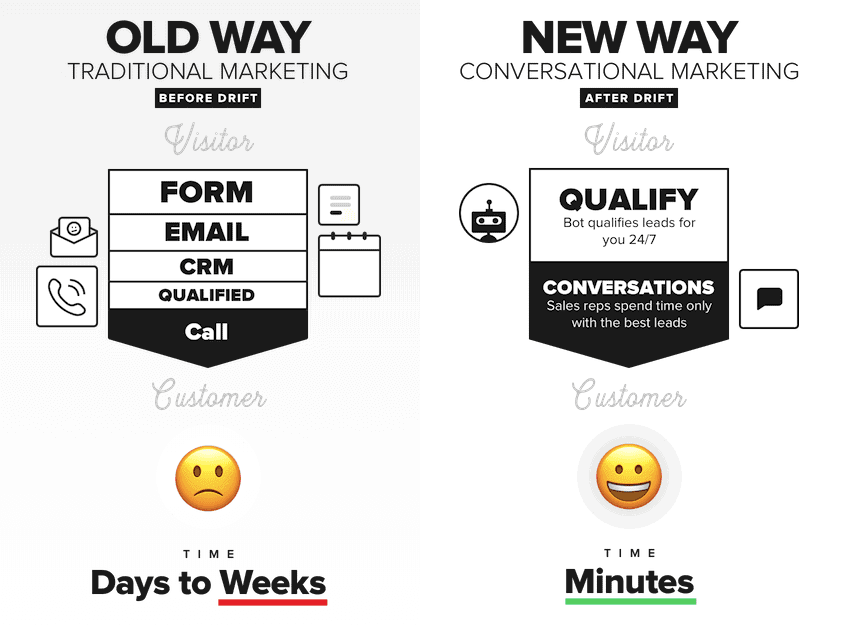
Image credit: Drift.com
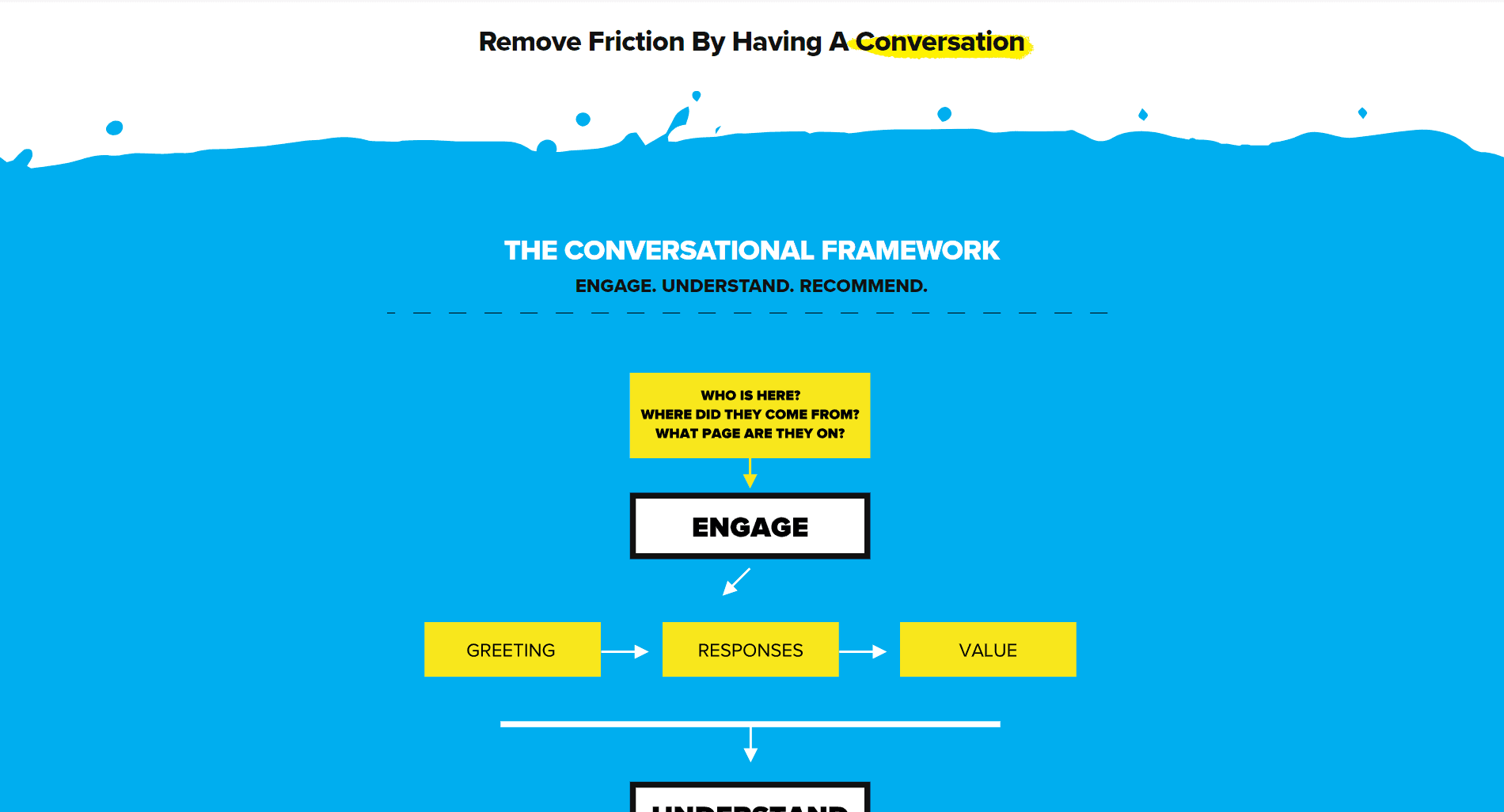
Instead of picking on their competitors, Drift picked a real threat that their customers face daily – website forms slow down the sales process. They framed the problem their customers are facing as the enemy – and not their competitors. Let’s briefly break down the few key elements of their messaging strategy:
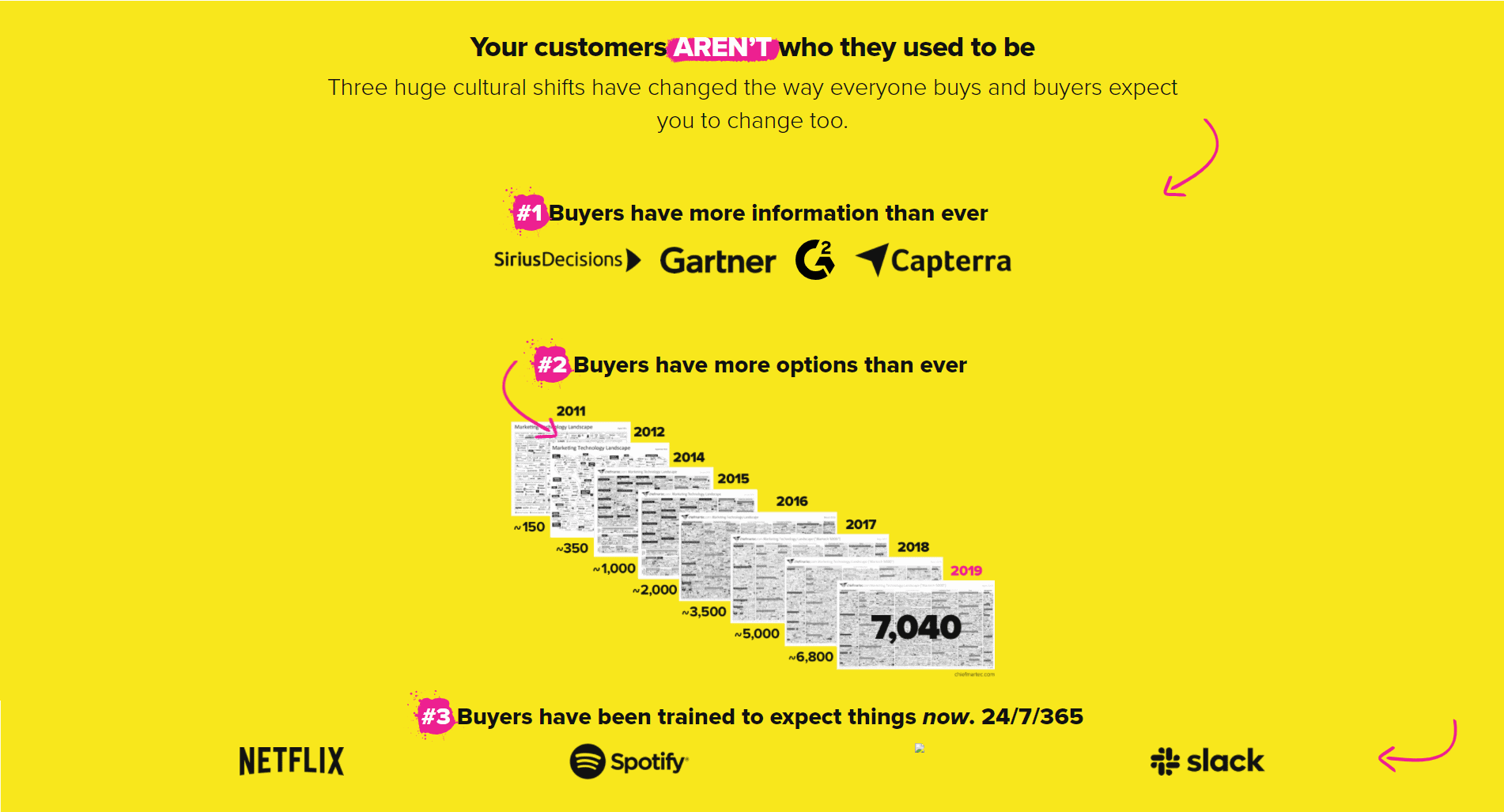
- Firstly, they explained how the world is changing and how that affects their target audience of B2B marketing software companies. The number of MarTech companies has grown from 150 in 2011 to 7040 in 2019. This introduces more options for buyers – and thus increased complexity in the sales process.
- Secondly, they set an enemy that is real and risky enough in their target customers’ eyes. In other words, what do they stand to lose if they don’t take action? In this case, the enemy was the “old” B2B buying process. It came with longer sales cycles, required many touchpoints, had higher drop-off rates, and brought in fewer (and more costly) sales.
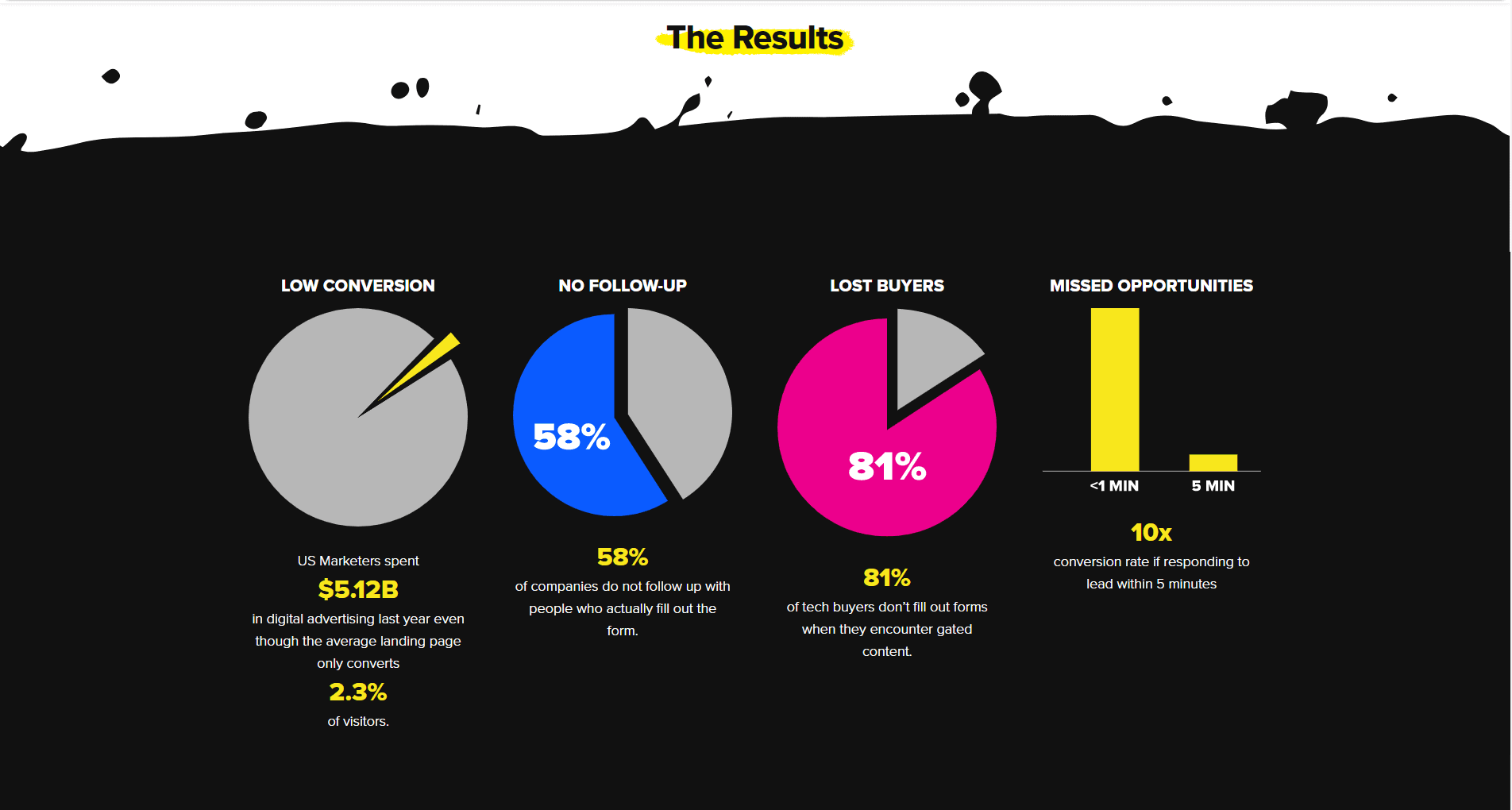
- Next up, notice how they start with neither features NOR benefits. Both of these are only supporting elements to their core message. Instead, they shift the focus away from competitors, features, and benefits – and tailor the message specifically to the perceived threat.
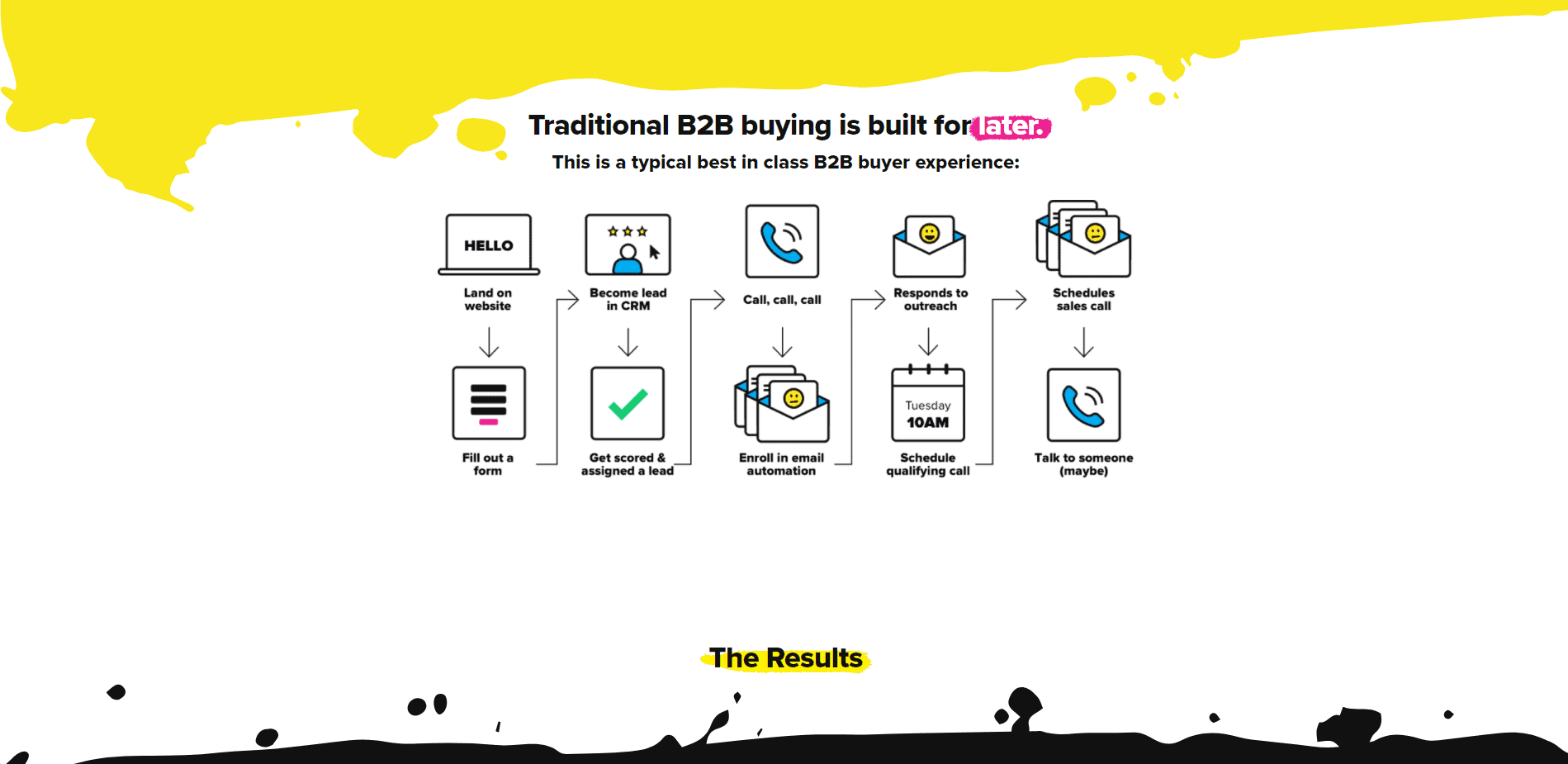
- Lastly, they masterfully show how they transform that process. With the information structured like that, customers are bound to see Drift as the only solution to that problem. At the very least, they are the ones who really care about that problem – and as such, can be trusted in solving it.
2. Improve conversions by re-structuring your pages
Because you’re not spending more to bring more people to your website, you have to make the most out of the current people visiting your website. Consequently, improving your conversion rates is critical in acquiring more customers if you don’t want to spend more on marketing. Current data shows that conversion rates for e-commerce sites hover around 2.5% to 3.0% in 2026, with established platforms like Shopify averaging 1.4% – however, some of the best websites have a CVR as high as 11%.
One of the most influential concepts in Conversion Rate Optimization is BJ Fogg’s Behavior Model. In essence, you aim to increase the user’s motivation to complete a task while reducing the friction of completing the task on their path.

Doing that effectively, combined with effective triggers, ensures that you’re incentivizing the behavior you want in your users – and they are more likely to carry it out.
For most websites, there isn’t a silver bullet to this, however. Instead, lifting overall conversions is a practice that requires many improvements throughout the buyer journey.
On a strategic level, you can start by mapping out your customers’ journey, followed by revisiting the channels you use and their conversion rates in your pirate funnel. This will enable you to find gaps in where and how you engage customers – essentially enabling you to increase the Ability of the user.
Similarly, on a more tactical level, implementing some of the best practices for effective landing page design allows you to influence the Motivation of completing the desired behavior directly. Best practices in 2026 include continuous A/B testing, AI personalization, and privacy-first strategies, which have shown to increase conversion rates and customer engagement. Optimization tools such as Google Analytics (GA4), Hotjar, and Crazy Egg facilitate heatmaps, session replays, and behavioral analytics, enabling hypothesis-driven testing.
3. Write relevant SEO content to increase sales without marketing or ads
SEO continues to be a powerful marketing channel, with organic traffic accounting for nearly 47% of all website traffic in 2026. It should come as no surprise that such an effective channel is one of the biggest drivers of traffic and sales.
There are two strategic ways that you can incorporate SEO into your digital marketing to drive more organic traffic and new customers.
The first one is to focus on creating landing pages optimized around profitable keywords. Those keywords are typically your products or services as they target consumers who are far enough in the buyer’s journey.
The great benefit of doing Search Engine Optimization this way is that you can pull customers who are ready to buy on their own terms – through exploring content in Google’s search results. This way, “the sale” feels more natural, and you can see more conversions from the same amount of traffic than when driving traffic through advertising.
In many cases, when facing tough competition in Google Search, you also have the opportunity to modify those keywords and target more niche yet less competitive ones. Otherwise known as long-tail keywords, these search terms allow you to narrow in on your products and services’ specific features or qualities. This way, you can rank better for some (although smaller) keywords instead of getting absolutely no traffic from broader, more generic ones.
For example, instead of competing on a keyword like “website chat system,” you can modify the keyword with “fast,” “lightweight,” “cheap,” etc. This way, search engines will understand that your products should rank for more specific search terms rather than generic bigger ones. If you’re just starting out, this can be a very viable way of getting SEO to work for you.
Alternatively, the second strategy to approaching SEO and content marketing is doing more Top-of-Funnel informational SEO. This way, you’ll be creating relevant content (primarily in the form of blog posts) optimized around common questions and informational queries your potential customers are interested in. While not all of these website visitors are warm enough to convert into customers just yet, you create a great opportunity to be the top-of-mind company later down the road.
Informational queries enable you to open the relationship and present your brand in a great way – by providing value first. Doing this, combined with some elements that incentivize conversions, can also be beneficial in the short term.
For example, this could be a popup promoting some of your other content, a downloadable resource to further solidify your brand, a landing page with your product, etc. With this, you can turn the less engaged problem-aware visitors into an audience aware of the exact solution to their problem.
Lastly, you can also use great informational SEO content on Social Media and in some networking settings to increase sales without marketing spend. It all starts with finding a topic that resonates well with your target audience. Once you have that, nothing stops you from distributing that content on your SoMe. This could be both your personal or business profile, business page, or relevant groups.
SEO best practices in 2026 emphasize topical content pillars, clear content hierarchy, and high-quality, user-intent matching content. Google’s recent core updates focus on AI-driven content relevance, E-E-A-T principles, and content usefulness. AI and zero-click searches are impacting CTR, making SEO content that aligns with evolving algorithms and user intent crucial for driving organic growth and sales.
Bonus:
One way of growing faster with SEO and increase buyer-ready traffic is to engage in affiliate marketing. This is a win/win solution as you will gain both SEO links, traffic and customers if you do it right. This great post highlights how to get started with it: SEO Tips for Affiliate Marketing
4. Incentivize referrals by creating “Growth Loops”
Referral programs now boast a median conversion rate of 3-5% in 2026, with top performers exceeding 8%. Referral marketing reduces customer acquisition costs by 24% and can increase revenue by 86% year-over-year. Moreover, referrals continue to be a primary source of new business for SMB owners. Lastly, referral customers have higher conversion and retention rates, and as a consequence, significantly higher lifetime value.
Because of that, one thing becomes obvious – you need to incentivize your existing customers to “spread the word” about your company.
However, you shouldn’t simply think about the typical referral programs that you see everywhere. Often, especially for more complex or personal products, directly incentivizing your customers for referrals turns out to be ineffective. This can be primarily seen in B2B spaces – because the referral system doesn’t resonate with the reason why customers are using the product.
If my job is to manage the company’s Social Media profiles, offering a reward to spread the word about the platform doesn’t directly fit into my personal voice as an individual, nor does it influence how I use the platform and what I get out of it.
Because of that, we need to “flip the script” and create referral growth loops built into our products. Also known as a viral loop, referral growth loops are mechanisms that incentivize continuous growth of a product or service.
The key element here is that growth loops are directly built into the product or service. It is how you use the product that creates the growth loop. In contrast, a referral system tries to incentivize referral users by offering an incentive. Referral systems aren’t naturally integrated into the product.
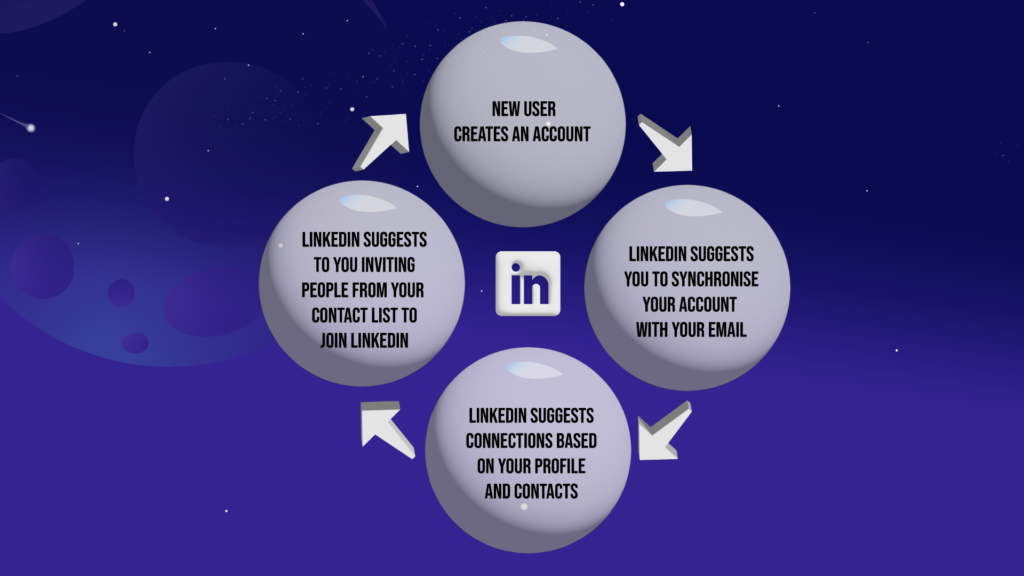
Image credit: Untaylored.com
For example, a referral system offers cash rewards, discounts, or more of the product or service upon referring another client. In contrast, a referral growth loop “requires” users to invite referrals to have a pleasurable experience with the platform. Creating a product environment where inviting others adds direct functional value for the user is the hallmark of a successful growth loop.
Because of that, incorporating this strategy when planning out or modifying your product can create an engine for long-term growth. Growth loops, especially AI-driven and omnichannel strategies, are highly effective in 2026, with 94% of B2B decision-makers favoring integrated sales models. Platforms like Viral Loops, ReferralCandy, and Tapfiliate facilitate scalable, automated referral campaigns.
To learn more about growth loops, we recommend this guide by Reforge, together with this guide by Phiture and this guide by NoGood.
5. Engage prospects with a smart AI chat system
Over the last few years, chat systems (and AI chatbots in particular) have proven to be an effective driver of sales for many companies. They are great in aiding users to find what they need exactly and also account for many sales during the odd hours of the day.
Current data shows that the ability to shop 24/7 remains the number one reason consumers shop online. AI chatbots manage up to 80% of routine inquiries, reducing workload and increasing efficiency. Additionally, it’s also not some “new-age tech” that only Gen Z uses. Research shows that the majority of customers have used chatbots in the past year, with adoption growing 4.7 times since 2020 and 85% of customer service leaders piloting AI solutions.
Consequently, using a chat system helps you get more out of the people who already visit your website, without the need to spend more on marketing or ads. Additionally, you can use chatbots proactively. Instead of waiting for the user to engage with you in some way, you can open the conversation with a starter message.
And these don’t have to be generic either. Many chatbots offer the functionality of customizing the logic of which message should appear under what conditions. For example, you can create a message on your features page prompting only signed-up users to explore your development roadmap – in hopes of converting more of them into customers.
Alternatively, you can ask visitors for their company size – and proactively recommend a package size that fits them based on that. This approach can be better than being passive, as it prevents losing the sale because users couldn’t find the right product.
Similarly, you can also use such proactive messages to activate users in your platform. For example, you can prompt uses with a “how to get started” guide once they create an account with you.
This method also works for retaining customers post the purchase phase and ensuring their loyalty. For this, we need to look no further than the food delivery company “Wolt.” Suppose a customer is having troubles and their delivery is taking longer than expected. In that case, the support team proactively sends an update over the chat system. Together with that, they issue a coupon for discounted delivery upon the next order. It’s quick, effective, and most importantly, it makes your customers feel listened to and respected.
Leading AI chat tools in 2026 include ChatGPT, IBM Watsonx, Drift, and Salesforce Einstein, which support real-time engagement, lead qualification, and personalized support. The conversational AI market is projected to reach USD 41.39 billion by 2030, reflecting rapid growth and increasing effectiveness.
6. Craft a PR story that earns you media exposure
It’s no secret that having unique and relevant content when doing PR is critical. This applies to both the media and journalists you’re pitching and their target market who reads their content.
There are countless ways to get exposure, many of which involve having previous experience or the help of a professional. So how can you get valuable media exposure without breaking the bank? We’ve found two effective ways that work even for small businesses.
The first strategy we found very effective is “newsjacking,” where you can piggyback on national news stories to increase sales without advertising. The idea behind that is to find relevant popular stories and add an angle to them with some valuable insights. Newsjacking success rates are around 20-30% when brands align quickly with trending news in 2026.
For example, a story about the effect on an individual’s health by/from/of working from home can be followed up by a company that offers, say, a humidifier. The unique spin on the follow-up story could be a research or survey. For instance, one highlighting how many people are affected by the environment they work in – light, temperature, humidity, etc.
Using such strategies can be great for businesses of any size and industry. Current data shows that the majority of B2B buyers want more content featuring industry thought leaders. Therefore, newsjacking helps you establish yourself as a thought-leader in your niche, positively influencing the purchase process.
Lastly, when pitching journalists, it’s important to put yourself in their shoes and understand what they are looking for. Journalists care about their work no different than you. Similar to how you want to make your company stand out among the industry noise, they want to offer unique insights into a relevant, trending subject. Recent data shows that journalists are significantly more likely to cover an exclusive story than repurposing an old one.
As such, you can adapt your strategy to solely tailor to individual media rather than creating something for the masses – in other words, offer an exclusive. Exclusive media placements have success rates of 15-25% in 2026, especially when supported by AI-driven media outlet targeting. Doing that increases your odds with the journalists you’re pitching because it makes the story more incentivizing for them.
An exclusive story showcases that you believe their media is the most important one for you – and that your story belongs there best. But that’s not all. The “hidden” benefits are that truly unique and newsworthy stories usually make it to other news outlets as well. You stand to gain even more exposure while still building a deeper connection with an important journalist in your industry.
7. How to increase sales without spending money on marketing using email automation
Email marketing is one of the greatest channels for generating sales, with automated emails generating 37% of sales according to current data. Email automation remains highly effective in 2026, with open rates between 25.2% and 42.1%. Over 80% of businesses rely on automation, which improves retention and ROI.
Email marketing continues to be a strong drive for acquiring customers, with the majority of SMBs reporting that it is their primary customer acquisition channel.
Similarly, email automation is a great way to activate and retain customers. “Welcome emails” sent out when someone becomes a user have a great potential in presenting your brand. That’s because the average open rate for such emails is very high. Such emails are also a great driver of engagement, with strong Click-through rates as well.
If you’ve never tried email marketing, it might look scary and complicated. However, it is not as hard, as the entry-level has become increasingly easier with the release of many powerful tools on the market. Additionally, you can do it completely for free, too. Tools like Mailchimp allow you to manage an audience of a substantial number of contacts completely for free. This way, you can set up an email automation sequence and practically generate sales on autopilot.
Here, understanding the buyer’s journey and user activation is critical, as they will directly inform what emails you need to create in what sequence. For example, before considering buying your product, the customer must have seen value for it. As such, it is your goal to showcase that value and thus activate the user with your initial emails.
From a customer retention perspective, emails can be great as they are a great channel for offers, deals, and updates. In other words, you get to create loyal customers as you keep them in “your company’s brand universe.”
What about more B2C-centric companies? Email marketing is a great driver of sales there too. Research shows that a significant percentage of website visitors abandon a shopping cart with products. To combat that, marketers use “abandoned cart emails” that incentivize the user to finish their purchase with a special discount or offer.
The understanding is simple – even if you create a very lucrative offer that doesn’t let you generate tons of profits on the first sale, you have still created a customer which you can then upsell to. That’s because the lifetime value of a customer is much higher than the initial sale, with the majority of small businesses earning more than half of their revenue from repeat sales.
Because of that, setting up an automation that offers upgrades or similar products to the customer’s previous purchase can prove to generate more sales – without the need of spending more on marketing.
Lastly, however, we have to be realistic in that email, on its own, isn’t very good at generating more newsletter signups. Because of that, you usually need another strategy for growing your subscriber list in the first place. These strategies don’t have to be paid, as you can leverage every other strategy we mentioned here. As a general note, however, we typically see that strong (personal) branding tremendously helps generate email signups, and ultimately, it all comes down to providing value.
Top email automation tools in 2026 include Zapier, ActiveCampaign, and Mailchimp, emphasizing continuous A/B testing, AI personalization, and multi-channel integration.
8. Pull leads & customers through guest appearances
Research shows that the vast majority of consumers trust products recommended by people they know. As such, appearing as a guest on other platforms can increase your traffic in the short term. It can also create long-lasting branding effects as you build trust with more of your ideal customers.
By being featured in relevant media outlets where you prove helpful content, you establish yourself as an authority in your industry and build trust among your target audience. Even if you operate in a niche industry, there are always ways to achieve that.
You can always get featured in “shoulder niches,” where Word of Mouth becomes a primary driver for reaching the right consumer. That’s because a significant majority of consumers report WOM is a key influencer in their purchase decision.
The great part about this strategy is that it’s very broad and allows for creative thinking. In other words, it works in both B2C and B2B, and the opportunities are endless. Guest appearances significantly enhance thought leadership and sales in 2026, with success rates of 15-25% for strategic placements. Platforms like Zoom, StreamYard, Podbean, and Libsyn facilitate scalable, engaging appearances. These appearances help build authority, trust, and influence, shortening sales cycles and validating strategic positioning.
The best tactics for getting guest appearances that we’ve seen work in are:
- Leveraging your existing network. Even if you’re just starting out your career, the odds are that you know someone who can help you get your company’s first media exposure.
- Leverage your location, experience, background, and origin story. There are tons of outlets regardless of where you live. You can start with media publishers and content producers that live in the same place and share the same experience or background. It also helps to know that they will highly resonate with your company’s origin story.
- Continuously build upon the previous results. The idea here is to start small and gradually build up momentum for bigger media. Don’t get me wrong, if the right big media features you, the odds are many small ones would want to do so too. However, if you have no previous record of being featured, starting small gives you enough “practice room” until you’re ready for the bigger outlets.
- Create something unique – preferably unique content featuring some data and statistics relevant enough for your audience and worth discussing.
9. Ways to increase sales without marketing or ads through video content
Video has totally exploded in recent years, with YouTube remaining one of the most visited websites and social platforms in the world. Video-sharing platforms like YouTube are great for boosting sales and don’t require spending tons on marketing or ads.
YouTube remains a dominant platform in 2026, with over 1 billion hours watched daily and revenue reaching $36.1 billion in 2025. This is a golden opportunity because you can both grow your channel and get featured on many other channels.
One of the best YouTube features you can utilize to quickly gain exposure is YouTube Shorts. Being similar to Instagram’s Reel and TikTok’s functionality, YouTube’s Shorts easily get millions of views – some of which can be yours. This also means that you can repurpose content from different social channels to fit the content. Specifically, you don’t have to invest more money to always produce something new for each channel.
You can further integrate creating video content together with blog content as well. YouTube is also the world’s second-biggest search engine, so it should come as no surprise that people are largely searching for information in a similar way as they do on Google.
Combined with your blog content, YouTube video content can create a positive feedback loop, where each channel helps the other grow. For example, on each article, you can create and embed a video that presents the same content but in video format. From there, your SEO blog content has a higher odds of ranking in Google as you feature a video. In a similar manner, your YouTube channel can grow both organically but also with the help of people who discover you through your blog.
Content trends in 2026 include real-life interactions, Shorts, AI-generated videos, and niche content. Monetization strategies involve ads, memberships, Super Chats, and brand integrations, with new policies supporting Shorts monetization.
10. Build credibility and get customers through SoMe
The majority of consumers are more likely to buy a product or service from someone they recognize, and there’s no doubt you want your name out there. And what a better place to do that than Social Media with its low entry barrier and high engagement rates?
There are many ways to grow your social media audience depending on your business. However, the common denominator among all advice is that you need to produce relevant, unique, and helpful content, which is worth talking about.
In your strive to build an audience, however, you can also leverage existing groups and communities. Being introduced to an existing audience can prove to be a shortcut to success as it helps you build credibility faster by sharing relevant content. As a promotion strategy for social media, you can also use existing groups and communities to build credibility by sharing relevant content.
As such, one of the key elements when it comes to building a community on Social Media is understanding your audience. Knowing who you’re talking to helps you tailor your message and connect to them easier.
For B2C companies, platforms like Instagram, Pinterest, and TikTok have proven to be great for generating sales through communities and influencers. Social commerce is projected to reach $1.3 trillion in 2026, with 17% of online sales occurring via social platforms. These numbers prove that, although free, this channel can greatly boost sales among consumers who aren’t actively searching for products.
Meanwhile, on the B2B front specifically, LinkedIn is a great channel for building a relevant audience with a significant number of senior-level influencers and decision-makers. The platform continues to be recognized as the number one social network for lead generation.
In 2026, authenticity and transparency are key in social media marketing, with AI tools optimizing content and engagement. Platforms like Threads, Bluesky, Lemon8, and BeReal are gaining traction, integrating AI features for content moderation and creation. Engagement rates remain between 1.4% and 2.8%, emphasizing the importance of high-quality, authentic content.
Should you solely rely on “free marketing” to grow your company?
Increasing sales without investing in marketing or advertising is possible for many small companies. However, without a marketing budget, the company can experience fewer leads and longer sales cycles than when actively advertising. For companies looking to increase growth rapidly, free strategies are often insufficient – and the demand for growth has to be backed by larger investments into marketing and advertising.
For these reasons, you should always consider re-investing a portion of your profits into your marketing and advertising budgets to help you increase sales without marketing or ads alone. Advertising can save you valuable time as the company grows. It also provides a more predictable and scalable way for your company’s growth. Lastly, investing money into marketing and advertising will also bring you results much quicker.
Because of that, consider even a tiny budget from the very beginning – as ads can speed up your growth in the critical early days. The two most popular and easy to use platforms are Facebook Ads and Google Ads (prev. Google Adwords). Consequently, there are tons of free guides and courses on both platforms – which can take you a long way and help you get started.
While the thought of spending money on ads can seem scary in the beginning, there’s always a possibility to start small. For example, you can start with as low as $1 ad budget per day on platforms like Facebook and utilize their remarketing ads. In essence, these are ads to segments of people who have already visited your website. For example, these can be people who have shown some interest in your products. Remarketing ads are one of the best ways to use any dollars you have available for marketing.
Increase sales and get customers on a tight budget
And there you have it! Those were ten original strategies that can help you grow regardless of your marketing and advertising budget. While you don’t need a large budget, it’s important to remember that marketing and sales are the most important activities for a company. They directly impact the bottom line, and it’s important not to neglect them.
FAQ
How can a small business evaluate the effectiveness of these strategies in increasing sales without traditional marketing metrics?
Small businesses can evaluate the effectiveness of these strategies through various methods such as tracking changes in sales patterns, customer feedback, and engagement levels before and after implementation. Additionally, utilizing analytics tools to monitor website traffic and social media engagement can provide insights into the impact of these strategies on sales.
What are the potential challenges or drawbacks of implementing these strategies, especially for businesses in highly competitive markets?
One potential challenge is the difficulty in standing out in a crowded market without the visibility that traditional marketing campaigns provide. There’s also a risk of misallocating resources towards strategies that may not resonate with the target audience. Implementing these strategies requires creativity, time, and effort, which can be significant, especially for smaller teams.
How can businesses tailor these general strategies to fit their specific industry or niche, ensuring relevance and impact on their target audience?
Businesses can tailor these strategies by deeply understanding their target audience, including their preferences, behaviors, and the platforms they frequent. Conducting market research, gathering customer feedback, and monitoring industry trends can inform a customized approach that aligns with the business’s unique value proposition and the interests of its target audience.
Frequently Asked Questions
Can you grow your company without marketing?
Yes, growing a company without traditional marketing is possible, though challenging. You can rely on organic growth strategies such as delivering exceptional product quality, leveraging word-of-mouth, and cultivating customer referrals. According to research on organic growth, these methods build trust and reputation over time rather than through paid advertising. However, it’s important to note that growth will typically be slower and require more time investment compared to companies that allocate budget to marketing and ads.
What is the 3-3-3 rule in sales?
The 3-3-3 rule in sales is a strategic guideline that helps you focus your efforts by concentrating on three key messages, targeting three core audience segments, and prioritizing three marketing channels where your audience is most active. This approach simplifies your sales efforts and enhances effectiveness by concentrating resources on the most impactful areas. By limiting your focus to three in each category, you avoid spreading yourself too thin and can achieve better results even with limited resources.
How can small businesses promote themselves without spending money?
Small businesses can promote themselves through excellent customer service, word-of-mouth marketing, local networking, and community involvement. You can also utilize free online directories and review platforms like Google My Business to increase visibility. According to Salesforce research on free advertising, content marketing and strategic collaborations with complementary businesses further extend your reach without financial investment. The key is consistency and providing genuine value to build trust with your audience.
How can I attract clients without social media?
Attracting clients without social media is entirely achievable through SEO, content marketing on your website, networking at local events, forming strategic partnerships, and implementing referral programs. Building trust through quality and consistency is essential when you’re not leveraging social platforms. You can also focus on email marketing, guest appearances on podcasts or blogs, and optimizing your website for search engines to drive organic traffic. These methods often result in higher-quality leads as they attract people actively searching for solutions.
What are proven strategies for organic growth?
Proven strategies for organic growth include focusing on existing customers through exceptional service, providing outstanding value that encourages word-of-mouth, and specializing in a specific niche. According to research on organic business growth, showcasing your expertise through content and continuous innovation are also fundamental strategies. Building trust and delivering excellent customer experiences create loyal advocates who naturally promote your business. These strategies compound over time, creating sustainable growth without relying on paid advertising.
How do you handle the “no budget” sales objection?
Handling the “no budget” objection requires empathy and a consultative approach. Start by understanding the client’s underlying needs and demonstrating the ROI of your offering with concrete examples. You can explore flexible payment options or emphasize the long-term value and cost of inaction. According to sales experts at Nutshell, using techniques like the Feel-Felt-Found method and reframing the conversation around timing and priorities can be highly effective. Sometimes, staying connected for future opportunities is the best strategy when budget constraints are genuine.